





Everyone knows that the main reason farmers markets exist is to create profit for their vendors. However, many of the organizations that create and run markets are managed as not-for-profit organizations—known as 501c organizations to the Internal Revenue Service. To maintain their tax-exempt status, these 501c organizations are required to have a “public good” purpose, such as a focus on religious, charitable, scientific, literary, testing for public safety, or educational purposes, or to foster national or international amateur sports competition, to promote the arts, or for the prevention of cruelty to children or animals.
Because of the opportunity to receive tax-deductible donations from individuals and foundations, many markets are 501c organizations, but any survey of markets also shows a significant number of for-profit corporations and limited liability corporations (LLCs) throughout the country. There also are markets that operate without any organizational status, run as an entrepreneurial business by an individual or a small group of people. Since lack of incorporation (not limiting liability) means that these informal market groups risk their owners’ personal property, tax advisors often encourage markets to incorporate sooner or later.
Organizations must register in their state as a corporation and then can apply for a specific tax-exempt status later on from the federal government. The federal tax definitions are what we know as the 501 section of the I.R.S. code. The most well-known of the 501c organizational definitions is the 501c3, which allows tax-deductible donations from individuals and other entities, such as foundations, but is strictly limited on how much political lobbying the organization can engage in.
The for-profit market has some advantages and some disadvantages, just as a non-profit market does. The for-profit is limited in its ability to apply for foundation or government grants. Its for-profit status may also raise concerns among its vendors and potential vendors who may wonder how their needs will continue to be met by the company and its officers, which may have other interests besides market management.
On the other hand, some market vendors may feel more comfortable relying upon the services of a market run as a business. For-profits may be seen as more narrowly focused on the financial success of their vendors and their markets, while nonprofits may be identified as more “distracted” from a vendor’s viewpoint, on serving a public good such as education. And certainly, when farmers decide to manage markets, the for-profit model may be more familiar, based on the experience of running their own for-profit businesses.
Sharon Yeago, who served as the president for the Farmers Market Coalition from 2009-2011 and works as a local food systems advisor in Florida, reports, “My experience with the for-profit management structure in Florida is that, as with any business, they put the profit/loss of the operation first. They are usually very well managed but often lack the authenticity of a market that puts local farmers first. They are most likely not concerned with access for low-income residents, nor with social and food justice issues. There are usually a high percentage of prepared foods at these markets. Often, beginning and small farmers cannot access these markets because they (1) can’t meet the requirements of, in some cases, the ‘right’ tent and table skirts or market umbrella that is required to make all the vendors look the same and/or (2) the fees are too high and their quantity of produce not large enough to make a profit and/or serve the volume of customers at these usually much larger markets. For-profit markets are most always seen in urban areas and located where higher-end shoppers will be attracted to shop.
“That said, these are probably some of the most well managed markets. These market operators go into the process of developing a market, as any for-profit business would do. They perform ‘due diligence’ to ensure that their operation meets laws and zoning prior to opening to ensure their profitability. We have a lot to learn from this model.”
Three for-profit markets are profiled below. One of the examples was founded by the farmers who left an existing market when it seemed to be losing focus. They also received help from a community member who remains on their board to this day. Another market has existed as a sole entrepreneurial business of a community member since its inception. The third market was started by a farming family, which saw the community need, as well as a chance to market their own products directly to their neighbors.
Washington, D.C.
One for-profit model is seen at the Mount Pleasant Farmers’ Market in the Mount Pleasant neighborhood in Washington, D.C. The owner, Rebbie Higgins, became a market manager through her connection to Virginia farmer Susan Planck and her daughter Nina Planck, founder and owner of the London Farmers’ Markets. When Nina hired Higgins as manager of her Washington, D.C., farmers market, she gave her a profit-sharing model to run the market for the year. At the end of the year, when Planck decided to sell the market, Higgins was first in line.
Planck had the market incorporated as Real Foods LLC and Higgins simply ran it as a sole proprietor after acquiring a significant amount of liability insurance to protect her. She left it as a for-profit she says “Because that’s how it was when I took it over. And I had no honest non-profit angle that I wanted to expand upon. My real mission was to support farmers in the region and help customers access good, healthy, local food. And throw a party every Saturday for the ‘hood.”
Higgins continues to act as the market manager, although she has other staff on-site to run the card machine and handle set up and breakdown. As a for-profit, she has paid herself an hourly wage throughout and now makes what she calls “a professional level hourly wage” rather than an entry-level wage.
When asked if anyone seems bothered by the market’s for-profit status, she says, “Folks have asked about it, but no one seems bothered by it. Most people in D.C. know what a pain it is to get and maintain nonprofit status, and can see why I don’t want to commit resources to an additional angle. Also, a lot of people in D.C. think there are too many non-profits already.”
Higgins generally continued to use the same model that Planck used for the market and her London markets. Both believe in a strong set of criteria for allowable food items and in championing real food: in Higgins’ definition, this means they don’t allow hydrogenated oils, MSG, artificial flavors and colors, or corn syrup. Meat and dairy must come from animals raised without antibiotics or hormones. Grazing animals and poultry must have access to pasture. Her market website shows the attention paid to ensure the market is appealing to a large group of people. The amount of effort to solicit feedback is also apparent, even though she does not have an official advisory board for the market.
She also informally checks in regularly with the other market organizations in the D.C. area, two of which are also for-profit. They also communicate with the well-known Fresh Farm Market organization, which is a non-profit 501c3 and operates markets in D.C., Maryland and Virginia, including the flagship DuPont Circle Farmers Market. All of the markets share information as needed and attend monthly meetings hosted by D.C. Hunger Solutions. Although food access issues are the focus of the meetings, the managers then have time to network.
Since hers is a seasonal market, Higgins spends winters working on her other interests. She starts attending to market details in February of each year.
The only major drawback Higgins has found in running the market as a for-profit is that it is “harder to apply for grants for matching dollars for food assistance programs.” She recommends that a for-profit market is “a good job for someone who’s gregarious and network-y. Having a for-profit market means being a benign dictator. I think it’s good that the information and responsibility reside in one person.”
Lafayette, Louisiana
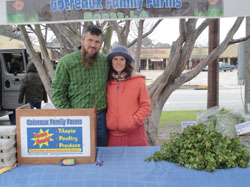
Farmers markets have been founded by farmers often because their region has few, if any, well-managed direct marketing opportunities. Brian Gotreaux, in Lafayette, Louisiana, is one of those managers. He and his wife Dawn (in the photo above) manage the Hub City Farmer’s Market as well as farming their Gotreaux Family Farms in Scott, Louisiana.
“Our farm is always improving and expanding, which is the incentive on our parts to have a great market,” he said. “We also consider it our donation to this community. It is also our marketing program for the products that we produce.”
The two handle the site visits and do all of the marketing. It is a for-profit corporation with an advisory board that was appointed at the beginning, but will have elected positions in the future. Brian is still considering the pros and cons of filing for 501c3 status, but as of 2012 says, “I do not have the funds, time nor energy for it.” The Gotreaux do sell at the market, 52 weeks per year.
Madison, Wisconsin
Westside Community Market in Madison has operated for four years as an LLC (limited liability corporation). The individuals (four farmers and one community resident) who started the market had begun to talk about a new market while vending and shopping at a market that had changed ownership and was losing customers – probably from an ill-advised move away from street access. After meeting with the property owners over a proposed second move, the founders incorporated the new market in a single day in order to receive their city permit. They chose the LLC incorporation, as it was the quickest and easiest way to begin. The market founders then created a board of directors made up of members of the market and one community member. They decided that it would not be required to be a member of the market to be a director. The board reviews memberships annually, assigns market spaces for the season, and handles conflicts as needed.
The Westside Community Market LLC operated the market for four years but is moving to 501c4 status in 2012. The decision to move to a non-profit tax status came because they operate on state property and worry that the state will expect the market to become a non-profit in order to operate there. The 501c4 is an IRS designation that is used for civic leagues, social welfare organizations, and local associations of employees. The market chose the 501c4 rather than the 501c3 status because board members felt “they did not meet the requirements of being an educational organization, since they only run the market” said Barry Orton, one of the market founders and current board treasurer. In 2011, they also hired their first paid market manager through local advertising after having volunteer market vendors managing the market for the first five years. The manager hired had been a farmer in Illinois previously and is paid for 10 hours of work weekly through the season.
Whether a market incorporates as a for-profit or as a non-profit is usually a decision made early on by the founders and is often based more on their access to good legal counsel, time to submit the paperwork for 501c 3 status, or a personal knowledge of corporate filing systems. For-profit and non-profit markets often share the same mission and most of the challenges. What separates the two is less important than what they share—the need for solid planning and appropriate partnerships so that the governance model chosen matches the intent of the community, while protecting the vendors and operators from risk.
Darlene Wolnik works as an Independent trainer, researcher and analyst on behalf of public markets across North America. She serves as the Board President of the Community Food Security Coalition, a leading national food policy and training organization with members throughout North America. She is currently conducting research on indicators to measure farmers markets and preparing case studies on market governance. She lives in New Orleans LA and travels widely to assist markets and food system organizations. More information can be found at www.darlenewolnik.com.
Leslee Goodman is a freelance writer with a long and happy work collaboration with Darlene and farmers markets.
Copyright Growing For Market Magazine.
All rights reserved. No portion of this article may be copied
in any manner for use other than by the subscriber without
permission from the publisher.