








There is an Old Russian saying taped above my desk that reads, “The worst disaster is a full harvest.” This simple statement helps me stay present to the fact that too much of anything can be a curse, and the more I can plan, spread things out, and aim for a steady balance, the better outcome I’m likely to have.
The first season I grew flowers in any kind of volume (1/2 acre) I didn’t have a clue about extending the season through succession planting. I sowed one massive wave of seeds in March, planted all of the babies out after our last frost and spent the following few months weeding, watering and waiting. I didn’t harvest anything significant until late June and then in a flash I was swimming in more bounty that I knew what to do with. For the next six weeks I cut, bunched and delivered as many flowers as I could manage. Much went to waste because there weren’t enough hours in the day to deal with it all. By mid August the abundance was nearly gone with only a small row of dahlias and amaranth still putting out blooms. In the short time my garden flowered I had built up an excited group of buyers who were eager for what I was growing. Having to call each one of them and break the sad news that my flower season had ended was not fun at all!
In an effort to learn from my mistake I spent that winter figuring out how I could spread out the abundance and keep it going all summer long. Each year I get better at lengthening our season and somehow keep finding new ways to stretch and cram more flowers than I ever thought possible into our teeny, tiny farm.
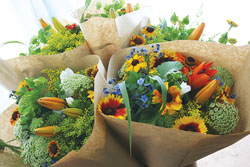
From the start, bouquets have been a large part of our flower business. In order to have a steady stream of ingredients (focal, filler, spikes and air) I invest a HUGE amount of energy each winter into planning out the entire season from March through October. While the planning process is daunting, the added effort has saved massive amounts of frustration and stress overall. There is nothing worse than having to put together 400 bouquets when you’re out of focal flowers or critical filler. Trust me; I’ve been there!
I have broken our field and hoophouses into eight separate planting quadrants, which allows me to plant nearly everything without bringing in outside labor. If I were doing the entire field at once, there is no way I could manage. The same applies to harvesting. Since there are multiple blocks of flowers staggered throughout the season, I am able to stay on top of the cutting without too much struggle.
In mid March, a month before our last frost, I plant cool-weather flowers. Another big planting comes at the last frost date, 4/20, and then at three-week intervals up through mid July. Sometime in September, the biennials are tucked in with fall bulbs. We direct seed hardy annuals in late October. My ultimate goal is to get at least two crops from each bed within a given year. While it is still a work in progress, this intensive approach allows us to produce a huge amount of volume out of a very limited space.
During the planning phase I like to separate all annual ingredients into three main categories. “Cut and come again” are flowers that crank out an insane amount of volume over a long period of time. The more you cut them, the more they bloom. Zinnias, Marigolds and Basil fall into this category. “Medium Producers” are similar to the “Cut and Come Again” group but have a shorter bloom window so they need to be replanted at closer intervals. Cerinthe, larkspur, millet, and snapdragons are all good examples. “One-hit wonders” is the last group and includes a lot of my favorite fillers like bupleurum, cress, poppy pods and flax as well as single stem sunflowers, stock and lilies. These beauties come on like wildfire and are gone in a flash. They should all be replanted every one to two weeks for a steady, uninterrupted harvest.
Over the past few seasons we have done a fair amount of trialing, seeing what can and can’t be succession planted in our climate and how many crops we can cram into a given season. Every area of the country is different so some experimentation is definitely needed to fine tune what will work for you. Here in rainy, cool Washington state, we have long, wet springs followed by very cool summers and dark, damp falls. Anything heat loving does best under cover and planted into either fabric or plastic. I know in warmer place growers can plant zinnias, basil and celosia every week for a summer-long bounty but, sadly, this isn’t our reality. Here we have only ever successfully grown two rounds of zinnias with the third planting inevitably melting down by late September into a puddle of disease and rot.
Luckily, cool season crops like bupleurum, ammi, bells, stock and larkspur can be grown nearly all season long which more than makes up for our climate’s shortcomings. When referencing the following planting suggestions, do be sure to keep in mind the climate differences. If you are in a warmer, drier climate then you’ll likely be able to get three to four more sowings of most heat lovers into your season whereas you may need to subtract at least one planting of flowers that like cooler weather. I have found that all annuals can be replanted at least once, often twice, usually three to four weeks between plantings. Due to space limitations, I am sharing only the most abundantly planted varieties we grow. The following references are based on a best-case scenario. Once the season hits, it can be really tough to keep on seeding and planting but if you can stick with it, you’ll be generously rewarded!
“Cut and Come Again”
Ageratum: I love this simple, beautiful blue filler flower which gives bouquets a pop during the heat of summer. I normally do three planting about three weeks apart starting shortly after our last frost. This season, in addition to Blue Horizon I will be trying Blue Sensation and Everest Blue in hopes of finding a taller variety. I am alsogoing to squeeze an additional late planting into a hoophouse for four total successions.
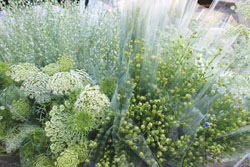
Ammi majus and Ammi visagna: I aim for three plantings of the A. visagna and four of A. majus. Both are directseeded in the fall and then planted as plugs outside, one month before our last frost date, around our last frost date and then followed by or or two more planting three to four weeks later. The last planting is always quite a bit shorter than the early ones since Ammi like to grow in cool, moist soil. But even with the decreased height it’s still a very productive crop.
Basil: In our cool climate, basil must be grown under cover or else it is prone to all sorts of mold and rot. With the addition of new hoophouses, this year I will have room to expand the basil patch and have four plantings scheduled, roughly one month apart.
Dianthus Amazon: This workhorse is such an import crop for us that while it isn’t a personal favorite (too bright!) I still plant and pick row after row all season long. Starting with an early hoop crop and then consecutive field plantings every month or so I have buckets of these blooms for bouquets all season long. Ideally I aim for five plantings three to four weeks apart.
Fiber Optic Grass: The first year I grew fiber optic, a 60’ bed (with 9×9” spacing) produced $1,650! While the initial customer obsession with it has faded, we still use a generous amount for bouquets and straight bunches all summer long. Each planting produces robustly for about three weeks and then peters out rapidly. I aim for five plantings, three weeks apart.
Malope/Lavatera: This old fashioned beauty was the star of bouquets all summer long. This season I’m upping our plantings to four total, every three weeks.
Marigolds: While we can generally only get two to three good crops outdoors, this season I am following Alison and Paul Weidiger’s lead, outlined in their wonderful book Walking to Spring, and planting an early crop in the hoophouse for four crops total.
Rudbeckia triloba: I can’t get enough of this airy, branching treasure and neither can our customers! I have planned three crops starting with a fall-planted batch, another planted in April and ending with the last planting in May. Hopefully this will keep us in flowers all summer long.
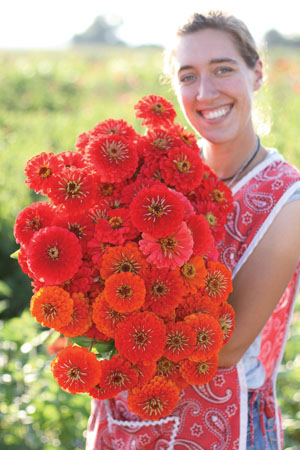
Zinnias: While we can’t grow more than two rounds outdoors, this season I am following the Wiedigers’ approach and planting an early and late crop in the hoophouses. This should give us an abundance of cheerful zinnias for many months.
“Medium Producers”
Amaranth: Most varieties are 80-100 days, so three to four plantings two to three weeks apart will provide a summer of cutting material. Opopeo, a brilliant maroon variety with dark foliage blooms in just 60 short days and can be planted every two weeks through early August. I aim for six to eight plantings a season.
Bachelor Buttons: I have a love-hate relationship with these guys. I love their pretty wildflower blooms in early summer bouquets but I HATE picking them; we all do. I direct seed a batch in late fall and then make three to four subsequent sowings about three weeks apart beginning in mid February. I find sowing smaller patches more often allows me to keep up with harvesting and spread their beauty out over a longer period.
Bells of Ireland: I would say, hands down, bells are the best filler you can grow. Each plant churns out masses of beautiful, fragrant stems that make bouquets look lush and so vibrant. Whenever there’s a lull in production I feel lost! Each year I somehow squeeze in another planting of these beauties and last year enjoyed five lush crops. This season I’m aiming for six, possibly seven plantings total. The first and last ones will go into hoops and each batch will be planted about three weeks apart.
Cerinthe: This one of my favorite early-season fillers. It is so easy to grow and each plant produces so many stems it can be a real struggle to keep it harvested. I now opt for smaller planting more often to stagger the abundance. Last season I sowed it every three weeks with good success and will try and squeeze at least one or two more batches out this year for five total.
Godetia: The first few years we grew WAY too much at one time and had whole beds go to waste. Godetia is wildly productive and comes on all at once so keep that in mind when planting. Even a small patch can take hours to harvest every morning and if you don’t keep up with it you’ll spend even longer having to pick off opened flowers. Now we opt for smaller plantings more often and are able to stay on top of it. This year I’m going for five plantings total, roughly every two weeks starting in the hoophouse in March.
Larkspur: If sown two to three times in the fall/winter and again in early spring, up to four or five good crops can be had per season.
Millet: Starting with plugs in the spring and then followed by direct seeded rows every two to three weeks, we plant a wide selection of varieties with varying days to maturity through mid July.
Nigella: This simple little beauty is as wonderful in flower as it is in pod. I direct seed six plantings total each season, starting with one in the fall and then every two to three weeks from mid March on.
“One Shot Wonders”
Bupleurum: Second to bells, bupleurum is one of the most useful fillers for bouquet making. Plantings disappear rapidly because of its usefulness so you’ll want to keep sowing every week or two as long as you can stand to do so. In a perfect world six to eight sowings would be ideal. I generally opt for plugs but after such great success this fall with direct seeding, I plan on splitting my approach. If you are growing plugs, seed can be tricky to germinate. After seeding, stack flats on top of each other and tuck them in a cool spot wrapped in black plastic. The basement or under a table in the greenhouse is the ideal environment since bupleurum needs cool darkness to sprout. Be patient! Like clockwork, they’ll emerge in two weeks with near 100% germination if you use this trick. I’ve been able to have it sprout all the way into early July by tucking fresh sown trays in the basement for a couple of weeks. Do be sure to keep an eye on them because once they sprout you’ll wanting to quickly get seedlings into the light.
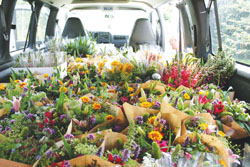
Cress, Lepidium sativum: Around here this wonderful and super unique filler is called bubble grass. Each stem is loaded with tiny green balls that fade to gold when dry. New to our farm last year, bubble grass certainly made the cut! It comes on all at once so a regular sowing schedule is necessary to extend the harvest. I direct seeded it every two weeks starting in early May. This year I’ll be trying to squeeze in at least six to eight sowings total. Blooming in 70-80 days it can be planted up until early July.
Flax, Linium perenne: New last season, this simple filler rocked late summer bouquets! It is quick to bloom (60-70 days) and does exceptionally well being direct seeded. I planted it every two weeks from early May through mid July. Ideally six plantings will go in.
Lilies: Last season there was only one week out of 20 that didn’t have a flush of lilies in bloom. They are the star of our bouquets and without them things get pretty stressful. I get monthly shipments of bulbs from Gloeckner beginning in late January and on through early July. I chose three to four varieties with staggered bloom times that allow each monthly planting to flower over four weeks.
Stock: I adore this flower! One stem in a bouquet will stop hurried customers dead in their tracks. In order to have the fragrant blooms for as long as possible I’m planning a two-wave approach. Starting in the hoophouse there will be two staggered plantings of the Miracle group, followed by a round of Japanese High Doubles and finishing with a handful of the Katz series. These early bloomers will be followed by two more rounds of the Katz group in the field and four to six waves of the Columnar series.
Sunflowers: One planting of single stemmed sunflowers generally blooms for about two weeks for us here. For a nice steady harvest I sow batches every 10 days beginning with plugs in mid March on through mid July.
Erin Benzakein runs Floret, a small organic flower farm in Washington’s Skagit Valley. www.floretflowers.com
Copyright Growing For Market Magazine.
All rights reserved. No portion of this article may be copied
in any manner for use other than by the subscriber without
permission from the publisher.