









At Honeyhill Farm in upstate New York, Fred Forsburg grows 2 acres of garlic for both seed and table. They plant about 40,000 cloves each fall, and harvest a similar number of heads each July. They grow only hardneck varieties, mostly German White.
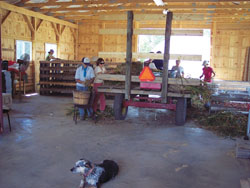
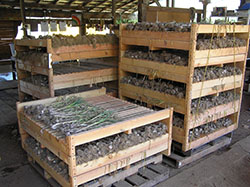
The garlic is lifted with an undercutter on the tractor (page 16). To avoid heat damage the crew quickly places bundles of garlic on a hay wagon and transports it to the barn. The bulbs are immediately cut, leaving about 3” of stem, and placed on the drying racks. The trimmed garlic is spread on chicken-wire racks to cure. Fans keep the air circulating around the bulbs.
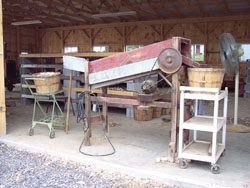
After curing, the garlic is cleaned in an old but functional vegetable dry brusher. Bulbs go in dirty on the left and come out clean on the right. For operator comfort, the fan blows dust out the door.
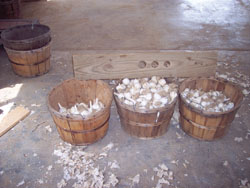
After curing and cleaning, a grading board is used to size the garlic. The baskets in front of the grading board show examples of each size; from left, 2.25 inches; 2.0 inches; and 1.75 inches. Honeyhill Farm sells the 2.0 inch grade as seed. The smaller bulbs are sold as table garlic. The jumbo garlic is sold for roasting and hostess gifts in a decorative mesh sleeve with recipes and information about the farm.
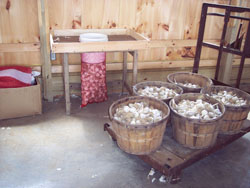
Inspecting each bulb at the grading stage allows for excellent quality control. After it’s been graded, the garlic is packed into mesh bags for storage. An old school desk has been modified with a new top to make packing easier. The garlic is stored in bags until it is sold.
Copyright Growing For Market Magazine.
All rights reserved. No portion of this article may be copied
in any manner for use other than by the subscriber without
permission from the publisher.