









Most vegetables set fruit at maximum temperatures of 90°F or less, so this summer’s sweltering temperatures in much of the U.S. have been a challenge. High tunnel production has been especially difficult, as temperatures can routinely go over 100°F on a sunny day.
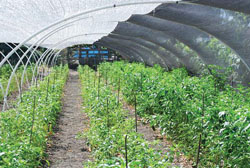
When the air outside is within a plant’s critical temperature range, hoophouse ventilation may be sufficient to keep crops from heat damage. But when the outside temperature itself is too hot, shading is the only way to cool down the hoophouse. Shading is also helpful for reducing sun scald on sensitive plants such as peppers and tomatoes, and it may also be used to extend the season for cool-loving crops such as lettuce and to get fall crops started in summer.
The two options for shading are liquids that can be sprayed or brushed on the poly hoophouse covering; and shade fabrics that can be placed on the outside or inside the tunnel. The cost of shading ranges from free to more than $500 for a 20×96 tunnel. But there is no certain way to predict whether the cost will be justified.
“Cooling a greenhouse where you have live plants transpiring is a fairly complicated thing,” said Dr. Daniel Willits, a biological and agricultural engineer at North Carolina State University. He did research on greenhouse cooling for several decades and is widely viewed as the expert on the subject. However, he shut down his program four years ago because of a lack of funding — an unfortunate circumstance, given the record-breaking temperatures of recent years.
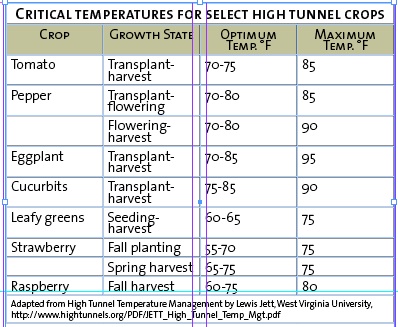
In this article, we’ll describe the shade options, their costs, and what’s known about the benefits and pitfalls of each method. On page 5, you’ll find a chart of critical temperatures for high tunnel crops, which may help you decide whether you should spend money on shading your hoophouses.
At the free end of the cost range is mud. Josh Volk of Slow Hand Farm in Oregon says that at one farm in the Willamette Valley, the crew goes down to the river and makes up a slurry of mud and then tosses it onto the outside of the poly covering with yogurt cups. At Singletary Farm Goods, also in the Willamette Valley, the mud mix is applied with a large-bore water gun. “Of course, it doesn’t rain here in Oregon in the summer, so you don’t really have to reapply,” Josh said. “The winter rain cleans it off.”
Mud is not an option in places where it does rain in the summer. A cheap alternative is white latex paint, which should be diluted one part paint to 10 parts water and applied with a sprayer or long-handled roller. It will not come off, though, so should be used ONLY when the poly is due for replacement for fall crops.
Higher on the expense ladder are shading compounds made specifically for greenhouses. The most commonly available is Kool-Ray, which should be diluted about 1 part to 8 parts water. One gallon of the concentrate costs about $35 and covers a 20×96 greenhouse. Another compound called Varishade is applied to the inner side of the hoophouse covering. White when dry, it becomes transparent when wet from condensation, which often occurs in winter when it’s cooler outside than inside the greenhouse. The cost is $60 a gallon, which covers 3200 square feet.
Mark Miller of G&M Ag Supply (www.gmagsupply.com) says that shading compounds don’t sell as well as shade cloth, probably because shade cloth is much easier to use and lasts for years. Most shade cloth is designed to be installed on the outside of the greenhouse or hoophouse. The density of shade cloth is expressed as the percentage of light blocked; for example, 30% shade cloth allows 70% light transmission.
The most popular type of shade cloth is knitted polyethylene, which can be cut to any size and won’t unravel. Quoting G&M Ag Supply’s catalog prices, black 60% shade cloth runs about 16.5 cents per square foot. Green knitted 60% shade costs 18.5 cents. Woven shade cloth is heavier and lasts longer, but needs to be taped to prevent unraveling.
Willits found that although shade cloth reduces light transmission to the percentage stated, it does not reduce heat load an equivalent amount. In fact, in some of his research he found that shade cloth of 30% or less didn’t reduce the temperature in the greenhouse at all. Higher percentages do reduce temperatures somewhat, but create low light conditions that can cause other problems.
He speculated that the dark colors of the shade cloth reduce its efficiency because the fabric absorbs heat and radiates it into the greenhouse. He experimented with misting the shade cloth, with the result that wet fabric was more effective at reducing the temperature inside because evaporative cooling reduced the temperature of the fabric itself.
The most expensive option is reflective shade cloth, Aluminet being the most common brand. It costs 25 cents a square foot from G&M. Because it reflects light, it does not absorb heat the way black shade cloth does. It can be installed outside or inside the hoophouse. Inside, it can be used as a retractable curtain that can be used to retain heat in the house when it’s cold outside as well as for shading when it’s hot.
Effect of high temps
Temperatures beyond the critical maximum can cause various kinds of physiological problems in vegetables. Tomatoes — the most researched crops — produce the largest yields of highest quality fruits when day temperatures are in the range of 80° to 85°F and when night temperatures remain above 62°F, but below 72°F.
According to the Florida Greenhouse Vegetable Production Handbook: “Excessively high temperatures can lead to poor fruit color (orange instead of deep red). High localized fruit temperatures (sun scald or sun burn) from excessive radiant energy on fruits can lead to yellow areas that never turn red. This symptom is referred to as “solar yellows.”
Unmarketable fruits result. On some cultivars that have the “green-shoulder” genetic background, excessive fruit temperature seems to enhance the green-shoulder expression. These fruits often will not develop uniform red color and the shoulders often become rough and cracked. High temperatures (above 90°F) also result in poor pollination and reduced fruit set.”
With cucumbers, fruit production and quality are reduced at temperatures above 95°F. Peppers are tolerant of temperatures above 100°F, but such extremes during bloom can reduce pollination, fruit set, and yield.
Resources
Florida Greenhouse Production Handbook, http://edis.ifas.ufl.edu/topic_book_florida_greenhouse_v3
Bell Pepper Production in California, http://anrcatalog.ucdavis.edu/pdf/7217.pdf
Copyright Growing For Market Magazine.
All rights reserved. No portion of this article may be copied
in any manner for use other than by the subscriber without
permission from the publisher.