











Review by Lynn Byczynski
When it comes to the mechanical end of farming, growers fall into two categories. In the first are people who grew up with farm equipment or have spent a lot of time around it, and are thoroughly comfortable using it. In the second category are the people who don’t know as much as they need to about buying, using and maintaining tools and machinery.
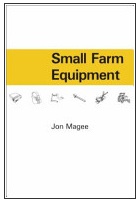
Small Farm Equipment, a new book by Massachusetts farmer Jon Magee, is written for both groups of growers. I consider it to be one of the best books I have ever seen about farm equipment, and I recommend it for every farm’s bookshelf.
For growers who don’t know as much as they need to, this book is a huge help. It’s clear, simple, and to the point. It assumes you know nothing about farm equipment and starts with the very basics in the chapter entitled Concepts: Mechanical Elements and Terminology. Here is where you learn the difference between a two-stroke and a four-stroke engine, get some understanding of the pros and cons of diesel versus gas engines vs electric motors, and how each is generally used on the farm. The author describes the precise elements of a PTO and defines, with illustrations, roller chains, V-belts, sprockets, zerks, and plenty of other terms for the parts of machinery.
This basic approach to farm equipment can be useful for experienced operators as well as novices. People who are extremely knowledgeable about a topic often have a hard time breaking it down into its simplest elements. That makes it difficult to teach to those with no knowledge. If the PTO on your tractor is an essential part of your work, you may never think to teach new employees (as Jon does in his book) that it is “a splined driveshaft which transmits power from a vehicle’s engine to auxiliary implements…usually at the rear, where most implements are attached.”
Basic concepts and terms are only the beginning of this book. It also pays close attention to safety, maintenance, and troubleshooting in general. Separate chapters cover the most commonly used types of equipment in detail. Walk-behind tractors, string trimmers, tractors, and irrigation pumps (see excerpt on next page) are some of the tools that are covered in the specific. Appendices cover safety instruction and supplies; working with fasteners and threaded fittings; keeping maintenance logs; and further resources.
Jon says that he was motivated to write this guide because of his own experience learning to farm. He has worked at several farms, most recently at Atlas Farm in western Massachusetts since 2009. He founded The Farmers Library as a technical resource for small farmers, and this book is expected to be the first in a series. Feedback and project proposals are welcome at www.thefarmerslibrary.com.
If you’ve ever been hindered or embarrassed by your lack of knowledge of common mechanical concepts — or if you can’t believe someone wouldn’t know the basics — this book is for you.
Small Farm Equipment by Jon Magee, 6×9, 118 pages, spiral bound. Available for $15 ($12 for subscribers) plus $5 shipping from Growing for Market, PO Box 3747, Lawrence KS 66046; 1-800-307-8949. Order online at www.growingformarket.com. To get the subscriber discount, use the words print and member in the Member Login fields in the top right column on the home page.
Copyright Growing For Market Magazine.
All rights reserved. No portion of this article may be copied
in any manner for use other than by the subscriber without
permission from the publisher.