









With last year going down as the hottest year on record, finding vegetables with heat tolerance needs to be a high priority for growers in many part of the U.S. Dr. Lewis Jett, the commercial horticulture specialist at West Virginia University, looked for heat tolerance in head lettuce last year at his research station in central West Virginia, 37°N latitude, where the temperature surpassed 100°F a few times. He also evaluated head lettuce for cold tolerance, which is important to high tunnel growers because temperatures under a tunnel can go from winter-cold to summer-hot in the course of one sunny day in spring.
Jett presented the results of his high tunnel lettuce trials at the Great Plains Growers Conference in St. Joseph, Missouri, in January. He encouraged growers to think about growing basic crops such as head lettuce year-round using a combination of high tunnels, low tunnels, and field production because he sees expanding opportunities for local growers to supply wholesale markets and farm-to-school programs.
Methods and results
Jett’s research involved three different plantings. The first planting was seeded into 128-cell trays on April 3 and transplanted onto black plastic mulch in the high tunnel on May 5. Mature heads were hand-harvested on June 4. In a 30 x 96 foot tunnel, he planted six 4-foot-wide beds, with eight rows of lettuce per bed. Plants were spaced 6” apart in the row, with rows 6” apart.
The second trial, to evaluate heat tolerance, was started in July and harvested in early September. Transplants were planted into white-on-black plastic mulch in the field. On some varieties, 50% shade cloth was draped over 4’ tall low tunnels. The shade cloth did not increase marketable yield on the heat-tolerant varieties.
A third planting to evaluate cold tolerance was started in the high tunnel in mid-October and harvested in January, again on black plastic mulch.
In all cases, plants were watered and fertilized through drip irrigation using a medium-flow tape with emitters 6 inches
apart.
Lettuce varieties
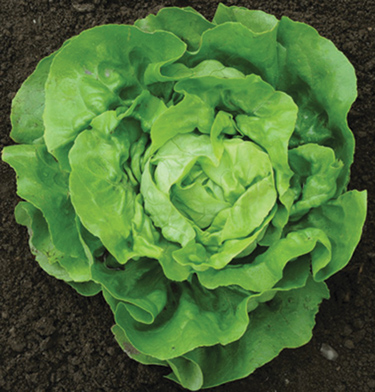
Jett trialed 30 cultivars of head lettuce. He chose Bibbs (in which he includes Butterhead, Boston, and Batavian types), Romaines, and one crisphead. He did not trial leaf lettuces because, he said, “I’ve never been able to get over 2 pounds per square foot from leaf lettuce, whereas head lettuce is up to 5 pounds per square foot.”
Jett named the following varieties as good choices for all seasons, based on their uniformity, heat tolerance, and cold tolerance. The seed source he used is in parentheses, though the variety may be available from multiple sources:
Big Boston (Baker Creek) — green Bibb
Dancine (Johnny’s Selected Seeds) — baby Bibb
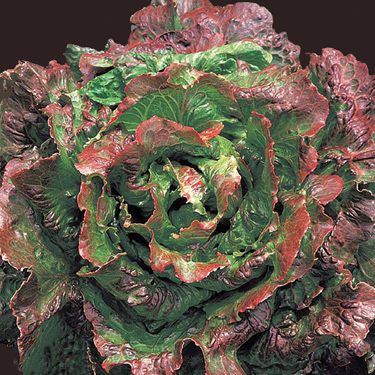
Maravilla de Verano Canasta (Seeds from Italy) — green with red tips
Nevada (Harris Seeds) — Batavian type
Nancy (Johnny’s Selected Seeds) — Boston Bibb type
Sierra (Harris Seeds) — Batavian type
Regina dei Ghiacci (Seeds from Italy) — Crisphead type
Among the varieties that had good heat tolerance and good quality in both the April and July plantings, he identified the following:Dancine, Nancy, Rex, Australe, Buttercrunch, Sierra, Nevada, Helvius, and Coastal Star from Johnny’s Selected Seeds.Regina dei Ghiacci and Rouge Grenobloise from Seeds from Italy.
Sierra and Nevada from Harris Seeds.
Here are his comments about each: “Australe is an excellent red buttercrunch lettuce with very good flavor and texture. Buttercrunch is a consistent bibb variety with excellent quality even in high temperature growing conditions. Dancine, Nancy, and Rex were extremely uniform with excellent heat tolerance and quality. Both Coastal Star and Helvius performed very well in both planting dates, Helvius seems to have slightly higher quality. Nevada and Sierra are Batavian lettuces with excellent heat tolerance. Regina delle Ghiacciole is a crisp head type which had excellent quality during the mid-summer. Rouge Grenobloise had very high quality during both planting dates.”
Economics
With the 6-inch plant spacing, Jett calculated yield at 8,500 heads of lettuce from a 30 x 96 tunnel. He calculated input costs, including the grower’s wages, at $980 per 1,000 square feet. He said net revenue from head lettuce would be $1,700 to $2,600 per 1,000 square feet, depending on prices. With a crop time of 60-80 days in spring and summer, 120 days in winter, growing lettuce year-round can be a profitable endeavor.
Dr. Jett’s presentation will be posted on www.greatplainsgrowers.org. He can be contacted at Lewis.Jett@mail.wvu.edu.
Copyright Growing For Market Magazine.
All rights reserved. No portion of this article may be copied
in any manner for use other than by the subscriber without
permission from the publisher.