











This fourth article in my series about being resilient, understanding what’s going on with the plants and the weather, and knowing when to take action, is about tools to help busy farmers with complex decisions that have to be taken quickly. The middle of a hot field in mid-afternoon of the day you need to plant is not the best place to make a hard decision. It’s better to have a framework in place to lean on when the going gets tough. This involves carving out some time to prepare the framework in advance — another job for winter. In this article, I’ll share some strategies for decision-making and tell you how we decide to give up on a crop when we can’t get everything done.
Decision-making methods
Decision Innovation (www.decision-making-solutions.com) offers a helpful section on decision-making techniques. They divide techniques into three categories: random, intuitive and analytical. It’s also possible to combine some intuition and some analysis. An example I’ve used is the Com-Pair technique for choosing among options: you separately compare all the options two at a time and it becomes clear which is best overall. There is no absolute need to justify each preference – that part can be intuitive.
Random decision-making, such as throwing a dice, isn’t much help in farming, although I do think it has a place if you’ve used other (more rational) methods and are left with two options that seem equally valid. Perhaps they are as good as each other, and so either choice will work. Or perhaps you just can’t know which is best because you can’t get the information you need. In that case, it can be better to plump down on one side or the other and then move on. Being paralyzed by indecision is also making a decision – to spend the time tied in knots rather than doing something else.
John Biernbaum at Michigan State University Department of Horticulture uses a system for overall crop planning called KISS: Keep it Simple and Sensible. Break down the problem into a series of simple steps.
Holistic Management is a method for making good long-term decisions, and also fast snap choices. To get the best from this method, you need to set a holistic goal to test proposals against. This ensures you consider both the short and the long term; the needs of everyone involved, including the wider community and future generations; and also the land and wildlife. This goal is something to have in place before you get too busy – you probably don’t want to be reading a 130-page document in mid-season.
In this method, each decision is run through up to seven testing questions, to flush out any decision that would not be sound environmentally, economically or socially, or would work counter to your goal. The questions can be found in detail at http://managingwholes.com/test-questions.htm. They can be applied to each of several options, to help you choose the one that passes the most tests. Using the questions helps develop good mental habits, which can become second nature. If no option passes most of the tests and you can’t think of other options, you may need to settle for a temporary solution and plan for better later. The seven questions are:
1. Will you be addressing the cause or just the symptoms?
2. Will this action lead towards greater sustainability?
3. Will this strengthen the weakest link socially, biologically and financially?
4. Will the needed resources (money, materials and energy) come from the most appropriate source and be the most appropriate use of that resource?
5. Are the social and cultural impacts of this choice an improvement for everyone?
6. Is there another choice which would be a better use of the resources and lead closer to the goal?
7. Which of the options best helps cover business costs?
Who decides? And how?
Clarity is precious when things get difficult. Who is the decision-maker on the issue in question? Does one person have the mandate to make certain urgent decisions? What are the limits on what one or two people alone can decide? How much input does a full-time worker get? What about a casual worker? CSA sharer? Is there an opt-out for those strongly opposed? (e.g., they won’t have to pick the extra late crop of beans, but do a different job instead.)
What are the limits of resources such as time, space, money? How will the decision be made? By the farmer/owners? A vote of the full-timers/members? Beware the trap of awarding decision-making power equally to absolutely everyone, regardless of knowledge, experience and commitment. And don’t choose a very slow method for decisions you need quickly. Consensus might sound great on paper, but if your group is not trained in it, nor committed to the same long-term vision for the farm, or the same agreements on how to proceed, you could be in trouble. For group decision-making, I like Sociocracy (aka Dynamic Self-Governance), a system using “consent-based decision-making among equivalent individuals.” Decisions are made by the members of the circle when there are no “reasoned and paramount objections”, that is, when all participants have given informed consent. The method for proposals and discussion is very structured, minimizing wasted time while making space for each circle member to voice their opinion. Objections must be clearly argued and the objector must be willing to work productively toward the group goals. Policy decisions are made by the sociocratic circle and then, within the policies, day-to-day operational decisions are made by people delegated to make those decisions. See the Resources List.
Another resource I have found useful is Stephen Covey’s Stewardship Delegation model. This system focuses on desired results rather than methods. Those delegated have a choice of methods and are responsible for the results. Together you agree to the desired results as clearly as possible; identify the limits of the (time, money, technical and human) resources available; identify the known paths to failure and the parameters (such as organic methods, or other important restrictions); set up specific times to report back and evaluate progress (and a description of what counts as success); and then specify what will happen if the desired results are achieved and if they are not. This method can share out the workload and the stress-load in a way that is likely to lead to success.
Biointensive IPM
One approach is to treat all farm decision-making like Biointensive IPM. The basis of this method involves a pro-planet, rather than anti-problem, approach of creating a healthy vigorous farm better able to withstand damage, keeping damage to a minimum, paying attention to what is happening, and managing problems by the least ecologically damaging method. The sequence of steps is basically: prevention, avoidance, monitoring, solutions. Preventative actions are also known as Cultural Controls. Focus on proactive strategies, starting at the planning stages, to minimize likely problems. Maintain vibrant health in your farm, increase biodiversity to provide greater stability. After growing the healthiest crops possible, the next stage is to avoid the chances of a specific problem getting worse. These actions are known in IPM as Physical Controls. Monitor your crops once a week, and also keep a “weather eye” open whenever you are working in an important crop. When you notice a problem, you can take a picture, mentally or with a camera, and then consult a variety of resources to identify the problem and some solutions. The Action Level or Economic Threshold is the point at which the losses from the problem warrant the time, money and ecological disruption put into applying control measures. When the established Action Level for a particular situation has been determined, and prevention and avoidance strategies have been exhausted, control measures can be used to reduce or eliminate that problem or its impact while minimizing environmental risks. Design a series of measures that work together, to ensure that one action does not mess up another. Choose the least toxic materials and the least ecologically-disruptive methods.
Tools for making decisions
List all the options, using a brainstorm approach. It helps to have more of the involved people in on this. The key is to write down all the suggestions, allowing no audible or gestural comments on the ideas as they come up. The goal is to think widely and suggest anything that comes to mind – even if you judge your idea crazy, it may generate a related but less crazy idea from someone else. Group related ideas, and perhaps re-write them. Next scrap the least promising, and short list the most promising. A brainstorm is only the first stage of a process. It is useless alone, as it does not move you towards being able to choose one action.
Consider the pros and cons of each option, either an existing list or one just short-listed from a brainstorm. There are various refinements of this process: the plus/minus/interesting (PMI) analysis, the pro/con/fix (PCF), the weighted pro/con or a force field analysis. Often a simple discussion of the pros and cons of each of the better options is enough to clarify which direction to go in.
The decision-making tree is one tool advocated by Decision Innovation to help clarify the best choice. To use this technique, you diagram the choices at each stage until you reach the concluding result of that branch of the possibilities. This can be useful in deciding between strategies when resources are limited. The convention is to draw a rectangle for each decision, and lines to connect to likely decisions down the road (until you reach the end – of the season, the crop, or the money.) Circles are used for uncertain outcomes, and the lines leading on from them are marked with the percentage likelihood of that result.
One way to harness the energy behind grumbling and complaining is to ask the grumbler to suggest three possible improvements or else they’re not allowed to complain.
One method I use when overwhelmed by something difficult is to go weed something and think only about weeding for 15 minutes. Doing something productive helps me not feel paralyzed by the difficult stuff.
When (and how) to cut losses
Decision-making can involve switching track – you’d been planning to leave the clover cover crop growing over the winter but you’ve just realized it has a lot of weeds – what to do? Know when to cut losses and re-prioritize. Farming never stands still, sometimes the best way to catch up with an interminable list is to remove some items, whether you’ve done them or not. When other tasks are also pressing, conditions change. This past year we decided to bail on our onion transplanting when we’d done 85% of what we’d planned: the transplants were getting too big (danger of bolting), the weather was getting too warm, we had so much else to do. As a consequence, we decided to grow less next year and hope to do a better job (less is more).
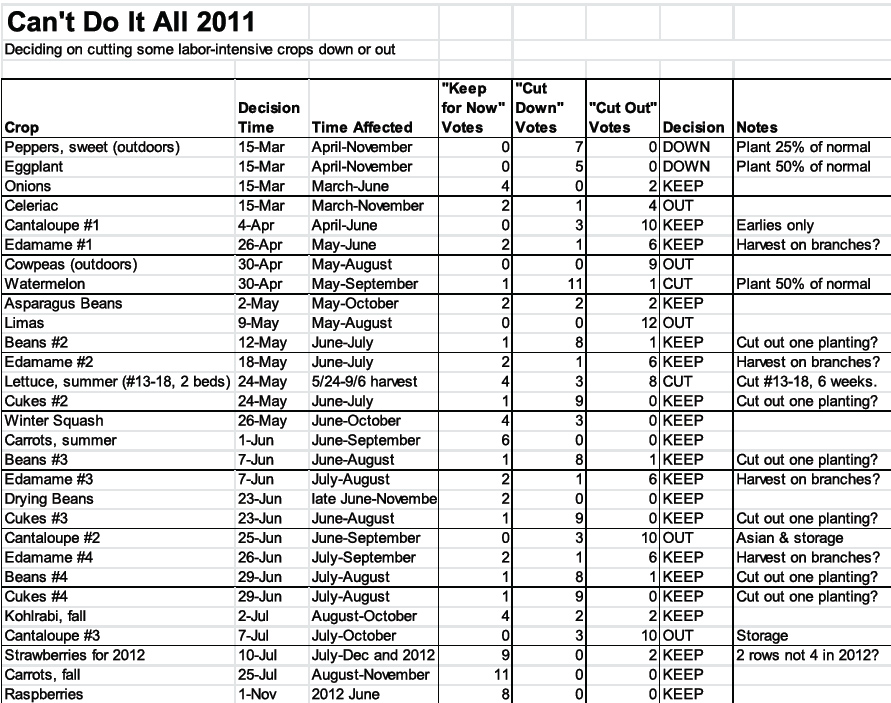
A couple of years ago in early March we realized we had nothing like enough experienced workers. We were looking at an overwhelming amount of work. We made a list of labor-intensive crops for possible cuts. The main point was to save us time, not just cut crops we personally disliked! Then we made a “Can’t Do It All” chart (shown on the next page) of possible crops to cut down or out, and listed the decision date by each. As each date approached we reviewed our situation. This method enabled us to make one decision at a time, in a straightforward way, and not go insane. Such a list is helpful for many types of calamity. It leaves the door open for possible upturns of fortune later in the year. It’s less distressing to take one bite at a time than to take a big decision when you already are struggling to cope with some big bad thing having happened.
Atina Diffley in her memoir Turn Here Sweet Corn describes the “Diffley Deal” when they needed to downsize their workload. Each person could choose one crop each to cut, in turn, until they got down to what they could manage.
Review your decisions
“Those who cannot remember the past are condemned to repeat it.” George Santayana. Don’t make the same mistake two years running. Reviewing decisions while the pain is fresh will help improve your response next time a similar situation comes up. Conduct a de-briefing: What went wrong, why, what could prevent the same problem another time? Write it up, take photos. Make a list of possible responses next time a similar thing happens These questions are asked in hospital de-briefings after a critical event. This leads to smart decisions such as hospitals using different shape and color containers for things that really don’t want to get substituted for each other by error.
Resources
BH Walker and D Salt. 2006. Resilience Thinking: Sustaining Ecosystems and People in a Changing World. Island Press, Washington, D.C. http://www.resalliance.org/2963.php
Allan Savory with Jody Butterfield, 1999. Holistic Management, A New Framework for Decision Making, Island Press
Ann Adams, At Home with Holistic Management: Creating a Life of Meaning
John Buck and Sharon Villines, 2007. We the People: Consenting to a Deeper Democracy. Washington DC: Sociocracy.info Press. http://www.beyonddemocracythefilm.com/trailer
Stephen Covey, The 7 Habits of Highly Effective People. https://www.stephencovey.com/7habits/7habits.php
ATTRA has a free online publication on Holistic Management: https://attra.ncat.org/attra-pub/summaries/summary.php?pub=296. Holistic Management International http://holisticmanagement.org/ is a non-profit which trains farmers and ranchers and offers consulting. You can read case studies of farmers helped by their systems on their website. You can take classes or join in distance learning or download substantial free packages that explain holistic management, or help with financial planning and land use planning.
Some helpful information, couched in terms of Risk Management or Stress Management, is available from the Cooperative Extension Service:
UC Small Farm Program http://www.sfc.ucdavis.edu/management/#risks
and the USDA Risk Management Agency http://www.rma.usda.gov/
http://farm-risk-plans.rma.usda.gov/index.aspx?action=riskman.home
and even the Australian Bureau of Meteorology, Weather and Risk in Agriculture
http://www.bom.gov.au/watl/about-weather-and-climate/risk/index.shtml#example
Pam Dawling is the garden manager at Twin Oaks Community in Louisa County, Virginia. Her new book, Sustainable Market Farming: Intensive Vegetable Production on a Few Acres, is available at www.sustainablemarketfarming.com
Copyright Growing For Market Magazine.
All rights reserved. No portion of this article may be copied
in any manner for use other than by the subscriber without
permission from the publisher.