











We stopped farming in 2011 after 30-plus years growing vegetables. One of the hottest items at our farm dispersal sale were the 80 greenhouse pallets we made, starting in our earliest years. They are cheap – current cost of materials is $18 – and easy to build.
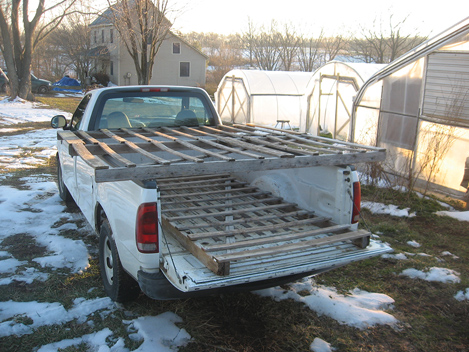
The 4×8 pallet holds 18 standard 1020 flats. Our 30’ x 100’ greenhouse held 60 pallets in three lines of 20 each. Our two 14’ x 100’ hoophouses each held a single line of 20.
The full pallets can be moved long or short distances quickly and easily by four people. We frequently rearranged pallets within the heated greenhouse, using the precise grid of aisles like the old elementary school game, Streets and Roads – first across, then down. We readily moved them to the hoophouses, and to the yard for hardening off. Greenhouse door openings need to be adequate. A full-sized pickup bed can carry three full pallets to the field for transplanting – one in the bed and two straddling the sides. Lift by the 2x4s only, never by the 1x3s. And never stand on a 1×3 of an empty pallet. A single person can easily move an empty pallet.
Pallets can rest on dirt, gravel, or grass, or be elevated on wooden crates or plastic lugs. We liked to place two pallets touching with a 12” aisle between those two and the next two, giving maximum access for watering, moving individual flats, or choosing flats for plant sales.
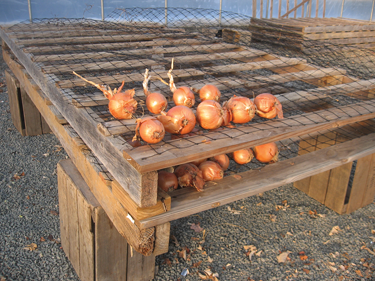
In July we used the pallets to cure onions and garlic, either in the greenhouse that was by then covered with shade cloth, or in the barn, with as many as eight pallets to a stack. On each pallet we used a staple gun to minimally attach a 4’ piece of our 7.5’ plastic deer fencing over the slats, laying the onions, immediately after pulling, with their bulbs on the netting in the spaces between the slats. To increase ventilation we set a 2×4 scrap on each corner to elevate the next pallet by an additional 1.5 inches. We did not need to use the deer fencing for the garlic as its stems were stiff enough to support the bulbs.
Materials for one pallet:
2 eight-foot 2x4s Set on edge as base.
8 eight-foot 1x3s One serves as diagonal brace. Rest are cut in half for surface slats. (Home Depot will make cuts for you for free.)
Coarse thread drywall screws, 1-5/8” Phillips head. Cordless drill.
Do not use treated lumber. It is toxic, heavier, more expensive, and unnecessary.
Set the two 2x4s on edge, four feet apart, and place a four-foot 1×3 on each end to make the frame. Square up, and attach with one screw. Add a second 1×3 at each end, next to and flush with first, square up again, and attach. You need the resulting 5” of surface at the pallet ends to support the two flats that will lie across the end — flats 17 and 18.
Arrange nine four-foot long 1x3s as slats, leaving 5” of open space between the two 1x3s at each end and the adjacent slat. Leave 7” of open space between the rest of the 1×3 slats. When you get them spaced correctly, mark placement with pencil, and attach, one screw at each end. Turn pallet over, and attach the eight-foot 1×3 diagonal brace. Insert these screws at an angle to avoid having them poke through on the top side.
Chip and Susan Planck recently retired from farming at Wheatland Vegetable Farms in Purcellville, Virginia. They can be reached at Susan Planck splanck@rstarmail.com.
Copyright Growing For Market Magazine.
All rights reserved. No portion of this article may be copied
in any manner for use other than by the subscriber without
permission from the publisher.