









It’s hard to believe that March is already under way and another flower season is right around the corner. We’ve been super busy this past month, working hard to stay ahead of the game. There are three new 140-foot ‘Kerr Hoophouses’ in the works and a dozen 150-foot caterpillars set to be erected by the middle of the month. Grand plans and big dreams are the theme of 2013! Our greenhouse is already brimming with thousands of little seedlings and every day more are being sown. While many of our standard field crops are in the mix, I’ve added in a whole ton of new varieties to the list as well. Some were past favorites that we haven’t grown in a while and others are part of a series of trials I’m conducting this season. Abundance is all around and it feels absolutely amazing!
But before I get racing off in a million directions, I want to share some of my favorite new varieties from last year as well as some that look quite promising this year.
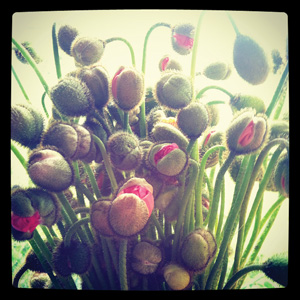
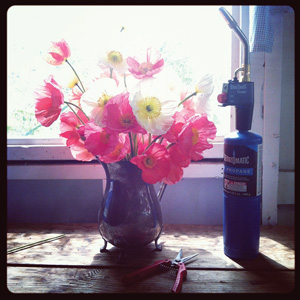
Papaver nudicale ‘Champagne Bubbles’: Icelandic poppies are fast becoming one of my favorite flowers. Their brilliant silk-like petals and citrusy scent are absolutely intoxicating. In the past I’ve grown both the Temptress mix and the San Remo mix but wanted to branch out even more. Champagne Bubbles was new to us last year and turned out to be a huge hit. There are five colors in the series (red, orange, yellow, pink and white) and they can be purchased either as a mix or individually. Gloeckner, Ivy Garth, and Geo all carry them. Both white and pink sold very well for us with wedding designers and orange was killer to our retail group. While a tad bit shorter than the other mixes, I found the stem sturdiness to be very good and their vase life off the charts. If picked in cracking bud stage (shown at left) and seared with a propane torch for 5-7 seconds, I got an average of six days from a bundle. They hold extremely well in the cooler and can be stored for up to a week with no diminished vase life on the other end. When harvesting, I rubber band the bundles about 3” up from the cut end and then sear 10-15 bunches at a time without melting the rubber bands. A Benzomatic propane torch with a trigger is the best way to sear efficiently, evenly and safely.
This year I’m also adding Meadow Pastels and Solar Flare Orange, and will report back.
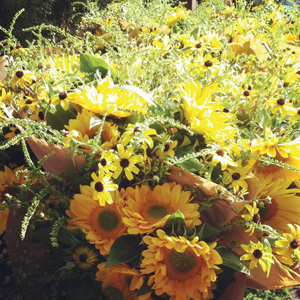
Rudbeckia triloba: If you haven’t tried this adorable coneflower yet, it should certainly be given a spot in this year’s garden. While it can be a bit finicky to start from seed, the extra effort is worth the trouble, I promise! In their book Local Color (available from GFM), the Arnoskys recommend mixing the seed with equal amounts of damp, fine vermiculite in a zip lock bag and refrigerating it for roughly 30 days before sowing. This trick worked great for me and I sowed two rounds of babies last year resulting in a two-month harvest window. Stretching to a massive 4-5 feet, each plant is covered with a million miniature yellow coneflowers. While individual bunches sold well, when mixed with sunflowers and other fillers in bouquets, we experienced record sales. Seed is available from Ivy Garth, Gloeckner, and Geo.
Larkspur ‘Earl Grey’: While not new to our lineup, this larkspur makes such a bold statement every spring I thought it was worth mentioning here. Only available through Renee’s Garden Seeds, this beauty is worth tracking down! Each tall spire is loaded with smoky eggplant purple blooms that are greedily snatched up by designers whenever we have it in stock. If you are looking for something unique or service a high-end clientele, this variety will make you the center of attention indeed.
Oxypetalum ‘Heavenborn’: Tweedia has long been on my “to grow” list but it was only last season that I actually got it planted in the hoophouse. Talk about a beautiful treasure!!! The star-shaped periwinkle blooms cover each 2-foot stem and really doll up anything they are paired with. Seed for this variety is available quite reasonably from Geo and Ivy Garth. Postharvest was a real struggle, though, since none of my normal tricks worked. Picking in the cool morning, storing in the cooler overnight before bunching, and searing the milky stem ends in boiling water didn’t do a thing to keep them from totally wilting. After finally throwing in the towel and leaving a bucket of limp flowers in the back of the garage for two days we noticed that the stems rebounded nearly 100%. After rehydrating, the flowers persisted for well over a week. If anyone has a special technique they use to get this beauty to stay hydrated from the start, I’d love to hear it! Blue flowers are rare and prized. Having a heat-loving bloom in this color is something to hold on to.
Achillea ‘Summer Berries’: Yarrow is a killer flower to grow since it comes in a wide range of colors, designers love it, it goes great in mixed bouquets and it doesn’t ship well at all. Local growers have a great advantage with this crop!. We grow Terra Cotta, Paprika, Moonshine and Appleblossom, which are all propagated by divisions. Last year I stumbled onto a beautiful seed series called ‘Summer Berries’, not to be confused with the much less favorable ‘Summer Pastels.’ The mix included corals, burgundies, and a number of delicate peach tones — every shade that brides and wedding florists are going crazy for these days. I have 400 plants started in the greenhouse and can’t wait for the first abundant harvest. I also snagged packets of Cassis and Cerise Queen to add to the mix. Seed available from Geo.
Cynoglossum ‘Mystic Pink’: Chinese forget-me nots are a unique crop worth considering both because of their delicate flowers and the fact that they can be successfully grown as annuals. In the past I’ve had great luck with the tallest blue variety called ‘Blue Showers’. Be sure to get new seed every year since freshness is vital to good germination with this crop. Also, sow twice as many as you’ll need because germination is quite irregular even with good seed. Last season I added ‘Mystic Pink’ to the list which did fantastic in both the field and the hoophouse. The pink variety is quite a bit taller than the blue and stems seem to be much more robust as well. While it wasn’t as popular in straight bunches, I did use an enormous amount in mixed spring bouquets. This year I’m also trying a new white variety called Avalanche. Seed for all three is available from Ivy Garth.

Dusty Miller ‘New Look’: If you subscribe to wedding magazines or follow along on any wedding flower blogs you’ve likely noticed the heavy use of dusty miller in design work these days. With the vintage-romantic look in full swing, this plant has been in high demand the past few years. While florists still use a decent amount of the old cut-leaf Candicans, I’ve found a surge of interest in the wide-leaf variety called ‘New Look’. Much larger and more refined, designers are actually fighting over it! If you sell to wedding florists or work with a lot of brides, be sure to add this into your mix. It’s available from Johnny’s Selected Seeds, among other seed companies.
Sources
GeoSeed, www.geoseed.com; 888-645-2323
Gloeckner, www.fredgloeckner.com; 800-345-3787
Ivy Garth, www.ivygarth.com; 440-729-7690
Johnnys, www.johnnyseeds.com; 877-564-6697
Renee’s, www.reneesgarden.com; 888-880-7228
Copyright Growing For Market Magazine.
All rights reserved. No portion of this article may be copied
in any manner for use other than by the subscriber without
permission from the publisher.