










We like mulching the aisles between rows of plastic on our 8 acres of vegetables, and after trying different methods we’ve settled on rolling the smaller 4’ x 5’ round bales down the aisles by hand. Compared to square bales they cost half as much per pound of hay, which is nice. More importantly, though, round bales are much easier and faster to move around and distribute. One person with a tractor and wagon can bring and distribute all the round bales for one of our 1/5-acre blocks in 15 minutes, without actually touching any hay or sweating, and if a bale’s in the wrong place it’s easy to move. Distributing the same amount of square bales takes three people 20 minutes of dirty work, for four times as many people-minutes, and if you get the distribution off you have to move a lot of bales twice.
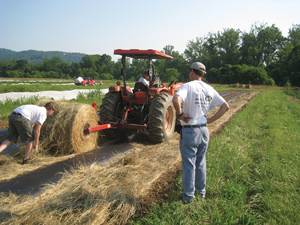
The big drawback of round bales, though, is getting them rolling, which up until now we’ve always done by hand. It takes two and sometimes three people to get them positioned just right and started, and if the bale is heavy or a little misshapen, it is hard work. Our farm is flat and our workers are willing, but there’s always a little psychological hurdle to overcome each time we start one of the 200+ bales we roll out each year. We once saw a machine capable of shredding and mulching a round bale while straddling a row, but it cost over $15,000.
Luckily, though, an extension specialist named John Wilhoit from the University of Kentucky has designed an implement that can roll out bales in the aisles with a tractor. He started with a regular round bale unroller, then designed and built an offset hitch so you can straddle your row while mulching the aisle. He brought his machine to our farm last summer to try out, and within five minutes we were experiencing a revolution. We had one person walk behind the bale unroller, making sure the hay was coming off, but the tractor did all the hard work, and it went really fast. We had distributed bales near the field beforehand, so after we’d finished unrolling one bale another one was nearby to pick up. With the help of a hydraulic top link, we could unroll the bales almost to the end, and got the fields about 80% finished with the tractor. Then we still had some little bales to finish unrolling, and the usual adjusting to make the job complete, but compared to our old system it was an incredible difference.
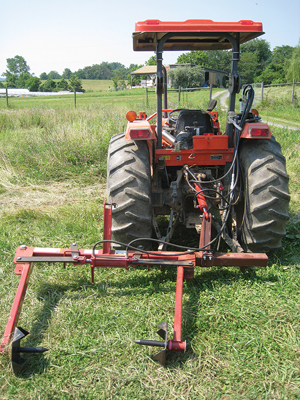
Unfortunately Dr. Wilhoit took his machine back with him to Kentucky, but he sent us detailed plans and we had one made this winter. We bought an unroller for $1300 and a hydraulic top link for $300, and we paid our local welder $470 to modify the unroller with an offset hitch, for a total cost of $2070. Then we decided to buy another tractor, as we do a lot of mulching and didn’t want to tie up our main tractor so often during the busy spring. We bought a tractor with two sets of hydraulics—one for the unroller arms and one for the top link—but Dr. Wilhoit had made a valve box for his unroller that let you move both cylinders from one set of hydraulics.
We are excited to make this change and encourage others to try it as well. For us it will take a little more coordinating to have two people start unrolling bales before other people show up to finish, but the physical and mental difference in mulching on our farm will be well worth it.
To see a brief video of our first try with the unroller made by one of our interns, go to http://www.youtube.com/watch?v=S0QRqjJwMB4. For detailed plans for modifying a bale unroller to make it offset, and for extension publications about mulching with round bales, go to http://www.bae.uky.edu/ext/Specialty_Crops/.
John Wilhoit at the University of Kentucky can be contacted at jwilhoit@bae.uky.edu
Eric Plaksin is the owner of Waterpenny Farm in Sperryville, Virginia.
Copyright Growing For Market Magazine.
All rights reserved. No portion of this article may be copied
in any manner for use other than by the subscriber without
permission from the publisher.