











This is the first in a series looking more closely at the five areas of potential food contamination identified by the FDA.
On the market farm, almost every crop is harvested and handled by human hands at some point between harvest and sale. People bunch kale, pick up carrots, sort tomatoes, and dump rutabagas into the barrel washer. Even the most automated salad mix washing line still gets cleaned and maintained by people.
From a food safety perspective, this is a challenge. People poop, and they move through a world with lots of poop in it. And poop can carry the microbiological organisms like salmonella and E. coli O157:H7 that make people sick. The vomiting and diarrhea that we call the “stomach flu” is usually the result of some of that poop getting onto somebody’s food and then into their body – what food hygienists call the fecal-oral route of transmission. For most people, the stomach flu is just an unpleasant interlude, but for children, the elderly, and the otherwise immune-compromised, food poisoning can be deadly.
For this reason, good food safety practices – and the FDA’s proposed Rule on Standards for the Growing, Harvesting, and Packing of Produce – put an emphasis on implementing policies and procedures that keep workers from contaminating produce, as well as providing training to help employees understand and carry out good food safety practices. And whether our farms are subject to the Food Safety Modernization Act or not, we all need to take these basic precautions to avoid contaminating our customers’ food.
Washing hands
Washing your hands, and being certain that every worker on your farm washes their hands, is the single most significant step you can take towards making the product leaving your farm safer.
Because hands are the body part most in contact with produce, they are the body part most likely to create a contamination problem. Hands pick up microbiological contamination from a myriad of sources – touching doorknobs, flushing toilets, working with soil, working with animals, changing diapers – so many sources, in fact, that hands should be considered to be contaminated by definition.
With that in mind, everybody who works on the farm should wash their hands before they start work for the day – even if they aren’t handling food, every worker is probably touching something that somebody who handles food will end up touching. And when workers stop working, they should wash their hands again before they start up again.
Workers should wash their hands after using the toilet. The problem doesn’t necessarily come from touching your own body when you go to the bathroom, although there may be more germs in those body areas than, for example, your elbow. The problem is that lots of people use the bathroom, and you have to assume they just aren’t as neat as you – you know this is true if you’ve spent any time observing sanitation in a public restroom.
If they’ve been in contact with animals, or working with their waste, workers also need to wash their hands. Even if your hands don’t touch the animals themselves, some form of indirect contamination is likely. By the way, this means any animal, not just livestock. I’ve seen what my dog rolls in, and I don’t want that on my vegetables.
When workers move from the field to the packing house, they should wash their hands. Because the organisms that cause food-borne illness can survive for a long time in the soil, you don’t have to see fecal matter for those organisms to be present; besides, you don’t want employees getting boxes and clean produce dirty.
Gloves are not a substitute for hand-washing. Good food safety practices actually include washing your hands before you put on gloves – otherwise, dirty hands can contaminate the gloves.
Contrary to much of the public restroom behavior I’ve observed, soap is an absolute requirement. Not using soap can actually loosen microbes and make them more readily transferable – just like muddy hands transfer more dirt than hands covered in dry dirt. On the farm, hand sanitizers simply aren’t an effective substitute for soap, because sanitizers are inactivated in the presence of soil and organic matter.
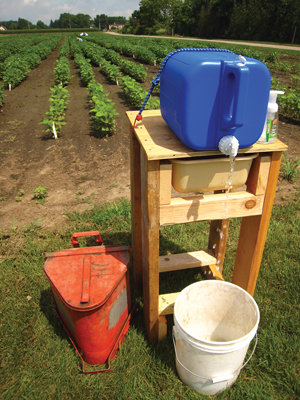
It doesn’t do any good to wash your hands with potentially contaminated water, so hand-washing must be done with potable water. You need to use running water, so that you don’t re-contaminate your hands. This doesn’t mean that your faucet needs to be connected to a pressurized water source, just that the water you wash in is moving over your hands, rather than sitting in a basin. A closed tank of potable water with a spigot can be considered a source of clean, running water.
You wash your hands because you assume they are contaminated; therefore, once you wash your hands in water, that water is considered to be contaminated, and needs to make its way into a septic system or another container that keeps it from running into the field. The sink or catch-basin for the now-contaminated water needs to be dedicated for hand-washing, so that you don’t contaminate produce or tools through contact with contaminated surfaces.
The amount of time you spend scrubbing and rinsing also matters; the standard guideline is twenty seconds. That’s not twenty seconds of holding your hands under the water and patting the soap absentmindedly, it’s twenty seconds of vigorous scrubbing. Pathogens hide and survive in crevices and crannies like the backs of fingernails and the folds of skin on your hands. The first few scrubs loosen the dirt and rinse it away, and more scrubbing and rubbing continues the process. It’s important to work the fingertips and on up the wrist to remove as much dirt, bacteria, and viruses as possible. (A while back, National Public Radio suggested some alternatives to the 20-second classic, the A-B-C song. They included the chorus of Neil Diamond’s “Sweet Caroline”, or the first six lines of Lady MacBeth’s “Out, Damned Spot, Out” soliloquy.)
At Rock Spring Farm, we installed a small, instant hot water heater right next to the hand-washing sink in the packing house, so that workers wouldn’t have to wait for hot water to arrive from a distant tank. While hot water doesn’t make modern soaps more effective, it does encourage people to spend more time washing their hands.
Drying your hands also matters. Wet skin is more likely than dry skin to transmit microorganisms – think again about muddy hands versus dry dirt. And you need to dry your hands with a towel that isn’t contaminated, so that somebody else’s sloppy hand-washing – or the back of your pants – doesn’t turn your hands into a health hazard. Single-use paper towels are the standard, although you could also use cloth towels that are used once and then laundered.
The University of Minnesota has published plans for a field hand-washing station that can be built for under $20, available at http://goo.gl/YdLQV. If you don’t have a hand-washing sink or a septic hookup in your packing area, something like this could be used there as well.
More on worker hygiene
Good worker hygiene involves more than just hand-washing. As I’ve written before in these pages, sick people need to stay out of contact with produce – and preferably off the farm entirely. Diarrhea and vomiting are explosive events, designed by the organisms that induce them to spread themselves far and wide. These expulsions come out of the body with such force that when they strike water or porcelain, they aerosolize, floating around the environment and landing on walls, doorknobs, and clothing. A person with diarrhea or vomiting should be considered a walking source of food-borne illness microbes.
Workers should wear clean clothes. At a minimum, they need to don other outer garments such as aprons, coveralls, or bibs that keep the crud from their clothes from contaminating produce. I’m partial to Helly Hansen bibs as a great way to keep workers dry in the field and packing house, while protecting the produce at the same time; I use white ones in the packing house because they have more of a “food-processing” feel. Rubber boots provide an easy-to-clean surface, and aprons can be a useful tool if you have employees cycling in and out of the packing area.
While we addressed hand-washing after working with animals and their leavings, employees really should avoid contact with animals altogether while they are working with food. Animal hair, fur, saliva, and skin can all harbor pathogens such as Giardia lamblia. The proposed rule does make an exception for “working animals” such as draft horses. Ideally, chores involving livestock and pets would take place after the produce work is done for the day, or as a distinct activity. Consider outfitting workers with an apron, smock, or coveralls while they are working with livestock or manure, then removing those garments before moving on to work involving contact with produce.
By themselves, gloves don’t improve food safety. They aren’t any less likely to transmit pathogens from one surface to another. As noted above, hand-washing is a must before putting on gloves. Gloves can lead to a false sense of security, because they are perceived as being somehow safer than bare skin. I’ve watched countless fast food workers ring up a sale with their gloves on, contaminating the gloves with whatever was already on the keys of the register.
Once wearing gloves, workers must keep them clean and sanitary, and change or sanitize them if they become soiled. If they are reused, gloves must be maintained in an intact and sanitary conditions – in other words, they need to be cleaned and sanitized like any other harvest and packing equipment, and stored dry; and if they become ragged or develop holes, they need to be discarded.
Food safety training
For most market farms with employees, seasonal staff turnover is a fact of life. Each worker on your farm needs to be trained about the basics of food safety – and that means everybody from a temporary contract laborer all the way up to you, the farmer. Under the proposed rule, workers will need to be trained upon hiring, and again at the beginning of each growing season. Supervisors need to know enough about food safety to monitor compliance.
Certainly, food safety practices contain some obscure elements, but the things most workers need to be trained on are pretty straightforward, and come right back to the basics of food safety: keep the poop off the food, keep any poop that does get on the food from spreading, and keep any poop that gets on the food from spreading to other food.
Workers need to understand what they need to do to keep food safe, such as not harvesting contaminated produce, and avoiding bruising and damaging produce. They need to recognize the symptoms of illnesses that can be transmitted through food, and to understand the important role that everybody plays in maintaining food safety.
For several years, Rock Spring Farm has used a DVD from Cornell University as the cornerstone of our training program. Available in English, Spanish, Hmong, and Creole, the “Fruits, Vegetables, and Food Safety: Health and Hygiene on the Farm, Worker Training Video” has provided a basic background on the principles of food safety, and generalized best practices on the farm. We expand on it by discussing specific policies and procedures at our farm that differ from or build on the information in the video. The video is fifteen minutes long, and we have another five minutes of information that is specific to our farm. The DVD is available at http://goo.gl/tizbV].
And it’s not just workers who need training. Visitors need to have an awareness of the necessary steps for food safety as well. Toilet and hand-washing facilities should be available to visitors, and visitors should be made aware of their location. And anybody who is going to spend any time on your farm, and who will come in contact with fresh produce, production areas, or food contact surfaces, should get some sort of basic orientation to the steps they need to take to avoid contaminating your customers’ food. This doesn’t have to be complicated: at Rock Spring Farm, we have a simple, one-paragraph explanation that lets visitors know they need to wash their hands before they touch any food or food contact surfaces, and that they shouldn’t go to the bathroom in or near the fields; we also point out the public restroom and the hand-washing sink.
Chris Blanchard owns and operates Rock Spring Farm in Northeast Iowa, and offers education and consulting as Flying Rutabaga Works (www.flyingrutabagaworks.com). He is the co-author of Fearless Farm Finances: Farm Financial Management Demystified, available from www.mosesorganic.org.
Copyright Growing For Market Magazine.
All rights reserved. No portion of this article may be copied
in any manner for use other than by the subscriber without
permission from the publisher.