







Since I last wrote about edamame, soybeans that can be eaten as a fresh vegetable, interest in this crop has increased and there is now more information available. Here I focus on providing edamame for a long harvest period. For more basic details see the June 2007 Growing for Market, or my book, Sustainable Market Farming.
Crop requirements
Edamame is a fast-growing, easy-care plant that grows in wet or dry weather, in varying soil conditions, as long as the weather is warm. It is important to supply enough water during pod-fill. Soil pH of 6.0-6.5 is best. At 100 seeds/oz. average, a pound of seed will sow 250’ at 2” spacing. Increasing spacing somewhat will induce more branching, and not reduce yield.
Photoperiodism
Catalogs list edamame varieties by “days to maturity” but this information is not truly accurate, because daylength is the critical factor for most varieties. Growers have reported confusion caused by the “days to maturity” numbers. The transition from vegetative to reproductive (flowering) phases of soybean growth can only occur when the daylength is short enough. It is a “short day” crop – flowering once the daylength has dropped below a certain amount. The length of darkness rather than the length of daylight is the actual trigger. Once the period of darkness is long enough, the plants begin flowering no matter how short or tall they are or how many leaves they have. Different varieties require different minimum lengths of darkness to start flowering.
For maximum yields, grow varieties adapted to your latitude. Northern states with short seasons will find that “early-maturing” varieties which flower and mature under a relatively long day (shorter night) are best adapted. “Early” varieties can flower while nights are quite short (mid-summer), while “later-maturing” varieties will continue vegetative growth until nights get longer (in the fall). The terms early, mid or late/full-season variety are relative — an adapted full-season variety for one area would not be a full-season variety if grown to the north or south. A variety would be considered late if grown further north, but an “early-maturity” variety if grown further south.
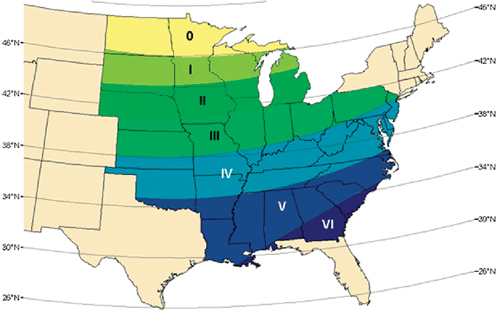
Soybean varieties are classified into 13 Maturity Groups (MGs) expressed as Roman numerals. Knowing which MGs are adapted for your latitude helps you choose which to plant.
Maturity Groups
Each variety is assigned to the Maturity Group where it will use most of the available frost-free growing season and mature before frost. The MG 000 varieties are the earliest in maturity and MG X varieties are the latest. Most of the US is within groups 0-VII. The groups are narrow strips across the US, with lower numbered groups in the north, higher numbers in the south. Varieties in each higher numbered MG require shorter days/longer nights to flower and ripen than those in lower numbered groups. Each higher group requires a slightly longer growing season. Virginia is in MG IV or V, depending which map I look at. Here is a link to one map:
http://www.ca.uky.edu/agc/pubs/agr/agr129/fff00074.gif
A thorough explanation of MGs is found in AGR-129 Soybean Production in Kentucky Part II: Seed Selection, Variety Selection and Fertilization: http://www.ca.uky.edu/agc/pubs/agr/agr129/agr129.htm
A variety can be grown 100 miles north or south of its zone fairly successfully, but not further away. The photoperiod response is also influenced by temperature. When a high MG variety (adapted to a southern latitude with shorter days/longer nights) is grown in the north, the longer daylengths (and cooler temperatures) keep it growing vegetatively for longer, resulting in a very tall plant, a later harvest, and the risk that pods may not mature before frost. If a variety adapted to a northern latitude is grown too far south (with shorter daylengths and warmer temperatures), it will stop vegetative growth and switch to flowering early, meaning smaller plants and reduced yields. (More vegetative growth means a higher potential yield.) If you prefer a harvest sooner, even if it is not as big as it could be at another time of year, go ahead and try a lower MG variety. Low MG varieties can sometimes out-yield full-season ones because of high rainfall and other weather anomalies.
The University of Illinois has developed a series of “Gardensoy” varieties adapted to U.S. conditions, ranging from early maturing (MG 0) to late (MG V). See the National Soybean Research Laboratory Edamame and “Gardensoy” which includes a map of MG regions (for mature dry commodity soybeans): nsrl.illinois.edu/general/edamame.html. The publication includes a link to contact Theresa Herman for a free sample of 30-50 seeds of several Gardensoy varieties to test and report back on. Each Gardensoy variety is numbered according to its appropriate MG.
In 2006, Patricia Stansbury in Virginia tested eight varieties of edamame, four of which were developed at Virginia State University – Asmara, Owens, Randolph and VS03-688. Three commercial varieties, Kanrich, Butterbeans and Envy, and a Japanese variety named Akiyoshi were also evaluated. Asmara was voted the best flavor (“nutty and delicious”) with a prolific and long season. Owens was close behind it. Butterbeans ranked well for flavor but was lower yielding than Asmara and Owens. All 8 varieties were sown on May 2, at a soil temperature of 70°F. The low MG varieties, Butterbean and Envy, were harvested in mid-August, and the later varieties in late September. The trial was featured in the online magazine Common Ground: southernsare.org/Educational-Resources/Newsletters/Southern-SARE-Newsletters/Common-Ground-Spring-2007 and can be found on the SARE Project database. Search for project FS06-210.
There are also some daylength-neutral varieties, although the names are hard to find. Early Hakucho 65-75d is close to daylength-neutral. Sayamusume 85d is adapted to the north. Envy 72d is a variety that was bred for New Hampshire. In Mississippi, Besweet 2020, Butterbeans and Envy all flowered 29-34 days after planting (dap) and were all ready for harvest 58-64 dap, equivalent to traditional soybean MG late III-early IV. Elsewhere, Envy has been considered MGIII or less.
For late-season plantings, use full-season varieties adapted for your area, not early varieties, as the nights will be getting longer by then. High MG varieties will be able to continue vegetative growth and have more potential for bigger yields.
In cooler climates, edamame can take considerably longer to reach maturity than the catalogs suggest. For example, in SW Washington, with 70% of the heat unit accumulation of the mid-west, crops took 40 days longer to reach maturity.
Soybean varieties also have different plant growth types. Generally, varieties in Maturity Groups 00 – IV are indeterminate: vegetative growth continues for several weeks after flowering starts. But Envy MGIII is only 2’ tall. Most southern varieties (Maturity Groups V – VIII) are determinate: flowering does not start until most of the vegetative growth has stopped. There is also a semi-determinate type which is between the two main types in both appearance and growth habit.
Sowing
Make a first sowing in a sunny location, just after the average last frost date, perhaps 7-10 days later than your first bush bean sowing date. Ideal soil temperature is 65°F at 2” depth, but definitely above 55°F, with air temperatures around 68°F. A phenology sign is apple trees in full bloom, starting to shed petals. Sow 1-1.5” deep, (less in cooler or wetter soils), with about 2-3” between seeds, and 6-24” between rows. Do not soak the beans prior to sowing, or overwater after sowing, as they will be more likely to rot. If you have not had many soybeans growing on your land in the past, use soybean inoculant, which is not the same as general purpose pea and bean inoculant. Don’t plant seed beyond the season after the one the seed was produced in, as the germination rate drops rapidly.
Where the seasons are long enough, edamame can be grown as a summer “catch crop” on a bed following a spring crop, and before a fall crop. A benefit of growing edamame is the nitrogen added to the soil by the root nodule bacteria, as much as 1 pound of nitrogen for each bushel of harvested pods (soybeans are only a moderate nitrogen-fixer, compared to alfalfa).
Planting several varieties from different neighboring MGs (or varieties within your home MG with differing days to maturity) on the same day can be used to spread the harvest period. It also spreads the weather and disease risks.
Season extension in spring
Edamame may be transplanted, and this makes growing the crop possible in areas with a shorter season. In Kentucky, researchers are working to extend harvest of fresh edamame from July 1 to October 31. They start edamame in greenhouses for field transplanting. Tobacco transplanting machines have been used successfully in Kentucky in a 2001 trial.
Edamame can be grown in a hoophouse earlier and later than outdoors. Preliminary studies at Virginia State University found that edamame planted in the ground in high tunnels in April can be harvested in late June, two and half months earlier than the earliest field-sown (Virginia adapted) edamame varieties.
The excellent Production System for Extending the Harvest Time Frame of Fresh-Market Edamame in Kentucky (uky.edu/Ag/NewCrops/edamame.pdf) has information on transplanting for earlier harvest, continuous planting for summer production, low tunnels and high tunnels. Varieties of four different MGs transplanted on the same date gave a longer harvest period than a single variety transplanted on three different dates. Harvest of four varieties from one date spanned 18-46 days, while harvest of a single variety planted three times spanned only 14-18 days. The four varieties planted on three dates gave a total harvest period of 37 days the first year, 75 days the second year (when the planting dates started later and the spring was warmer). The study recommended transplants for early production (with row covers for the earliest plantings), no artificial light and, at their latitude, sticking to MG II, III and IV, not MGI. Start planting out as soon after April 1 as convenient, and continuing succession transplants with MG III and IV until early-mid May. This schedule provides harvests 6/1-8/15, after which direct-seeded crops may be harvested.
Succession planting
As with spring transplants, a long harvest season can be provided most reliably by sowing varieties from different MGs on a single sowing date. Until more accurate information on MGs and local experience is available, “trying-and-seeing” is necessary.
The Kentucky study notes that plantings from early May to mid-June produces the biggest yields, and later sowings have lower harvests. They sowed four varieties (MGs I-IV) six times, 14 days between sowings. The total harvest period lasted from approximately 8/12 to 10/4. Later planting dates gave narrower harvest windows, due to shorter daylength. The gaps between harvests varied even though the gaps between sowings were equal. They also found that July sowings yielded considerably less than May sowings for all varieties. Their recommendations are to direct sow on May 1, two varieties, one MGI or MGII, the other MGIII or MGIV. Then sow a MGIII or MGIV every 14 days till mid-July. This should result in a harvest every 7-10 days from mid-August to early October. If you really like an MGI or MGII variety, you could sow that every two weeks after the initial sowing, but the number of days between harvests will be variable.
For us in central Virginia, at a very similar latitude to Kentucky, outdoor sowings are possible from April 26 (with row cover), to mid-July (about 90 days before the average first frost date). We grow Envy, which takes about 77 days to mature from our first sowing, 72 days later in the season and more like 90 days with the July sowings. We sow 4/26, 5/14, 5/31, 6/16, 7/1 and 7/14. The gaps between sowings are 18 days, 17, 16, 15 and 13 days. Figuring the best succession dates is still a work in progress for us. We find that 50’ double rows of Envy provide enough for a couple of servings each for a hundred people.
Summer and fall
Edamame can be a good crop for the hoophouse in late summer in the south, and provides a rotation away from the usual nightshades, lettuce, spinach and brassicas. We grow Envy in our hooophouse in summer as a seed crop. Soybean seed is easy to save: expect about 1 lb/10’. Our hoophouse sowing (6/2-7/23) needs 110-120 days to reach the dry seed stage. We sow after early summer squash or cucumbers, harvest in late October or early November (ripening does slow down some in cooler weather). We have followed edamame with a sowing of bulb onions for outdoor transplanting the following spring, or greens transplanted on 10/30.
The same hard-working Kentucky researchers used hoophouses to grow fall crops of edamame, because low temperatures outdoors limit the rate of growth and frosts kill the crop. Using similar varieties as in their earlier trials, they sowed on 7/27 one year and 7/29 and 8/12 the next. The temporary hooped structures, with 6 mil plastic, were put over the already growing plants in late September. Harvest began 10/21 and lasted 4 days (for all 4 varieties). This was only two days earlier than unprotected plants, but the yield was significantly higher. The MGII variety yielded the most. Their recommendation is to look at whether the price you can get for late season edamame makes the cost of a hoophouse worthwhile. Outdoor sowings up till mid-August can extend the harvest until the end of October, but the chance of frost needs to be factored in. Of course, you will also need to compare this with other possible crops, if you already have a hoophouse.
Harvest and postharvest
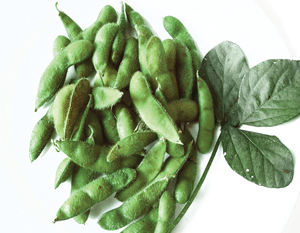
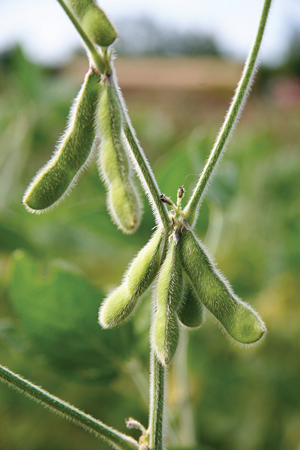
Pods are ready when the beans are big, almost touching within the pod, and the hairy pods are still bright green. The exact color of the pods does seem to vary between varieties, and is somewhat a matter of personal taste. As the beans age the flavor becomes more starchy, less sweet and nutty, so don’t wait too long! Edamame beans reach maximum sweetness a month after flowering. For manual harvesting, one pound of marketable pods per three feet of row is a reasonable expectation.
The optimum harvest window is only about five days. Usually a single harvest is the most efficient method. If the weather is hot, pull the plants and retire to the shade to pull the pods off the stems. Some pods will inevitably be immature, but most will be ready at once.
Selling the whole plant requires the least amount of time and labor: clip the leafy top part of the plant off and sell the plants with the pods attached, in bunches of four to six plants. When pods are kept on the stems, the crop maintains freshness and flavor. The beans retain high sugar levels for several days, and the quality remains at its peak.
You may want to clip the stems above soil level and leave the roots with their nitrogen-fixing bacteria in the soil. Some will scrape off and remain, even if you pull up the plants, which is quicker.
Edamame are not easily stored in pods for long. They need cool conditions with good air-flow to prevent molds growing. Washing, draining, and icing the beans before refrigerated storage in mesh bags is the method recommended in the University of Kentucky study. In Asia, the shelled beans are available as a frozen vegetable year-round.
Marketing
Several SARE projects have been researching edamame marketing. Go to http://mysare.org and search for Marketing Edamame Soybeans in Southeast Missouri and Marketing Edamame Soybeans in Kentucky.
Pam Dawling is the garden manager at Twin Oaks Community in central Virginia. Her book, Sustainable Market Farming: Intensive Vegetable Production on a Few Acres, is available at www.sustainablemarketfarming.com, or by mail order from Sustainable Market Farming, 138 Twin Oaks Road, Louisa, Virginia 23093. Enclose a check (made payable to Twin Oaks) for $40.45 including shipping. Pam’s blog is also on facebook.com/SustainableMarketFarming
Copyright Growing For Market Magazine.
All rights reserved. No portion of this article may be copied
in any manner for use other than by the subscriber without
permission from the publisher.