











In November of 2010, Steve and I attended our first national conference of the Association of Specialty Cut Flower Growers in Tulsa. At the airport, waiting for our plane home, we sat next to Dave Dowling of Farmhouse Flowers in Maryland and tried to soak up what last bits of information our brains could hold. As Dave walked away to board his plane, he said to us, “If you take one thing out of this conference, GROW LISIANTHUS!”
As soon as we got home, we ordered some plugs and so began the journey. The summer of 2011 we grew 1,100 lisianthus, in 2012 we grew 2,200, and this year we grew 4,200. We are planning to add more next season, too, as we can always sell more! Now we know why Dave was so straightforward—it is a moneymaker for sure, definitely worth the time, energy, and high tunnel space.
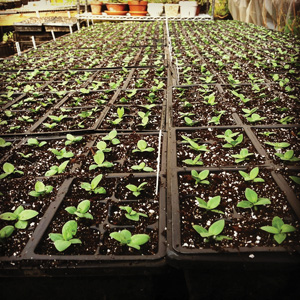
Seeding or buying plugs
I have found no organic source for lisianthus plugs, so you may have to start your own seeds if you are looking for organic. Seeds have to be started in December for bloom next summer, so you need heated winter space to grow them from seed.
We get our plugs from Raker in Michigan, ordered through Leo Berbee Co. in Ohio, but available through several other brokers including Harris Seeds, Germania, and Fred C. Gloeckner. If ordering plugs, you need to plan for 12 weeks of lead time — so order soon for spring planting. We have ours arrive March 1. They come in 288-cell trays (around $53/tray) and we bump them up to 72s upon arrival. We grow these in our propagation house for 4-5 weeks at 50 degree nights before transplanting. If you do not have heated space, the plugs could possibly be ordered later and be planted straight into unheated space, but it depends on your climate. We always plant ours as annuals, so have never left them in the tunnel for the following year, and do not know how profitable that use of space would be.
Transplanting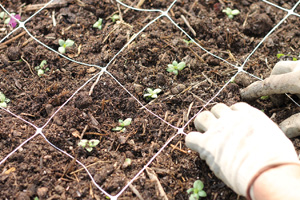
We plant ours into 30” raised beds in our high tunnel to which we add compost, feather meal, soft rock phosphate, and composted chicken manure. Some farmers grow them out in the field, but we tried and did not get the stem length or vigor we were looking for. As an experiment, we planted our first plugs on March 15 straight from the 288 cells into our heated greenhouse but they were still a little small, making them hard to weed. We hand watered them the first few times while the roots develop because drip may not do the trick since the root balls are so small. WE have concluded that it is better to bump the plugs up to 72s before planting.
We plant the 72s on April 9 into unheated tunnel space, five rows per bed, every 5 inches. We lay Hortonova netting on the beds to serve as a grid, and plant one plant per hole. Other growers will plant them two per hole, but for us the stems were too spindly and the harvest too tangly. Plus, we were concerned that reduced air flow might increase the risk of disease. We remove the Hortonova after planting so that we can get in to weed the beds more easily. When the plants start to stretch and the longer stems with buds are forming, we put the netting on the bed for support and then raise it as the plants grow.
Overwatering lisianthus can lead to Botrytis and other fungal issues. Drip irrigation is the best way to water because the petals do not like to get wet and can show damage if water sits on them—another reason why covered space is beneficial. We try to keep the beds as weed-free as possible, hoeing and weeding a few times, getting one last detailed weeding before putting the netting on. As the lisianthus is getting established, we water 2-3 times a week depending on the weather conditions. Once a week we fertigate with fish emulsion run through the drip tape. After the plants are a little more established, we cut it back to once every other week.
Harvesting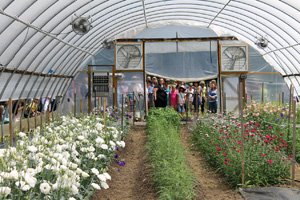
The first variety starts blooming July 4th and then the first flush of blooms lasts through the beginning of August. To get multiple blooms per stem, we deadhead the first bloom that appears (which hurts, I know, but it is for the good of the flower in the long run). With experience, you will become more familiar with the plant. The one that has to go is tucked down in the stem that will have lots of buds left to bloom and it will open and then start to wilt before the others are blooming. Since we sell by the bloom, that would be money down the drain if we harvested them for that first bloom. We harvest with three to four open blooms per stem, and we cut them hard leaving just a few sets of leaves on the plant. This gives us a long stem with many open, beautiful blooms. All stems get the bottom leaves stripped off at the processing table, not in the tunnel, in order to decrease debris in the walkway. We then bunch them with 40 open blooms per bunch, which are big bunches. We sleeve each bunch with a big Kraft paper sleeve we get from A-Roo which helps protect the stems in transit. Then off they go to the florist.
We get three to four stems per plant over a span of two to three weeks. The last stem may be more of a single bloomer, so it may not be as full as that amazing first stem you cut, but that’s why we bunch by bloom count and not by stem count. Once we are getting close to the end of cutting a certain color, we cut them all back, and in mid to late September we get a second flush of blooms. This year our second flush was about three weeks later than normal due to the cooler weather throughout the summer, making it last through October, which worked great for my end of the season weddings.
Varieties
There are lots to choose from, but our biggest sellers are the purple (or blue as some breeders call it) and white. The other colors sell, too, but we alwasy sell out of purple and white or use them in weddings. Who knew the purple wedding phase would stick around so long? People at market also are drawn to the purple.
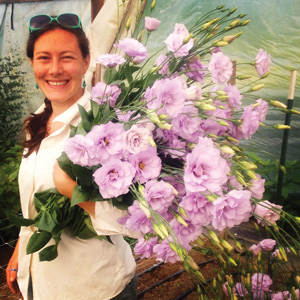
The verdict is still out on succession planting. When we first started we were told that lisianthus could not be forced into successions. But Emily Watson of Stems Cut Flowers in Wisconsin gets a second shipment of plugs five weeks after her first, which works to fill that August gap between the first and second flush of the first planting, but only gets the first flush of blooms off of the later planting. We plan out the varieties with different bloom times to create our own succession of blooms, planting them all at the same time. Next year, though, we will order a shipment of them earlier than normal to plant into our heated greenhouse space to see how much earlier we can get blooms.
We grow several series of lisianthus: ABC, Echo, Mariachi and Super Magic. The ABC series is numbered according to their sequence of bloom. Here are the varieties we grew this year by bloom sequence from first to last: Echo Blue, Echo Champagne, Echo Lavender, ABC 1 Yellow, ABC 2 Blue Rim, ABC 2 Green, Super Magic Green, Super Magic White, ABC 3 White, ABC 3 Purple, and Mariachi Carmine.
Echo Lavender is a great color, but from our experience has the weakest stems and the blooms bruise easily, so we will probably replace it with another variety. Also be aware that Echo Champagne means light peachy pink, not a cream color, although still pretty for being soft pink (goes well with Café Au Lait dahlias). Super Magic we only got because it was what was left at the plug supplier and we were so excited when we bought our refrigerated box truck this spring we thought, “We need to get more lisianthus to put on the truck!” We weren’t too impressed with Super Magic, because it grew too tall before blooming and the stems were very thin, not supporting the blooms and causing them to flop. So it will probably be replaced with more of a tried-and-true variety, and we will definitely add in some more Mariachis. We sell the Mariachi Carmine as “raspberry” and florists love it, although it is a little shorter than the rest.
Selling
Some florists are not used to seeing quality lisianthus, so are not aware of how awesome it can be. They also may not expect it to last long because shipped-in lisi can be smashed and moldy with just one bloom per stem. When they see a bunch of 40 open lisianthus blooms, and find out it lasts two weeks, they change their minds. Showing them the lisianthus in person definitely increased sales over just telling them over the phone or emailing a picture with availability list. Year to date, lisianthus is our fourth highest gross sales; we have sold 320 bunches to florists at $20 per bunch.
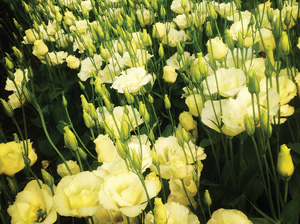
Lisianthus are great in wedding flowers. They can handle being out of water, so they work well in wearable flowers such as boutonnieres and floral crowns. Lisianthus works as a replacement for a rose in bouquets, especially the ABC series, which tend to look a little more double. Plus, the buds at the top of the stem give a different, more fluid dimension to a bouquet.
When we have extra lisianthus, we take them to market in 20-bloom bunches for $12. We have some pre-made bunches and some loose stems for people to add to their bouquets. When using them in market bouquets, they only go in the high-dollar ones. Our larger bouquet at market is $20, so the people who buy the standard $12 bouquet will either have to add lisianthus or buy a separate bunch of it. This year we didn’t have much left over for market, so people bought them quickly when we did have them. That’s part of the reason why we will grow more next year, to give the people what they want — that flower that they can never pronounce.
Moral of the story: GROW LISIANTHUS! We could not imagine our farm without lisianthus at this point.
Gretel and Steve Adams own Sunny Meadows Flower Farm in Columbus, Ohio. They will be speaking about cut flowers at the Great Plains Growers Conference Jan. 10-11, in St. Joseph, Missouri. www.greatplainsgrowers.org.
Copyright Growing For Market Magazine.
All rights reserved. No portion of this article may be copied
in any manner for use other than by the subscriber without
permission from the publisher.