



A Harvest Schedule is a list of which crops to expect when, perhaps including quantities. From this you can derive a Field Planting Schedule and a Transplant Production Schedule. Because the details of each farm’s harvest schedule are so individual, in this article I will mostly describe the steps you need to take to create your own, and point out some resources I’ve found useful.
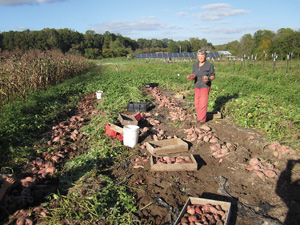
With a Harvest Schedule, you can pace yourself and your work through the growing season and have full CSA bags or groaning farmers market tables every week. You will have the information at your fingertips to let customers know when broccoli is likely to start, or cucumbers to end. You also can look at your Harvest Schedule for balance: some leafy crop each week, something brightly colored, something bulky and filling, something new and interesting, something highly flavored, and so on.
At Twin Oaks, we’ve identified accurate planning as one of the key factors that help us to keep good food on the tables year round. During the winter we spend a few hours each week working on some aspect of planning the coming year’s work. We have a Harvest Calendar listing dates and crops, but not quantities. The Twin Oaks Harvest Calendar by Starting Date and by Crop are available as PDFs on my website sustainablemarketfarming.com/2013/11/07/growing-for-market-articles-2/
If you are expanding or changing your farm significantly, you will need to pay close attention to the sequence of planning steps. If you only need to make small changes, the exact order of planning steps matters less, as a small adjustment can be made without seriously upsetting previous calculations. Nowadays we do our quantity calculations when we plan our field planting schedule, transplant production schedule and maps. For new farmers planning can be daunting, but each year it becomes easier, as you are only tweaking the plan you used last year. Some farmers prefer notebooks or loose-leaf binders, others are fond of electronic devices.
Planning sequence
Producing crops when you want them and in the right quantities is a complex task, and growers don’t control all the variables. To have the best chance of success, consider a logical sequence of decisions.
1. How much money you need, to make farming a sustainable livelihood.
2. Which markets to sell at (Farmers market, CSA, restaurants, wholesale, a mix).
3. Which crops to grow for the best chance of success.
4. When to sell (dates of the year).
5. What to sell (you’ll need diversity, not just big earners).
6. How much of what to harvest when, how often and over what length of time.
7. How much to plant to achieve this harvest goal.
8. How much to add as a margin for failures.
9. When to plant each sowing of each crop to meet the harvest date goals (you’ll need to know the length of the total harvest period for each planting).
10. When to sow for transplants (Greenhouse or Seedling Schedule).
11. Where in the fields to plant each sowing of each crop (mapping).
12. How to record results for next year’s planning.
13. What to do if something goes wrong (have a Plan B).
Resources
In Crop Planning for Organic Vegetable Growers, Daniel Brisebois and Frédéric Thériault use 11 steps to cover the above territory and also ordering seeds, planning the season’s work, reviewing the year and tweaking the plan for next year. They provide worksheets (Excel spreadsheets or PDFs) which can be downloaded blank. Their plain-spoken style and the step-by-step approach can save you from panicking or missing something important. Their book, and most of the others mentioned in this article, are available from growingformarket.com/store.
Crop planning usually goes best when farmers start with the money they intend to earn and then work from there to achieve that with the land, climate and markets they have. New growers are often advised to start with a farmers market rather than a CSA the first year, as you can sell a more erratic supply of crops at market. On the other hand, if you have experience from working on another farm, a commitment to careful planning, and you need that upfront beginning-of-season cash, you may decide to start a CSA right away.
The Iowa State University publication Determining Prices for CSA Share Boxes www.extension.iastate.edu/agdm/wholefarm/pdf/c5-19.pdf compares pricing based on what customers will pay, what other growers are selling the crop for and what it costs to produce. It includes a chart of share value of 24 crops based on grocery prices and the quantity included.
Some crops are more profitable in terms of time put in, some offer more money per area. Clifton Slade in his 43560 Project at Virginia State University aims to show how to earn $43,560 from one acre ($1 per square foot), which he says is four times the return of a typical large-scale commercial vegetable production. Clif chooses crops which produce one vegetable head or stalk, or 1 pound of produce, per square foot, using 5’ x 300’ raised beds. Leafy crops feature prominently. Clif reckons the cost of production is about $10,000 for one acre. See the Virginia Association for Biological Farming newsletter vabf.files.wordpress.com/2013/08/clif-slade-43560-demo-project.pdf.
Richard Wiswall in his Organic Farmer’s Business Handbook shows that outdoor kale can produce $2,463 from 1/10 acre, and of the crops he compared, only parsley and basil earned more. Field tomatoes came in at $1,872, and several vegetables (bush beans, sweet corn, peas) made a loss.
Mark Cain points out that they have 50% of their growing area in cut flowers and 50% in vegetables. The cut flowers bring in 75% of the income. Mark is a good mentor, especially for those using notebooks as well as spreadsheets. At www.drippingspringsgarden.com under the CSA tab, you can see their Harvest Schedule. Also see Planning for Your CSA: www.Slideshare.net (search for Crop Planning).
Steve Solomon in Gardening When it Counts provides tables of vegetable crops by the level of care they require. Bulb onions, leeks, Chinese cabbage, asparagus, celery and celeriac, cauliflower, Brussels sprouts, early cabbage and cantaloupe are on his Difficult list.
Vern Grubinger in Sustainable Vegetable Production from Start-up to Market explains how to make an enterprise budget for each crop. This concept was also explained by Liz Martin in GFM in February 2011. Record the weight or count of each crop at each harvest, the time spent harvesting and cleaning it, and the money raised from each crop each week. Combine this with records from your daily Crop Journal, where you record the amount of work done on each crop each time. At the end of the season, add up total time for each crop, and divide the income for that crop by the area, or number of beds. Aim for $400 per 100’ bed per season. She found a range from $109-1,065, averaging $1.11/minute worked. These calculations compare one crop with another, while not delving into overhead costs. Pumpkins were second highest in terms of income rate, but lowest for income/area.
There are reasons to grow certain crops even if they don’t make a good income: rounding out the variety of crop offerings, providing a good crop rotation for your farm, providing needed diversity (customers will only buy so much parsley and basil, they need other crops too). Cold-hardy winter crops provide for the “back end” of the year. Consult tables of cold-hardiness, and consider fall crops to harvest before serious cold, crops to keep growing into the winter, crops for all-winter harvests, and overwintering crops for early spring harvests. Consider your climate and what protection you can provide. Hoophouse growing offers the best results, but rowcovers and low tunnels can offer good returns too.
How much to harvest
If the average person eats 160-200 pounds of fresh vegetables per year (www.usda.gov/factbook/chapter2.pdf) and the average CSA share feeds 2 or 3 people, an annual share will need to include about 500 pounds of 40-50 different vegetables, distributed, say, once a week for 8 months and once a month for 4 months. Many CSAs have a shorter season than this – that’s your call. Estimate what you will need to provide (CSAs) or what you can sell, and write down when you want to harvest each crop. Then you will have a list of how much of what to harvest when, how often and over what length of time in the growing season.
John Jeavons in How to Grow More Vegetables has a chart Pounds Consumed per Year by the Average Person in the U.S. and another Average U.S. Yield in Pounds per 100 Square Feet. These are particularly useful to small-scale growers, and can be multiplied up by others.
The Center for Agroecology and Sustainable Food Systems at the University of California, Santa Cruz has a lot of useful information including a 30-page Crop Plan for a Hundred-Member CSA, with planting requirements including total bed length and acreage for a range of 36 crops in its Unit 4.5 CSA Crop Planning: casfs.ucsc.edu/education/instructional-resources/downloadable-pdf-files2 or directly at 63.249.122.224/wp-content/uploads/2010/05/4.5_CSA_crop_plan.pdf
How much to grow
The next step is to calculate how much to plant to achieve your harvest goals. Take likely yields and add a margin for failures (10%?). The table I provide in my book, Sustainable Market Farming and in Calculating How Much to Grow (GfM February 2012) lists 48 crops, along with likely yield, quantity required for 100 CSA shares, and length of row needed to grow this amount.
Jean-Paul Courtens of Roxbury Farm, a thousand-share CSA farm on 300 acres in Kinderhook, New York, has posted an impressive array of information at www.roxburyfarm.com. Under the Information for Farmers tab you’ll find the 100 Member CSA Plan, including a Weekly Share Plan, Greenhouse Schedule, and Field Planting and Seeding Schedule (with charts of possible crop yields). Some seed companies have tables of likely yields in their catalogs. See www.johnnyseeds.com/assets/information/vegetablecharts.pdf.
Deciding sowing dates
For this step you can use an online calculator, spreadsheets, or worksheets. Before delving into each of those, I’ll describe what you will be doing. Working back from a target date, you need the number of days to maturity (from the seed packet or the catalog). Check if that number is from seeding to harvest or transplant to harvest – some catalogs use one method, some the other. If the crop is to be transplanted and the catalog doesn’t include the time to grow the transplant, add that. Use your own experience or the catalog information, or somewhere in between. (In future years you will have your own records to customize your calculations).
Days to maturity in catalogs are generally for spring planting once conditions have warmed to the usual range for that crop. If you are pushing the season by starting early, add about 14 days, because seedlings grow slower when cold. As the season progresses, crops mature sooner than in spring. This should be considered when timing succession plantings. If you are pushing the season at the other end – growing late into the fall, after temperatures are cooling down beyond what’s comfortable for that crop, add about 14 days for that slowdown. Take into account the 4-6 Fahrenheit degrees of warming that row covers or tunnels provide.
“Days to Maturity” usually means “Days to First Harvest” which may not be the same as “Days to Full Harvest.” So you could add another 7-14 days to ensure you have a plentiful harvest when you do start.
Add all these numbers, subtract back from your target date, perhaps adding time to harvest a couple of days prior to sale. Bingo – out pops the sowing date. It is possible to do this without spreadsheets of course (farming is older than computers), but using a spreadsheet means you save time on calculations, and you can re-sort the schedule by sowing date. And with 50 crops, some of them sown five or more times, that’s a lot of calculations.
You’ll also need to know the length of the total harvest period for each planting, to calculate when that crop will end. For continuous supplies of popular summer crops such as beans, squash, cucumbers and sweet corn, as well as fast-turnaround crops like lettuce, you’ll need multiple sowings. These succession plantings each need planned sowing dates.
Then you can extract the dates to sow for transplants, and make your Greenhouse or Seedling Schedule.
Web-based CSA planning
AgSquared online planning software: www.agsquared.com includes a free 30-day trial. It includes tools for planning, operations and record-keeping. If you already have your plans on spreadsheets, you can import them to AgSquared – you don’t have to start over and type it all in. And once you’ve got your information in there, you can adjust a date or row length and the changes will automatically be made to the other relevant spreadsheets. And because space for recordkeeping is vast, you can include things like comments on the weather, which might be helpful later when you review the season.
COG-Pro is a record-keeping software made for Certified Organic Farms: cog-pro.com
The planning tools include prompts for information needed for certification. It uses a simple tabbed notebook appearance and generates reports for the certification process.
Free open-source database crop planning software is at code.google.com/p/cropplanning.
Mother Earth News offers an interactive Vegetable Garden Planner, also free for 30 days: www.motherearthnews.com/garden-planner.
Spreadsheets
The main value for us in using spreadsheets is that the program does the calculations. We enter how many cabbages we want, the in-row spacing and the row length, and out pops the number of rows. We can quickly switch to a different number to make a whole number of rows. Then we can enter the harvest date and the days to maturity and out pops the transplant date and the sowing date, along with the number of starts and the number of flats to sow. The second advantage of using spreadsheets is the ability to quickly sift out selected parts of the information and rearrange it to give us, say, a list with just the 46 lettuce sowings in date order, or just the crops planted in the East Garden, or the seed orders sorted by supplier, so we can print these out separately for ordering online. During the year we follow printed sheets – we don’t often go back to the computer.
Johnny’s Selected Seeds has an Excel spreadsheet called the Target Harvest Date Calculator: www.johnnyseeds.com/t-InteractiveTools.aspx. There are also Calculators for Seed Starting, Succession Planting and Fall Planting, and one for the number of seeds or plants for a given space.
At Growing Small Farms: www.growingsmallfarms.org click Farmer Resources, Farm Planning and Recordkeeping to download Joel Gruver’s spreadsheets on crop scheduling, field production and harvest planning. He tackles crop timing and quantities, and covers 31 popular crops. Josh Volk offers consultancy and spreadsheet-based crop-planning workshops; he wrote about spreadsheets in GFM, Nov/Dec 2010. www.slowhandfarm.com
Cindy Connor explains worksheets in her new book Grow a Sustainable Diet: homeplaceearth.wordpress.com/2013/08/13/grow-a-sustainable-diet-the-book. She also sells a DVD/CD set Develop a Sustainable Vegetable Garden Plan. Aimed primarily at homesteaders, the steps of assembling a notebook with your complete plan using worksheets will help you figure how many seeds and plants you need, when to plant and where, and when to expect a harvest.
How to improve
During the main growing season, we don’t do a lot of paperwork. We record planting dates and harvest start and finish dates on our Planting Schedule. At the beginning of the winter, we hold a Crop review, when we discuss and write up what worked and what didn’t, so that we learn from the experience and can do better next year. The total yield of each planting is also valuable information.
When I revise our schedules, I adjust harvest dates to halfway between what we had in print and whatever happened last year. This way we can gradually zero in on the likely date without wild pendulum swings to dates based on variable weather.
Pam Dawling is the garden manager at Twin Oaks Community in central Virginia. Some of this material is from her book, Sustainable Market Farming: Intensive Vegetable Production on a Few Acres, © Pamela Dawling and New Society Publishers, 2013. The book is available at www.sustainablemarketfarming.com, or by mail order from Sustainable Market Farming, 138 Twin Oaks Road, Louisa, Virginia 23093. Enclose a check (payable to Twin Oaks) for $40.45 including shipping. Pam’s blog is also on facebook.com/SustainableMarketFarming
Copyright Growing For Market Magazine.
All rights reserved. No portion of this article may be copied
in any manner for use other than by the subscriber without
permission from the publisher.