










Over 16 years, our farm has owned four vehicles for delivering produce. They ranged from small to quite large. Our current line-up includes an all-wheel drive station wagon for local errands and very light wholesale as well as a great Isuzu box truck that happily hauls 8-10 tons of cargo. I advise taking these steps before deciding what to purchase:
Evaluate your goals and needs as precisely as possible, especially the cargo area’s cubic footage. Hauling space is the key limiting factor. When we outgrew our cargo van, we tape-measured the actual usable areas of different vehicles (the cubic foot data given by manufacturers can include unusable space), then multiplied by 1.4 to find one with the space we need. That gave us expansion room for subsequent years of higher production. Since our CSA is the farm’s economic driver, we used the standard CSA box dimensions to then calculate how many subscribers’ cases (plus a typical or higher-than-normal wholesale load) we could fit into a given truck model, such that one delivery event could handle everybody. Older or injured farmers may also want a hydraulic lift gate; by the time I’m 65, I am sure I’ll need one.
Know your present and future delivery areas well! Spacious loading docks are rare in big cities; the more crowded the urban area, the smaller the delivery trucks you’ll see. Our farm no longer delivers to a few of our original restaurant accounts because our box truck is too wide to comfortably fit in congested old city streets.
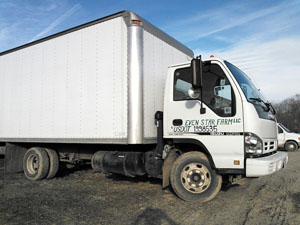
After doing lots of research, the author settled on an Isuzu box truck for deliveries.
Decide on diesel vs. gasoline (hybrid trucks are not readily available in the U.S.). Diesel engines last longer if properly maintained and typically can haul much more per gallon of fuel. It isn’t important that diesel costs more per gallon. For example, our Ford cargo van uses about $72 worth of gas to get to our main urban delivery zone, but can safely haul only about 1700 lbs. The Isuzu uses about $80 worth of diesel, but easily hauls 10,000 lbs. Diesel is effectively cheaper. Further, some models of diesel engines can be converted to biodiesel readily.
Assess whether you need a refrigeration unit. We cool our cargo area to 64° F during tomato season (lower temps would cause quality loss), but must minimally heat the cargo area in deep winter to prevent the packaged foods from freezing. I’d only get a refrigerated unit if we were primarily a berry or fig farm.
Consider appropriate vehicles from different manufacturers. The Sprinter-type is very attractive because it does superbly in cramped city streets, but when we compared both total cargo area and price per cubic foot of cargo area, we chose the Isuzu box truck (it was much bigger and cheaper). An 18-wheeler is certainly attractive, with plenty of room to grow into, but is way more truck than many produce farms need and performs badly in crowded streets.
Know your tolerance of risk. I prefer new rather than used equipment because there is already too much uncertainty in farming. I want the Deere to work every time, the Stihl chainsaws to perform even during hurricanes, and the Isuzu to reliably get food to our customers. If you are good mechanically and/or tolerate risk well, then a used truck is certainly worth considering. But be aware than although many tractors were designed for mostly straightforward, on-farm repairs, diesel trucks nearly always require a specialized diesel shop.
If you do decide on diesel, be sure that you have a skilled and reliable diesel repair company nearby. Otherwise go with gasoline. We now use the only great diesel shop within 30 miles of us. When we had our usually-trustworthy car repair company work on the Isuzu, they made a costly maintenance error that eventually cost us downtime and $1,400. Diesel and gas rarely mix, especially in the mechanic/repair shop world.
I love our Isuzu box truck because it hauls heavy loads with incredible fuel efficiency, because loading and unloading is a snap, and because its design is “cab-forward “ (i.e, the engine is under you rather than at the absolute front of the truck). That means I can back this into tight parking spaces as I would a Civic, even though the truck is nearly twice the length of a typical van.
Copyright Growing For Market Magazine.
All rights reserved. No portion of this article may be copied
in any manner for use other than by the subscriber without
permission from the publisher.