








In our gardens we use several kinds of mulch:
Our small fruit crops have landscape fabric or cardboard, topped by sawdust, wood chips or hay. I wrote about using landscape fabric for strawberries in the September 2013 issue of GFM.
Our asparagus has hay (though we used cardboard and sawdust once when we had a disastrous hay crop).
We use hay for garlic, potato onions, spring broccoli and cabbage, some tomatoes, eggplant, celery, chard, and summer planted potatoes.
We use a mow-killed, no-till rye and vetch mulch for our big planting of tomatoes and peppers. See the November 2013 GfM.
We used the regular black plastic mulch once, for strawberries, but we prefer to minimize our use of plastics because of the disposal problems.
We like the biodegradable plastic mulch for long-season warm weather crops, as it has the advantages of plastic without the disposal issue.
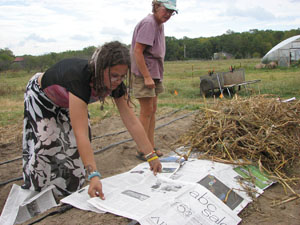 Above: The author, standing, supervises the mulching of new strawberry beds with a double layer of newspaper topped with organic mulch. Photo by Luke J. Stovall.
Advantages and costs
The main advantage of mulch is weed control, including a reduced weed seed-bank. Mulches also conserve moisture, which can mean higher yields and less need to water. Plastic mulches raise soil temperature, making a big difference in spring to growth and maturity. Organic mulches keep temperatures lower in summer. Mulches reduce rain splash, helping prevent fungal disease and increase marketable yield. Organic mulches improve soil structure and organic matter. No-till mulches including legumes can add nitrogen to the soil.
The costs of mulching include materials and labor – for hauling, applying the mulch and sometimes for removing it. There are reduced costs in cultivation time.
Organic mulches
Organic mulches reduce afternoon soil temperatures in summer and maintain higher soil moisture levels than bare soil or plastic mulch. The full-season yield is highest with organic mulches, but the early yield is higher with plastic, because plastic mulches warm the soil. Bulky organic mulches insulate the soil, reducing temperature fluctuations to the benefit of the plants. Spring brassicas do well with organic mulches spread before soil temperatures reach 60°F, as do potatoes after hilling.
Unlike synthetic mulches, organic mulches contribute to the soil organic matter. The earthworm count at season’s end can be twice as high as under plastic mulch. Excessive use of hay mulch can lead to high soil potassium and magnesium levels, and low available calcium levels. If your available soil calcium is low, you would benefit from using aged tree leaves, rather than hay or straw.
If we had straw we’d use it, but there is little grain grown in our area. Straw has few seeds and is longer-lasting than 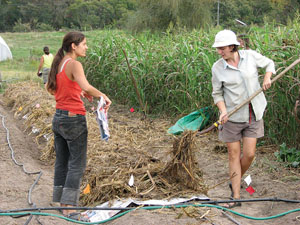 hay. Most farms can grow some hay themselves. We use spoiled hay that isn’t suitable for feeding our cattle, so we have to contend with some mold and slime. Ah, but the price is right! The large round bales are convenient for mulching, if you plan your rows to be 5-5½’ apart. For warm weather crops, it is often best to wait for a month after planting out, remove one round of weeds, then roll out the mulch. Few weeds other than perennial grasses will come up through a 4” layer of hay. For cool weather plants in spring, we roll the mulch then make “nests”- holes at the required spacing – down through the mulch to the soil, using two hands to open up a round hole. After all the nests are made, we transplant the crop and close the hay at soil level back around the stems.
Beware purchased hay! There is a class of herbicides which can persist in hay and kill your crops when it is used as a mulch. It can also pass through animals fed on treated grass or hay into the manure, through composting, and still be dangerous. For a list of herbicides and brand names, see the North Carolina State University Publication “Herbicide Carryover in Hay, Manure, Compost, and Grass Clippings)”. http://www.ces.ncsu.edu/fletcher/programs/ncorganic/special-pubs/herbicide_carryover.pdf
It is possible to spread hay or straw over a double layer of newspaper pages. (For large areas and large plants, cardboard can be used in place of newspaper.) Only half as much hay or straw is needed, compared to mulching with straw alone, and the final result is only half as deep. This is an advantage when transplanting small plants, which can get lost in deep organic mulch. We avoid using glossy paper with colored inks, because of concerns about toxicity of the inks and the paper coatings. I believe the colored inks used on regular newsprint are not toxic.
Standard plastic mulches
Many growers use a tractor-mounted plastic layer and bed shaper to form beds, lay drip tape and plastic mulch in a single pass. The wheel tracks are often then mulched with straw, which helps absorb rain run-off, deter weed growth, and add some organic matter. Another technique is to prepare beds in the fall, cover with plastic mulch, and sow the aisles densely with rye. When the rye is waist high in spring, run the tractor through the field, flattening the rye to mulch the aisles. Others with plastic-mulched beds use clean cultivation in the paths.
For maximum soil warming with plastic mulches, aim for an even soil surface. Air spaces between the mulch and the soil surface caused by rough cloddy soil reduce the warming effect. We lay plastic mulch manually and despite using some very rough soil surfaces, we still get a good amount of soil warming.
Researchers are busy improving on the standard black plastic mulch. Various colored mulches have been found to be good for different applications. White-on-black or metallized silver plastics are used in hot areas in the summer to avoid heating the soil. Or black plastic can be painted with white latex paint diluted with water (1:5), once the weather has warmed enough. (Check with your certifier if you are USDA Organic.) Green is even better than clear plastic for warming the soil, because weed seeds don’t germinate – all the green light is absorbed by the mulch. Red, blue, yellow, gray and orange plastics have uses for particular crops.
It may be possible to get a second year of use from black plastic by mowing off the finished first crop and transplanting a second crop, either in the same holes, or new ones. I believe this works best if the second crop is one that sprawls and covers the used plastic and its rips and punctures. Melons would be a good candidate. In Virginia, Clif Slade recommends pulling up strawberry plants in mid-June as soon as harvest is over and sowing cantaloupe seed in every hole, for a harvest until early September. Then by 9/15 transplant collards in every other hole. Next spring, pull the collards and sow sweet corn, 2 seeds per hole, for August harvest. The corn will be 10-14 days earlier than if sown in bare soil. This makes good use of the plastic mulch, but for organic growers the challenge is to keep the soil fertility up. Organic fertilizer injection through the drip tape could work.
While the up-front cost of regular plastic mulch is much less than biodegradable plastic or paper, the additional labor cost for removal is substantial. USDA Organic regulations currently require all synthetic mulches to be removed from the soil at the end of the growing season.
Biodegradable plastics
These are relatively new. BioTelo and Eco-One are the main brands. BioTelo and Bio360 are made in Italy from a “biopolymer” called Mater-Bi. See http://www.duboisag.com/en/plasticulture/biodegradable-compostable-mulch-films/biodegradable-mulch-films.html. BioTelo mulch is approved for use on organic farms in Europe and Canada, but not yet on USDA-certified Organic farms. Johnny’s Selected Seeds sells Bio360, described as “Made of Mater-Bi®, a non-GMO corn starch-based raw material which allows micro organisms in the soil, combined with water, carbon dioxide, and biomass, to degrade the mulch. Degrades in four to six months depending on conditions.” Eco-One is made in Canada, and classified as oxo-biogradable: “Laboratory studies indicate that this degradable plastic breaks down into CO2, H2O and biomass without toxic residues.” (from their website http://www.eco-light.net/eco-one.aspx). The National Organic Standards Board has been petitioned to allow use of biodegradable plastic mulches on Organic farms, and a decision may be made later this year.
Biodegradable mulches need to be distinguished from photodegradable mulches which break down in sunlight into small pieces, but are not necessarily reduced to simple molecules or organic mater as the biodegradable ones are. See the 2014-2015 New England Vegetable Management Guide, Biodegradable Plastic Mulch http://nevegetable.org/cultural-practices/plastic-mulch-films for more details.
The bioplastic comes in 0.5-0.8 mil thicknesses, thinner than regular plastic mulch (1.25 mil). It is somewhat fragile – extra care is needed to prevent tears. Try not to store it! Buy just what you need for one year. If you have to, store it in the dark, on end, well wrapped. If stored flat, the layers can stick together under the weight of the roll. The cost is about 2½ times that of regular black plastic, but there are no removal and disposal costs. The following year there will be some scraps left on the soil surface. Next time you till them in, the soil micro-organisms will cause the final biodegradation.
When laying bioplastics, do not stretch as tightly as you normally would with black plastic. Rolling in the early morning when temperatures are cooler can help prevent over-stretching. (The mulch breaks down more quickly when stretched.) Apply right before planting because it will start to break down as soon as it makes soil contact.
Bioplastics are ideal for crops which will cover the whole area when they mature, such as watermelon. The foliage will take over from the plastic to inhibit weed growth. Like other plastics, these mulches will accelerate the rate of growth of plants in spring, meaning you can have melons a month earlier than on bare soil. For long-season upright crops, such as peppers and trellised tomatoes, the mulch will warm the soil initially. Later, as the bioplastic starts to disintegrate, it can be covered with an organic mulch, keeping the soil cooler in high summer.
We lay bioplastics manually. We set out the drip tape, then form a team of six people: two to unroll the plastic and the others to shovel soil. This is best viewed as an Olympic team sport, as it is undeniably aerobic and needs endurance. But it can be done! The full rolls are heavy and need to be laid on the ground and pushed to unroll, or pulled using a rope threaded through the inside of the roll. The unrollers need to pay attention to not get too far ahead of the shovelers. The job of the two “forward shovelers” is to put a shovelful of soil every yard to hold down the edges. The “rear shovelers” then complete the coverage of the edges. If we are covering raised beds, the soil comes from the paths below the bed height. It can be hard to get soil to stick on sloping edges if it is too dry. For some crops, such as watermelons, we do “wall-to-wall” mulching across the whole flat patch. In this case the second edge of each run of plastic will be covered by the overlapping edge of the next run, so we only put enough soil on the edge which will be overlapped to keep it in place until the next run is in place. Then we fully cover the overlap with soil. Any rips or random holes that happen can be held down by rocks or clumps of soil.
When we transplant through this mulch into uneven soil (not recommended!), we use rocks to support the edge of the drip tape in the best position relative to the plant, or to hold the plastic down next to the plant. Small rocks always seem plentiful! It is easy to make holes in this plastic with your fingers. It is recommended to make round holes rather than slits, which could rip further.
Landscape fabric
Landscape fabric is a more expensive, durable plastic mulch. The price is about eight times that of regular plastic mulch. Some growers use the fabric for vegetable crops or strawberries many times, by burning planting holes at regular intervals using a small propane blowtorch (carefully!) If you have permanent raised beds you can plan to get 5-10 years from the landscape fabric and make holes ahead of time appropriate to the crops you will grow. Use landscape fabric without organic mulch on top, if you need to avoid the problem of crickets in late summer.
Issues around plastics
Agricultural plastics are sometimes burned at the end of the season, releasing dioxins and other pollutants. Or they are sometimes tilled under, or baled and stored behind the barn, waiting for a miracle. Work is underway to make recycling of agricultural plastics easier. Plastic mulch and drip tape are made of recyclable low density polyethylene, a material which can be used to make plastic “lumber” for decking, railroad ties, etc. A few states have had pilot programs for agricultural plastics, but dirty plastics are not easy to recycle. As much as 45% of the weight of baled plastic mulch and drip tape is soil, plant debris and other trash. Cleaning large volumes is expensive. The black coloring also causes problems in recycled plastic boards – not just aesthetically – the dark color absorbs more heat and the boards sag. Research is being done into making fuel nuggets from waste film plastics. The energy content of polyethylene is almost as high as fuel oil. Conversion into (back into?) oil is also being investigated.
One key to increasing the use of waste plastic mulch is collecting a large quantity. Compacting into dense bales improves the efficiency of handling and transportation.
Winter-killed mulches
Winter cover crops such as rye, crimson clover and hairy vetch can be mowed as they begin to flower and then left in place to act as a mulch. Large transplants such as tomatoes can then be planted into the no-till patch, using a small shovel to dig the holes. There are some tools and machines to cut slots and set out transplants in a field with mow-killed mulch. If rye is used, germination inhibitors exuded by the roots deter weeds from germinating for several weeks. When the cover crop rots down, additional mulch (or regular mowing) will be needed to control weeds for the rest of the season. If the stand of the cover crop has been dense enough and a high-yielding legume was used, the cover crop alone may supply all the nitrogen needs for the food crop.
No-till planting is also possible into winter-killed cover crops in the spring. Oats are a popular winter-killed mulch. Late summer sowings of frost tender crops such as soybeans, cowpeas or sorghum-sudan grass can also work well. These all leave an in-situ mulch of dead organic matter. No-till spring plantings are not appropriate for heat-loving crops such as melons, as the untilled soil is slow to warm up in spring.
Editor’s Note: We will cover paper mulches in an upcoming issue.
Pam Dawling is the garden manager at Twin Oaks Community in central Virginia. Some of this material is from her book, Sustainable Market Farming: Intensive Vegetable Production on a Few Acres,
© Pamela Dawling and New Society Publishers, 2013. The book is available at www.sustainablemarketfarming.com, or by mail order from Sustainable Market Farming, 138 Twin Oaks Road, Louisa, Virginia 23093. Enclose a check (payable to Twin Oaks) for $40.45 including shipping. Pam’s blog is also on facebook.com/SustainableMarketFarming
Copyright Growing For Market Magazine.
All rights reserved. No portion of this article may be copied
in any manner for use other than by the subscriber without
permission from the publisher.