











In our years as a market farm near Columbia, Missouri, we became known in the community for our diverse garlic. This crop consisted of 12 or so varieties with distinct culinary qualities and uses, which we presented on our market stand using methods that attracted and informed consumers while maximizing our income from the many sizes and variations inherent in our garlic crop. We found that customers really responded to our presentation of garlic as a diverse ingredient that could be targeted to specific culinary uses. This allowed us to charge higher prices than for garlic presented as a bulk commodity crop, and attracted a loyal following of customers who sought out our garlic and then bought other items as well. Growing around 2,000 heads per year, from which we saved our own planting stock, diverse garlic became an important part of our farm’s offerings and remains so in our current incarnation as a CSA.
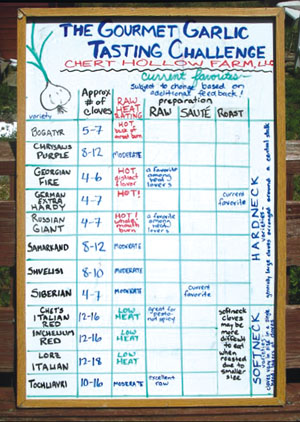 Chert Hollow’s signboard has information about their varieties, and is used to encourage shoppers to do their own variety trials by participating in the “Gourmet Garlic Tasting Challenge.” All photos courtesy of Chert Hollow Farm.
Growing and handling
The choice to manage and market many varieties of garlic was based on several factors, both agricultural and culinary:
Marketing multiple varieties of garlic requires more recordkeeping, labeling, and general attention to detail than managing one variety, but the diversity can be used to command a higher price.
A range of maturity dates for different varieties allows the harvest and handling to be spread out over several weeks. Diversity provides some resilience to crop failure. Though we were affected by the 2012 garlic problems that plagued much of the Midwest, not all varieties were affected uniformly, and we used failures to guide us in culling especially problematic varieties.
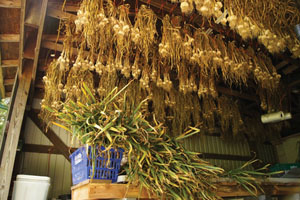
A late-maturing variety is being sorted on the table, with early-maturing varieties already drying down in the rafters.
Diverse varieties also differ in clove counts & sizes, with implications in the kitchen and economically. Softnecks tend to have the highest clove counts per head and are thus economical to replant, because a smaller percentage of the crop needs to be saved for replanting. The typically lower-clove-count hardnecks are easy to use in the kitchen but require a higher percentage of crop be saved to replant; we’ve found that marketing the scapes can make up the economic difference. We rejected trying to price varieties by clove count, choosing to use the same pricing structure for all varieties for simplicity’s sake. We found that high-clove-count hardnecks, such as Samarkand, are especially worthwhile for our approach.
Finally, flavor variations are a major motivation in growing diverse varieties, and are discussed further below.
During harvest, each variety is placed separately into containers that we label in consultation with the planting records. At the barn, we use our homemade garlic grader (described below) to sort the harvest into four size categories, keeping records of the size distributions for each variety: a very useful data set for assessing varieties over time and for forecasting income potential for the crop. Heads are bundled by size category and hung from the rafters in organized, labeled fashion, so that we could always find the proper bundles needed for a given market day, restaurant sale, or (now) CSA distribution.
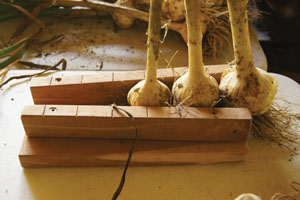 A homemade garlic grader is used to sort heads into size categories at harvest time and to assign prices at the market stand. To use, swipe one head at a time and observe where the midpoint of the head intersects the wooden funnel.
Size grading and pricing
At market, we sold our garlic by size, not weight or count, using a homemade size grader cobbled together from scraps of our own milled cedar wood. This funnel-shaped device sat on the market stand in easy reach and view, marked with various gradations. Any garlic head could be swiped quickly into the funnel, and its size and corresponding price could be easily read by looking at the location that the midpoint of the head met the funnel. We found this far more efficient and accurate for pricing garlic of variable size compared to weighing, and more economically sensible than assigning a lump unit price to garlic of various sizes. Customers loved this system, as it was far more visually intuitive to them than a weight-based system, and the swipe-testing of garlic heads became a pleasurable ritual. We priced garlic on a sliding scale, adding $0.50 for every ¼ inch of diameter, ranging from 1.25-1.5” for $1 to >2.25” diameter for $3. Using this system, we generally sold 100-150 heads per week, with most of our heads falling in the $2.00-$3.00 (1.75”-2.25”+) range, despite multiple other market vendors offering bulk garlic in bins for far cheaper. We generally tried to keep a range of head sizes available at all times, since some customers gravitated towards huge heads, and others were unwilling to part with more than $1 for a head.
Market display rack
We built a simple but attractive display rack using cedar wood cut & milled on our farm. The gently tiered structure with its internal divisions kept each variety separated and distinct, while keeping everything visible & attractive from a distance. It also kept heads in their proper place, not rolling around, and possibly off, the table.
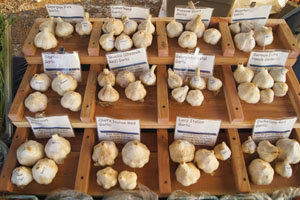 Chert Hollow Farm made a wooden display board to sell up to 12 varieties of garlic.
We brought garlic to market still bundled with its stalks, and hung these bundles around the back of our market tent where it was clearly visible and could help draw in customers. We only cut down enough heads to fill the display rack with 3-4 of each type, cutting down new ones as needed to restock. Thus our back stock remained whole, and most unsold stock could be rehung after market for another week, as we felt it stored better that way.
Variety distinctions
We designed and printed basic information cards for each variety, presenting its name and culinary qualities/uses. We also set up a white board with a comparative grid of garlic virtues, for easy customer reference. Customers were very interested in the ability to choose among a variety of specific uses and target their garlic to their culinary needs for the week. Our standard distinctions included:
Spicy raw: great for salsa, gazpacho
Mild raw: great for salad dressing, pesto (no aftertaste desired)
Roasters: extra sweet when roasted
General purpose: can’t go wrong
Large clove size: good for people who cook a lot
Small clove size: good for people who just want a hint of garlic at a time
We arranged our varieties in a consistent and logical order to facilitate customer interaction; our hot varieties ran across the top of the display rack, with general purpose varieties in the middle, and mild varieties at the bottom. Customers were less overwhelmed by the choices presented when they could easily understand the organization of the options. We labeled heads on request, using strips of masking tape and a quickly scrawled version of the name; this took momentary time but we didn’t feel it slowed us down too much. Slow moments at the stand also gave us time to pre-label some heads.
Other marketing
We held a garlic-tasting event on the farm, in which many of our varieties were presented in a number of taste tests including raw, roasted, and garlic butter. Participants, clearly serious fans of garlic, had a great time filling out data sheets while overwhelming their taste buds! We used the feedback from this event to further refine our marketing descriptions, since we could now cite direct customer feedback for the product. In addition, having invited the local newspaper’s food editor to the event, the resulting article boosted our profile even more.
We also presented a “tasting challenge” for customers who purchased multiple labeled heads, sending them home with a tasting data sheet. Anyone bringing back a sheet was invited to a special event on the farm, culminating in a drawing for a collection of one each of all our varieties. The tasting challenge sign was very effective at drawing in new customers who often expressed wonderment at the idea that garlic wasn’t just a monolithic commodity.
Non-market contexts
Though we have since transitioned our farm to a CSA model, we still treat our garlic as a diverse specialty crop, treating it similarly to other crops with different uses like sweet/hot peppers and diverse tomatoes. This makes members’ shares, and home cooking, more interesting and raises the value of their memberships. Targeted promotion of garlic varieties could have benefits in wholesale settings as well, whether for specialty groceries who wish to offer a market-like display of options, or for a restaurant interested in a specific type of garlic for a specific use. Plus, our marketing has worked on us; how could we ever get by in the kitchen with just one garlic variety?
Eric and Joanna Reuter own Chert Hollow Farm in Boone County, Missouri. They can be reached at contactus@cherthollowfarm.com.
Copyright Growing For Market Magazine.
All rights reserved. No portion of this article may be copied
in any manner for use other than by the subscriber without
permission from the publisher.