











There are many types of clover used to discourage weeds, add nitrogen and biomass to the soil, and prevent erosion. In addition, clovers attract beneficial insects and reduce aphids. The main uses for clovers are: as overwinter cover crops; green fallow (full-year cover crops); undersown in existing food crops; and no-till or reduced-till crop sowings in standing clover. I’ll talk about each of the uses we have tried, and look at the various types of clover and their requirements.
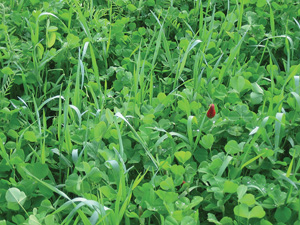 Crimson clover starting to flower. Photo by Kathryn Simmons.
We use crimson clover in over-wintering cover crops in our rotation: For maximum nitrogen, we mow and incorporate cover crops as they start to flower. A good leguminous cover crop can provide all the nitrogen the following crop will need. We spread compost for our late crops only if we had poor luck with the legumes. Crimson clover is our favorite clover for over-wintering. Red clover would also work, but grows less biomass.
To get best value from crimson clover we need to wait until mid-April at the very earliest for flowers, before we turn it under. Our records show that it starts to flower here in central Virginia from 4/16-5/2, most usually around 4/20. So the following crop needs to be planted after late April. Suitable crops that we grow after crimson clover include winter squash and pumpkins, June-planted potatoes, watermelons, sweet potatoes, and mid-season and late successions of sweet corn. Fall brassicas are another category of suitably timed crops. An overwintered cover crop mix of winter rye and crimson clover or hairy vetch could be disked in at flowering, and be followed by a short-term, warm-weather cover before the brassicas.
Looking at the other end of crimson clover’s life-cycle, it is best sown here before September 20 (although we sometimes go as late as 10/14, our average first frost date), so it has to follow a crop that is finished by then. Our list of crops that can be followed by crimson clover is very similar to the list that has time to grow after crimson clover: later corn plantings, June-planted potatoes, watermelons and sometimes tomatoes and peppers (if we have an early frost).
The sequence is: crop finished by end of September/crimson clover/crop planted after late April. We manage to use crimson clover in almost half of our winter cover crop mixes. Here are details from our rotation:
The tomatoes and peppers to watermelons transition. After the frosts end the nightshade harvests, we sow winter wheat or rye with crimson clover or Austrian winter peas, which have time to flower before the next year’s watermelons. There is time in the spring for leguminous winter cover crops such as crimson clover, hairy vetch or (in zones 7–9) Austrian winter peas to reach the flowering stage before we need to transplant watermelon, around May 11.
Our watermelon is followed by our three mid-season sweet corn successions the following year, sown in June and early July. Once we have harvested enough watermelon, we disk the patch and sow a winter cover crop of wheat or rye with crimson clover (if before Oct 14, as is usual) or Austrian winter peas (if later).
Corn successions 3, 4 & 5 finish early enough to be followed by more wheat or rye and crimson clover in early October. Sweet corn speeds up in ripening in summer, quicker than the catalog spring numbers. The crop following mid-season corn is the June potatoes.
The June-planted white potatoes are harvested before the first frost (average Oct 14) if possible, and can be followed by wheat or rye with crimson clover and/or winter peas. Often we are too late for crimson clover for this transition. Winter peas don’t provide as much nitrogen as clover, so if we have used peas, we might supplement with some compost. The year following the June white potatoes, we grow winter squash, sown late May.
When clovers are unsuitable
If crops finish too late for clover, we plant winter rye or wheat and Austrian winter peas (which can be sown here as late as November 8). Other winter cover crops in our rotation include oats and soy to be winter-killed. We also use hairy vetch with Austrian winter peas and winter rye, for a no-till cover crop before our paste tomatoes. The hardiest cover crop is winter rye, so we use this alone to follow crops we don’t clear until the middle of November, a month past our average frost date.
It is usual to avoid legume cover crops ahead of legume food crops, to reduce the likelihood of spreading pests or diseases. However, we routinely choose to add soybeans to our summer cover crop mixes and Austrian winter peas or crimson clover to our winter mixes, because we value the benefits of legume cover crops. We haven’t seen any problem that we can directly blame on a poor rotation, and until that happens we’ll likely continue to add legumes frequently, to increase the soil organic matter, feed the soil microorganisms and support the nutrient cycle. Beware beets, buckwheat and legumes such as red and crimson clovers, and some peas and beans, before white potatoes, as these can host Rhizoctonia and scab.
Green fallow
Full year cover crops (green fallow) using perennials or biennials such as clovers can build soil fertility. When we set up our ten-year rotation in a more organized fashion, following Eliot Coleman’s method in The New Organic Grower, we discovered to our surprise that we had a plot “spare,” which we now use to grow a mix of clovers for a whole year to replenish the soil and reduce annual weeds. We establish this clover mix by undersowing our fall brassicas in August, to form a green fallow crop for the whole of the following year.
Our system for fall broccoli, cauliflower and cabbage uses a fast turnaround. We plant potatoes (Irish potatoes) mid-March, harvest mid-July, spread compost, and disk it in. Then we transplant the broccoli, cauliflower and cabbage right away. And so we get two food crops in one year and none the next from that plot. Plus it is ready early the following year for our first corn planting.
A couple of weeks after transplanting the brassicas (August), we set aside the rowcover or ProtekNet (needed to keep the bugs off), stakes and ropes and the sticks we use to hold down the cover edges, then hoe and till between the rows. In recent years we have taken to using wheel hoes, rather than tilling. We can uncover sections of plants to wheel hoe, then re-cover if needed. We can more easily work around the obstacles which we couldn’t do with the tiller, and we don’t have to deal with a whole row or nothing. The wheel hoe stays shallower than the tiller, so bringing up fewer new weed seeds. Plus, no noise, no gasoline! We like our wheel hoes from Valley Oak, which have metal frames with adjustable handle height.
A month after transplanting (late August-early September), we cultivate again and sow a mix of clovers, usually 1 oz crimson clover, 1 oz white Ladino clover and 2 oz common red clover (medium, multi-cut) per 100 square feet. There are three main types of white clover: the lowest growing type (Wild White) is used for high traffic areas like orchard alleys; the intermediate-height range (up to 12”) includes Dutch White and New Zealand White; and the large (12-15”) type, Ladino, produces the most biomass and the most N. It is not as durable or as heat-tolerant as the intermediate types, and is later to flower. Don’t use mammoth red clover if you want to mow more than once. The crimson clover is the fastest growing in the fall, and the others gradually take over in the spring and summer of the next year. We like watching the progression from crimson clover to red to white as each type comes into its strength.
Previously, we used an Earthway seeder on a shallow setting, with the “light carrot” plate, to sow four rows of red clover, white clover and crimson clover between each pair of brassica rows. The clover rows were about six inches apart, the brassicas about 34”. Nowadays we simply broadcast the pre-mixed clover seed. Although we have drip tape for the brassicas, we usually need overhead irrigation to get the clover germinated, which also helps cool the brassicas. The ideal is to keep the soil surface damp for the few days it takes the clover to germinate. Usually watering every two days is enough.
Usually the cover crop is relatively weed-free due to the intensive cultivations of the first seven months of the year. We plan to keep the clover growing for the whole next season, mowing several times to control annual weeds. With cover crops it’s always wise to have a back-up plan, in case things don’t work out as you hope.
In spring, we bush hog the old brassica stumps and let the clover flourish. In late April, we assess the clovers. If there are too many perennial weeds, or the clover did not germinate well enough, we disk the patch and plant a mix of warm weather cover crops, such as buckwheat, soy and sorghum-sudangrass hybrid, for the rest of that season. This gets mowed to 12” whenever the sorghum-sudan is 4’ tall, to encourage deeper rooting for better soil drainage. It can continue growing until killed by the frost. If the plot is not too weedy, we keep the clover, mowing once a month or so to prevent the crimson clover and the annual weeds from seeding. I have often been surprised at how a patch that looks thin and weedy in March and April can look really good again by May, and incredibly lush by the end of June.
In July, we assess again. If the weeds are bad then, we disk in the clovers and sow sorghum-sudangrass mixed with soy. While this deals effectively with the weeds, it is a poor crop rotation, as the next year’s crop in that patch is early sweet corn, which is related to sorghum-sudan. Once we get to August, if the weeds are gaining the upper hand then, sowing oats (perhaps mixed with soy) is a better bet. If the clover is still growing well (as it usually is), and the weeds are not too bad, we leave the green fallow to overwinter, and disk it in February, a year and a half after sowing.
Clovers undersown in existing food crops
You can undersow a spring vegetable crop with white clover to take over after the spring food crop is finished, if you don’t plan on another food crop. You can also use this technique for summer vining crops like winter squash, pumpkins or watermelon, if not on plastic mulch, provided the cover crop between the rows is low-growing and will not compete with the crop or it is progressively mow-killed or tilled in as the vines expand.
A method from New York State, is to undersow summer vining crops with crimson clover when the vines are just starting to run. If necessary, fold the vines over to one side to cultivate and sow, then fold them back over the other side to deal with the next aisle. Cucurbits don’t like to have their vines turned upside down, so be sure to restore order before leaving the field. The clover germinates OK in the low light levels under the squash, and survives foot traffic. Financially, this is probably only worthwhile if the clover grows for a full year. We tried this undersowing scheme in central Virginia with winter squash and pumpkins and it was a hopeless failure, as the vines grew so much faster than the clover and smothered it.
We also tried undersowing corn with crimson clover, another method from NY. The corn can be mowed after harvest, and the clover left to grow over the winter. In the South, corn and squash grow too fast compared to clover for this scheme to work. It is difficult in Virginia to get the clover to germinate in the heat and dryness of June and July. Soy is much easier to deal with, and cheaper.
No-till in standing clover
No-till corn planting into strips tilled in a white clover “living mulch” sounds good but has been found tricky, especially during the grower’s learning curve. Jeanine Davis of North Carolina State University addresses this in Organic Sweet Corn Production. The clover may out-compete the corn, becoming invasive and hard to get rid of. Soil temperatures will be lower (a disadvantage in spring) and slugs and rodents may abound. Undersowing month-old corn with white clover is a possible alternative.
For years I have kept a note that planting crimson clover in the fall before transplanting eggplant (into the clover) will reduce flea beetle outbreaks, but I have yet to try it. At the Coastal Plain Experiment Station in Tifton, Georgia, they are trying peanuts interplanted with crimson clover.
Choosing clovers
Heights given below are when planted with a grass crop. Alone they sprawl. When sowing in mixes with cereal grasses, use the same amount as when sowing alone, and sow on the dates for the grass. “Frost Seeding” means broadcast clover seed on prepared soil, early in the morning after a hard frost. The thawing will wet the seeds and pull them down into the soil.
White clovers are perennials used as winter annuals in the South. Good for all-year cover, they tolerate foot traffic, so make a good cover for fruit plantings. The dwarf type is not a good choice to mix with grasses. Has stolons, so good at re-growing after mowing. Competes poorly with weeds until well established. Water frequently until established. Drought tolerant. Generally hardier than red clovers, and smaller. Can be frost-seeded in very early spring (2/15-3/15 in central Virginia). Or sow in fall, at least 6 weeks before a hard frost, to ensure winter survival. Only sow in summer if you can keep the soil damp.
Use 5-9 lbs/acre if drilling, or 7-14 lbs/acre broadcast (1.5oz/100 sq ft). Hardy to −20°F. Crimson clover is a deep-rooting annual, 18” tall, or even 36” with grasses. Shade tolerant. Attracts beneficials, including assassin bugs which eat Colorado Potato Beetle. Suppresses Italian ryegrass. Fall sown crops make fast growth in spring. Provides lots of nitrogen. Usually sown in the late summer or fall (7/15-10/10 in central Virginia). Can also be sown in very early spring, but will not make much growth before flowering (in our climate at least).
Use 15-18 lbs/acre drilled, 22-25 lbs/acre broadcast (2-3 oz/100 sq ft). If seed is not raked in, increase the seeding rate and ensure adequate irrigation. Hardy to 10°F.
Red clovers including Medium (multi-cut) or Mammoth (single cut), grow 24-36” tall. Short-lived perennials. Mammoth is easier to establish in dry soils than Medium, faster growing, more biomass, but less good at re-growing after mowing. Cheap. Best incorporated after a full season of growth (needs time to bulk up). Good weed suppression. Tolerates shade and poor drainage (not flooding). Attracts beneficial insects. In the south sow in fall or spring, ideally 30 days before first fall frost, and 30 days before last spring frost. In zone 7, frost seeded 2/15– 3/15. In the north, from 45 days before last frost, up till 30 days before first frost. In warmer weather, sow with a nurse crop (rye, buckwheat or oats) and ensure sufficient water.
Use 8-10 lbs/acre drilled, 15 lbs/acre broadcast (1-2 oz/100 sq ft) Fairly high cold tolerance (not as hardy as white clover).
Subterranean clover (Sub clover) is a re-seeding cool season annual. Best suited to areas with dry summers, mild wet winters. Thick, low growth, good for long-term orchard floors, living or dying mulch, erosion control. Survives close mowing. Strong seedlings, good weed suppression. Dormant in winter, regrows in spring. Seeds, then dies in summer. New plants germinate in the fall. In hardiness zone 7 and warmer, sow in the fall. In colder zones, sow in spring.
Use 10-20 lbs/acre drilled, 20-130 lbs/acre broadcast (3oz/100 sq ft)
Berseem clover/Egyptian clover (Bigbee, Multicut), grows 24” tall. Very productive, vigorous annual white clover. Does best in hot moist conditions, tolerates wet soil. Mow to 3″, not less, when 7–20″ tall. Excellent weed suppression. Sow in spring, or late summer if water is adequate. Sow with oats as a winter cover before early spring vegetable crops. Frost seeding is not very successful.
Use 15-20 lbs/acre drilled, 15-20 lbs/acre broadcast (2 oz/100 sq ft). Hardy to 15°F. If it winter-kills, it leaves a friable seedbed needing minimal spring tillage, if any.
Sweet clover grows up to 6 ft tall. White Hubam variety is an annual, other sweet clovers are biennial. Yellow sweet clover is not easy with small scale equipment, and can be difficult to incorporate. (White is much easier.) The yellow is earlier than the white, but less productive. Yellow sweet clover seed is cheap, white is expensive. Mow high for maintenance, e.g., if inter-seeded between crop rows. Deep rooted. Requires 17″ of water per season. Sow late summer for heavy growth next spring. Spring sowings make growth by early summer. Can be frostseeded in late winter.
Use 6-10 lbs/acre drilled, 15-20 lbs/acre broadcast (1-4 oz/100 sq ft) White Hubam variety winter-kills at 19°F.
Resources
The SARE book Managing Cover Crops Profitably sets out the info on each type, as well as many other cover crops. www.sare.org/Learning-Center/Books. Like most of their books it can be read online, downloaded free, or you can buy a print copy.
CEFS Organic Production: Cover Crops for Organic Farms, under Resources, Guides, Organic Production Guide:
cefs.ncsu.edu/resources/organicproductionguide/covercropsfinaljan2009.pdf
eOrganic Agriculture Resource Area of the eXtension website, Cover Cropping,
extension.org/pages/59454/cover-cropping-in-organic-farming-systems#.U-J-ufldUa8
USDA/ARS Cover Crop Chart, ars.usda.gov/main/docs.htm?docid=20323
The crop “tiles” can be clicked to access more information about 46 cover crops.
University of California Davis, Cover Crop Database: sarep.ucdavis.edu/database/covercrops
Cornell University, Cover Crops for Vegetable Growers, covercrops.cals.cornell.edu
Virginia Cooperative Extension Service, Cover Crops.
Pam Dawling is the garden manager at Twin Oaks Community in central Virginia. Some of this material is from her book, Sustainable Market Farming: Intensive Vegetable Production on a Few Acres, © Pamela Dawling and New Society Publishers, 2013. The book is available at www.sustainablemarketfarming.com, or by mail order from Sustainable Market Farming, 138 Twin Oaks Road, Louisa, Virginia 23093. Enclose a check (payable to Twin Oaks) for $40.45 including shipping. Pam’s blog is also on facebook.com/SustainableMarketFarming
Copyright Growing For Market Magazine.
All rights reserved. No portion of this article may be copied
in any manner for use other than by the subscriber without
permission from the publisher.