











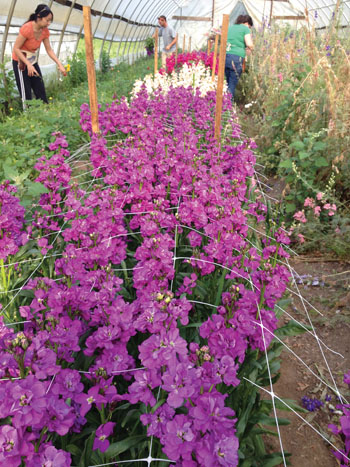
Matthiola incana is a cool-weather crop; for us in zone 6a, it gets too hot about mid-June and stock starts to bloom too short, even the varieties that are supposed to be more tolerant of warmer temperatures. All of ours are grown under cover in high tunnels with plantings both minimally heated and unheated. Florists buy all that we can produce, it works great in bouquets, and with our schedule we can have it blooming for 10 weeks in the spring, starting week 15 and going through week 25.
Every winter we test our greenhouse soil to come up with a nutrient mix that we apply to the soil in between every planting. Because we turn beds over so quickly under cover, rather than tilling in as we do out in the field, every bed gets ripped out when we are done with it. We then apply a layer of compost and our nutrient mix, tilling it in before any new planting in that bed.
We use Hortonova netting as a planting grid and put two plants per hole, so in our greenhouses there are 5 rows with 2 plants every 6” in row (or one plant every 3”). We used to plant two starts, in opposite corners of the net, but instead have just started double seeding them in our 128 flats for quicker, easier planting. The transplants are easier to pull that way also, as long as we plant them soon enough they don’t get root-bound.
Stock seed produces plants that are singles and doubles, with some hybrid varieties having a higher percentage of doubleness. Some varieties can also be selected to keep only the doubles, meaning that you could pluck out the seedlings after they have developed cotyledons (the embryonic first leaves). When selecting, the plants you want to keep (the double-flowered ones) have lighter color cotyledons. We choose not to select them because we can use the single flowers in bouquets, or just sell them bunched to the florists who are looking for something different. The singles from most varieties are usable, except from the Lucinda series, which quickly shed petals and don’t open up very nicely.
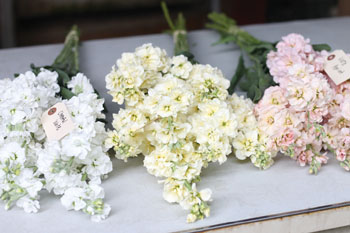
When harvesting, you want the flower stalk to be as long as possible without the bottom set of flowers starting to look bad. We determine if a flower is ready based on how dense the flower buds are when you look down at the top of the stem. You want it to be at least 2/3 bloomed, and the top set of buds starting to stretch out of the center.
Since most of our sales are to florists, we decided to plant by color rather than mixes. This means I have to choose colors, so I like to run trials before I officially decide. Here are my results; the varieties marked with an asterisk are our favorites, and definitely in next year’s plan.
Cheerful series
This series we have always liked in the past, but this year the stems seemed to be smaller in the middle of the bed, maybe in response to the density. I also read in Specialty Cut Flowers that too much nitrogen can make soft, thin stems, so we will try this variety again next year, but also trial new varieties of these colors to compare. It only comes in white and yellow.
White: A nice, standard white. Has a little space between the buds, so the stalk is longer. Will trial against Japan All Double White Surf.
*Yellow: A beautiful buttercream color. Works well with brides who want ivory as opposed to pure white. Will trial it this year against Katz Yellow.
Japan high double series
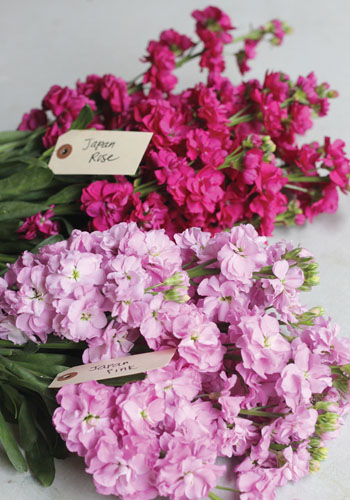
These are mostly doubles, about 70%, and the singles are usable for the mixed bouquet business, but may not be for sale to florists.
*Blue 2: Our favorite because of waxy leaves and a strong stem. A great bluepurple, similar to blue lisianthus. A florist favorite.
Light Pink 1 (shown next page): Baby girl pink. A little too pink to be considered blush, but not quite medium pink.
Katz series
PanAmerican Seed, the breeder of this product, say 5% of their net seed sales of this product will be donated to PanCan for Pancreatic Cancer research in honor of Philip Katz, former PanAmerican Seed Product Manager. Sourced from Gloeckner. These are about 60% double, but the singles are nice—definitely marketable to florists who want something different.
*Apricot: This color was a great soft peachy color, resembling the color you would use out of the crayon box for blushing cheeks. Perfect for wedding work.
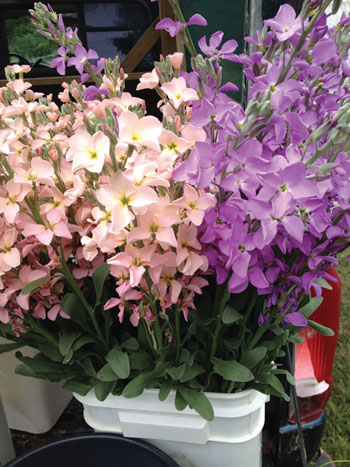
Purple: This purple is more of a red purple, almost burgundy in some lights, plum maybe. Definitely a different purple than the Japan Blue. With my love of dark flowers, I really liked this one. Would look great as the dark contrast to a mainly light or neutral arrangement.
Lucinda series
We found this series to be inferior to the others we grew. They were shorter, which according to Specialty Cut Flowers could be because of low seed starting temperature, but these were started the latest and warmest of all our seeds. We visited another grower in our area, and their Lucinda was short also, so it may have been a bad year for it. They have more leaves on the stalk, so are harder to strip. It comes in a large variety of colors, but the red is actually a dark pink. The singles are not usable as their florets are unimpressive and they shatter quickly, so this variety would need to be selected for doubles as seedlings.
Our timing of plantings is based on the suggestions in Specialty Cut Flowers, and then adapted for our environment. Stock takes about 8-10 weeks before it is planted out, which is done in our propagation house. All of the numbers below are based on week numbers, which makes the information transferable to the following year. Week numbers we use are in the back of Gloeckner’s seed catalog, on an app, or in my planner. We start seeding week 44, and those are transplanted into our minimally heated greenhouse, which bloomed week 15—good timing for Easter. The next seeding was week 48, which bloomed week 18 and went into week 19, the week of Mother’s Day sales.
Resources
Specialty Cut Flowers by Allen Armitage and Judy Laushman, available from www.growingformarket.com.
Ball seed cultural information about Katz stock:
http://www.ballsb.com/en/index.php?option=com_content&view=article&id=13&Itemid=24
Gretel and Steve Adams own Sunny Meadows Flower Farm in Columbus, Ohio.
Copyright Growing For Market Magazine.
All rights reserved. No portion of this article may be copied
in any manner for use other than by the subscriber without
permission from the publisher.