








When we started our farm in our mid-twenties, we didn’t plan to have kids. We jokingly said the farm was our baby. And it was. Like so many others before us, we poured ourselves into building our business, market base, soil fertility, equipment, variety selection, and overall farm system. We didn’t have time for kids. But as our farm became increasingly established (and as we got older), we reversed course and decided to take the plunge into parenthood. At the time, we wanted nothing more than to ask other farmers how they’d done it. We hope this article sheds some light on our experience farming + child.
We intentionally set up our farm as a two-person operation: no interns or hired labor. We wondered how to fit pregnancy, then infancy, then the toddler years, and beyond into a busy farm. The farm is our sole source of income. To provide ourselves with a safety net and peace of mind, we saved up some money before having a kid with the understanding that our income would likely take a hit those first several years.
Not surprisingly, we hoped to time our child’s birth for our winter slow season. Fortunately, this worked out with a November 2012 due date. The 2012 season brought early and bountiful harvests, one of the hottest summers in Oklahoma history (with temperatures in the 100s by 11 a.m.), and consequently, definitely not an easy season to farm while pregnant. By July, we realized we needed assistance harvesting. Two wonderful friends came to help pick from about 7 to 11 on Friday mornings. It was our first taste of the farm’s labor changes to come.
Heat and bugs gave us a serendipitously early end in mid-August, and just as well. We had our daughter in November 2012, spending the winter adjusting to the new love of our lives and sleep deprivation.
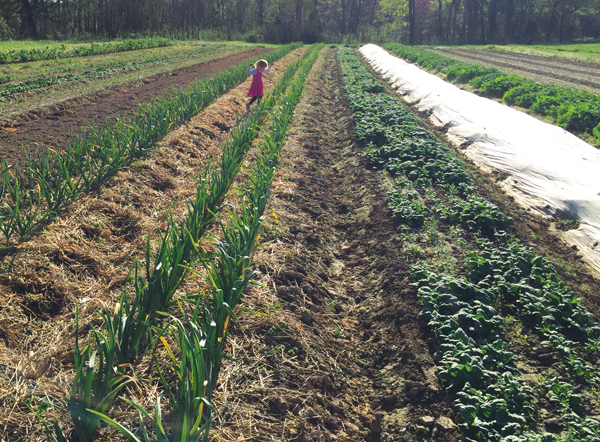
Below: The authors found that their 2-year-old daughter loves to “help” outside.
From the start we had romantic hopes of bringing our baby out in the fields while we worked. We’d studied agriculture around the world, had seen moms in other countries do this, and thought we surely could too. We knew babies’ temperaments varied, but we were hoping for a recessive gene for “chill” to emerge in our daughter. Not so! We tried bringing her out with us, initially to prune fruit trees in February, but she generally only lasted 10 minutes before wanting to get out of the windy weather, or needing to be held, fed, etc.
Naively, we thought we could find a magical baby carrier that would be a panacea. We researched and we googled, we tinkered and we borrowed. Yet we couldn’t find a solution that gave her head support, didn’t crush her legs as Emily bent down, or was pleasant for more than 30 minutes. Either because our child simply had other plans, or maybe because we hadn’t grown up in baby-wearing cultures and our kid instinctively sensed that we were novices, or perhaps because farm labor with an infant in tow is just plain hard, we ultimately realized that Mike was going to be shouldering the lion’s share of the field work that season.
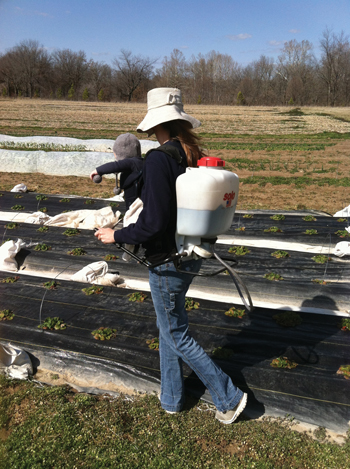
Below: Emily and three-month-old daughter Lisette apply fish emulsion to strawberries in February 2013. “If only every task looked this easy,” Emily says. The reality is that she needs a babysitter to get most chores done.
We live in a fairly isolated area. The nearest town of any size is a half hour’s drive. Finding harvesters or babysitters under those limitations is a challenge. Luckily, we were rescued with babysitting and harvest help by two friends. Both of those women were true farm-savers as we adapted to being a 3-person, or rather 1.5-person, farm. They gave us practical and spirit-keeping help that got us through the summer. They came Thursday and Friday mornings, and Emily either stayed inside with our daughter on those afternoons or brought her to our wash station. We used old Pack-n-Plays, Exersaucers, and a baby backpack to keep her entertained. Although there were times the juggling act was rocky, just getting through that first season-with-baby was a huge milestone. Having farm mentors to call on for advice and reassurance showed us it can be done.
By her second year, our daughter was spending harvest mornings with another friend/babysitter who came to our farm and harvest afternoons in the barn with us. There she would play with our dogs, splash in water, draw on an easel, and more often than not, “help” us clean produce. On non-harvest days, she spent the mornings with both of us out in the field. She had her own work clothes, hat, and water bottle. In the heat of the summer, we couldn’t keep her out much past 11 a.m., but we were able to get a good deal done together as a family.
Having a kid taught us to be flexible about our labor model. Our same amazing friend volunteered to help us harvest again last year, this time all day on both Thursdays and Fridays. We have a new appreciation for the role interns and hired labor play helping the farms that use them to have families. We imagine our future labor needs will now always include a combination of babysitting and harvest help, if for no other reason than that we want to be in by five or six in the evening for dinner and our child’s bedtime.
The romanticized notion of strapping an infant on our backs and hoeing all day long may not have panned out, but other ideals have. We are both “at home” with our child; even when one or both of us is out in the fields, our home is our farm. As our daughter gets older, things have only gotten easier. When illness or other unforeseen circumstances kept our babysitter away on our harvest days last season, we could take our toddler in the fields with us to dig in the dirt, roll around in dusty furrows, talk to the plants, and pick “baby” tomatoes into a bucket. While working this winter on projects outside, she gladly entertained herself with sticks and leaves for hours.
Our child is more jealous and disruptive of our time on the phone or computer than she ever is outside. While she’s thrilled for a project that involves dirt, things like CSA newsletters or other office work are most conveniently done during naptime. Yet here again, the older she gets the more we can get done. Having a dedicated play area away from our office has made computer work more viable.
We sell all of our produce through a farmers market and CSA on Saturday mornings. Friends and family have helped by meeting us at the market just before it opens to take our daughter for the morning. While we initially woke her up at 3 a.m. and kept her with us all market when she was a young infant, we soon realized that wasn’t viable. Those four hours of selling are far too important to handle the interruptions of having a young child present.
There are some tasks that require all three of us. When it’s time to transplant, our daughter gets strapped up front in the tractor with Emily while Mike rides the transplanter. We bring her out to put up the greenhouse plastic. She plays alongside us when we roll up t-tape. There are times when it hasn’t been very merry for anyone, like laying out row cover before a spring freeze. Sometimes we push our daughter beyond her comfort level when a job simply needs to get done. Fortunately, those times are infrequent, but it’s part of growing up on farm.
Children take time
The reality is that kids need someone to take care of them. It can be you, a friend or family member, or a hired caregiver. Babies need more time than older kids, and we are still in the learning stage. Yet the universal truth is that starting a family changes farms. In our admittedly limited experience, the first year seems to bring the biggest changes and demand the greatest amount of time. Farms with an abundant supply of available laborers and the cash flow to hire them are at an advantage when it comes to having children. But smaller operations like ours can adapt and thrive with children. Many of our farmers’ market and CSA customers are every bit as concerned with our daughter’s progress as with the crops’.
So what effect did having a kid have on our bottom line? Surprisingly little. The first season we farmed + child we had a 6% drop in income from the previous three-year average, but our income was back to normal by her second year. Having a child certainly constrains our time in new ways, but that has been a gift, not a liability.
One of our concerns about becoming parents was how to fit a kid into 10, 12, and 14-hour workdays. It turns out, you can’t. And that has been one of the immeasurable joys having a child brought us—perspective. Gone are the days when we could, or wanted to, stay up until 9 p.m. cleaning produce for the next day’s market. Our lives now manage a much better work/life balance. We have a compelling reason to come in for dinner at a decent hour, to give ourselves Sundays off, and to step back from some of our board commitments. Our lives, and our farm, are richer for it.
While people joke that we need another dozen kids to run the farm, we are happy where we are. Our farm has matured into an established business in our community, and we have grown up with it. Although when we started farming we couldn’t fathom having a farm and a family, now we can’t imagine having it any other way.
The bottom line: don’t let the demands of farming keep you from having kids. Older farmers with families: please share your insight and wisdom with younger growers around you looking for advice. Three things allowed us to start a family, continue farming, and mange to work less overall: 1) waiting to have a child until our farming system was established, 2) babysitting and harvest help, and 3) learning to be flexible to the changes having a family meant for our farming system. Farming is a wild ride and never easy, but it can be a beautiful life for a family.
Emily and Mike own Three Springs Farm in eastern Oklahoma and grow 6 acres of certified organic fruits and vegetables.
Copyright Growing For Market Magazine.
All rights reserved. No portion of this article may be copied
in any manner for use other than by the subscriber without
permission from the publisher.