











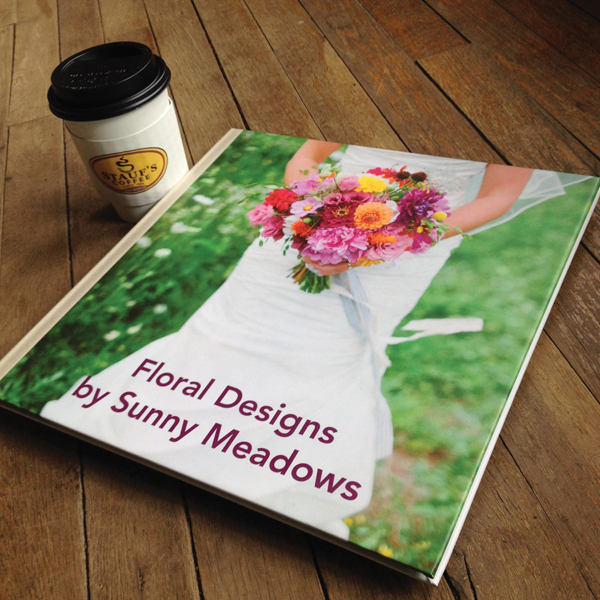
Above: A portfolio of flower photos is easy and inexpensive to create with an online book-printing service. Gretel uses Shutterfly for hers. All photos courtesy of Sunny Meadows Flower Farm.
The omnipresence of technology and social media makes it of growing importance to every business, even farming. It seems backwards that choosing to work in the dirt also comes with computer work and building a brand, but they are necessary for success.
Photography is the foundation of our efforts on social media, so we work hard at it. It provides a way for us to share the beauty of what we do, but it also helps communicate to customers who we are and what our business is about. This is a beautiful life we are living, even though it is tough, dirty work. We show plenty of gorgeous images of our botanical journey through the seasons. But we try to balance that with photos of some of the nitty-gritty so that folks really know what goes into producing their flowers. Showing what’s happening behind the scenes corrects people’s assumptions about what we do in the winter or that we get to play with flowers all day. They see that we are pouring our souls into it—working long hours to create as much beauty as possible. And for those of us who do wedding floral design, having great photography is especially important.
Creating a portfolio
Brides need to visualize, so having a portfolio of good photos helps sell your designs and describes how they reflect the change in seasons. When we are doing flowers for weddings, we always try to take time to photograph the bouquets, although sometimes it doesn’t happen.
We also try to get pictures from the wedding photographer. We introduce ourselves, give them our card, and let them know we would love to see photos of the finished project. Even if we did take photos ourselves, the professional gets the images of people holding and wearing our flowers, which gives them more appeal to potential customers.
In cases where we don’t meet the photographer in person, we ask the bride to list the photographer on our contract. In the winter when we have more time, we gather information from all the brides we worked with that year. We email them a link asking them to review us on Wedding Wire, one of the premier wedding planning websites.
And we ask them for photos of our flowers. Sometimes a bride will send a few photos, but other times we receive a link to the entire gallery from the wedding. In either case, professional courtesy requires us to identify the photographer when using a photo. If we need to contact the photographer directly, we make sure to tell them how much we love their work, and ask if we could include some of their beautiful photos in our portfolio, giving them credit whenever it is due. Note that not all photographers will necessarily credit the floral designers if they use a flower photo. But being in the wedding business is a lot about networking, so if you love each other’s work, you can start to refer each other business.
Once we have acquired the photos and chosen our favorites, we create a hard-bound portfolio book. We use Shutterfly, and use the 12” x 12” books so we can fit as many photos in as possible. We simply upload the pictures onto the Shuttefly website, and work through finding the best placement and number of pages. This year we organized by season, and it has been really helpful when consulting with brides.
Having a portfolio book can help sell the higher-end designs we are creating. It is easier for someone to see what the difference is between your $20 market bouquet and a bridal bouquet, or the difference between seasonal floral design and your typical ball of red roses. Remember that you are selling yourself as an artist and they are also paying for the service that goes into wedding design.
Oh, Technology!
We also have an online wedding portfolio. We use Tumblr, but you can also use Flickr. Both can be linked with an Instagram account, so you can post directly from your smartphone. You can also link a Facebook or Twitter account to Instagram. I use Instagram mainly because it is in the palm of my hand. If it is something that I want to promote, I will post it to Facebook as well as Instagram. If it is wedding design I want permanently documented in my portfolio, I will link the photo to Tumblr. I try to post a photo of each wedding, congratulating the couple, so those I will post to all three avenues (we don’t use Twitter).
Photos from Tumblr or Flickr can be pinned on Pinterest, so you can bring brides back to your portfolio website and get more photos on the web for the masses to see. The most gratifying thing is when someone brings me my own work as a wedding reference photo they found on Pinterest! Jennie Love of Love ‘N Fresh Flowers and Ellen Frost of Local Color Flowers both have really great Pinterest boards, listing out each flower by month with photo reference so the brides know exactly what flowers are available. I mainly use my portfolio book to point to things while we are consulting since I haven’t set up that intricate of a system on Pinterest.
There is also a web-based service called IFTTT (rhymes with gift), which stands for If This Then That. IFTTT allows you to set up “recipes” or formulas to connect with a lot of different technological avenues. For example, we have used it to post to Facebook when we posted a new blog on WordPress. (“IF I blog on WordPress, THEN post to Facebook.”) You can use IFTTT to link pretty much anything you can think of. The possibilities are endless! You can even have it record in your calendar what days it rains or gets below a certain temperature if you want, but that is another article. IFTTT is also available as an app for iPhone and Android.
We have recently decided to stop blogging. A blog is a commitment that takes time sitting down in front of the computer, uploading photos, and creating content. Instead, we decided we would tell a visual story through other avenues, especially ones we can do from our phones while out in the field. It takes less time and gives us much more instant gratification!
Photo basics
You can definitely use your phone or a standard point-and-shoot camera, but having a good digital SLR camera makes all the difference for high-quality photos. A DSLR can do a lot on the auto setting while you are learning, but the more you understand about how the camera works, the more artistic your photos become. I use a Canon Rebel, but there are a lot of options out there, so ask around to see what others’ favorites are. Some point-and-shoot cameras also have manual settings, so you can experiment with changing the aperture and shutter speed. Check your manual to learn what’s possible.
Many of us on the farm have taken photography classes. There may be local photographers or camera shops that are offering classes in your area, or you can take online classes. Creative Live is a website that broadcasts live classes for free, or you can purchase classes to watch at your own pace. I took classes in high school, but had forgotten most things, so went to photography classes held by a local studio, and then took the Eyes Open Creative Photography E-Course (http://eyesopenecourse.com).
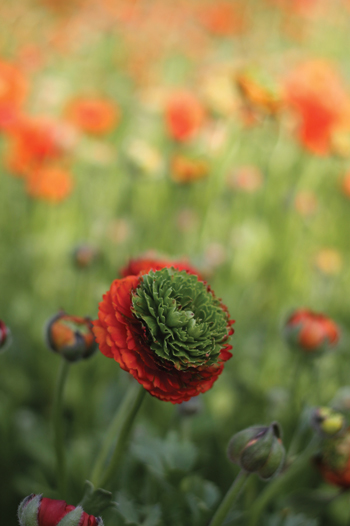
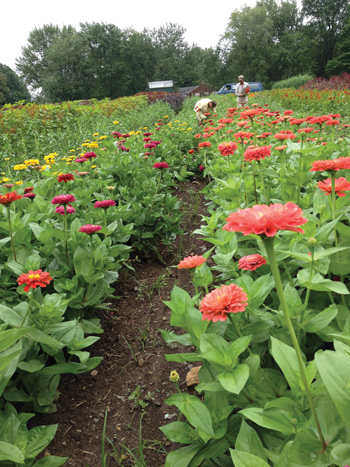
Below: Both photos were taken in high-light situations. The first field photo was shot with an iPhone, which automatically determines ISO, aperture, and shutter speed. Gretel took the next photo with her Canon EOS Rebel digital SLR camera. To achieve this look, with the flower in front in crisp focus and the background blurred, Gretel used ISO 100, aperture F2.5 and shutter speed 1/1250
 It took me a few times learning about the photo basics to really grasp how all elements work together, but it is all about light. Flowers are best photographed in natural light; a built-in, front of the camera flash tends to make flowers look flat and distorts color. We want to see how truly beautiful the people/flowers are that we are shooting! Here is a quick crash course in flower farmer terms, but don’t be afraid to learn more. It’s a great winter project if you don’t have time now.
Aperture: This is how wide the opening of the lens is that lets in light and is measured in f-stops. This controls the depth of field, or how much of the photo is in focus. It is kind of confusing because the lower the number, the bigger the hole, but just remember that the lower number gives you the shorter depth of field. This gives you less in focus, so you can accomplish those photos of the flowers in the foreground being highlighted with the background being blurred, or vice versa. If you can’t shoot in full manual, I would choose to shoot in Aperture Priority as a flower farmer. On my camera the Aperture Priority setting is marked as AV on the dial. Use the lower number if you want less of the image to be in focus—for photos of bouquets and specific flowers, for example. Use the higher number to get more in focus, like field shots or multiple people or flowers. Even with everything else set on auto, using the AV setting will help add dimension to your shots.
ISO: This used to be the film speed measurement, or how sensitive the film was to light. In high light situations, you want the number to be low. On the brightest sunny day, you will have to shoot in 100, or go into soft shade if it is still too bright. On a partly sunny day, you would shoot in 400. And in lowest light situations, you will have to go up to 6400, but the picture may start to look grainy if enlarged. As a beginner, I would just set the ISO to auto for most days. I take photos until the highest ISO isn’t enough, and then I quit because there isn’t enough light. I don’t know enough about flash photography yet and don’t have studio lights, but that is the next step. Maybe this winter I can tackle that piece of photography class!
Shutter speed: This is how long the shutter stays open, which used to be defined as “exposure time” in film days. It either freezes action or blurs motion, depending on how long the shutter is open. Shutter speed is measured in fractions of a second. I wouldn’t shoot below 1/50 or 1/60 of a second without setting the camera on something, as my hands aren’t steady enough for the picture not to be blurry, even if I make myself a human tripod.
One photographer compared aperture and shutter speed to a field full of sheep with you controlling the gate: the aperture is how big the gate is, and the shutter speed is how long you hold it open, so both together control how many sheep get through the gate. If the aperture is low, the gate is huge, so if there is enough light outside, you may not need to have the gate open for very long to get enough sheep through. In low-light situations, you would want a low number aperture for a big gate, and would need to have the gate open longer to try to let in as much as possible. If you don’t understand completely, don’t worry, it takes time. Just remember it is all about light. Now, go photograph some flowers!
Gretel and Steve Adams own Sunny Meadows Flower Farm in Columbus, Ohio. They sell to florists, grocery stores, at farmers markets, and they do floral design for weddings and other events.
Copyright Growing For Market Magazine.
All rights reserved. No portion of this article may be copied
in any manner for use other than by the subscriber without
permission from the publisher.