











If you are growing plants, eventually you will have pest and disease problems. Here is the list of things that I guide my clients to have on hand for both scouting and preparing for the inevitable.
Tools for scouting
As I mentioned in my previous article (GFM, March 2016) and was reiterated in last month’s magazine by the growers of Sunny Meadows Flower Farm, Gretel and Steve Adams (GFM, April 2016), scouting is key in pest management. I’ve never seen any grower successful in pest management who did not do scouting, systematically searching for pests before they become such a problem that they are easily seen when doing other tasks in the field or greenhouse.
Hand-held magnifying lens (10-20x magnification): As my eyes are not as good as they used to be, my 17x is now my standard lens. You’ll need the higher magnification to identify mites. Russetmite (pest of tomatoes, potatoes and eggplant) cannot be seen with less magnification. Additionally, when you have spider mites, you’ll want to also consider the population of native or introduced predatory mites in order to make the right pest management decision.
Hand-held microscope (30x and greater): This tool has saved me a lot of time and money. While you can use the 17x to confirm that what you think is Russetmite really is RM, and not just dust, you cannot be sure if they are alive until you look at yet a higher magnification. Before this handy tool I had to cut pieces of tomato stem and take them to the office and examine under a dissection microscope. Today, I use a Lumagny illuminated 30x bought on Amazon for about $15.
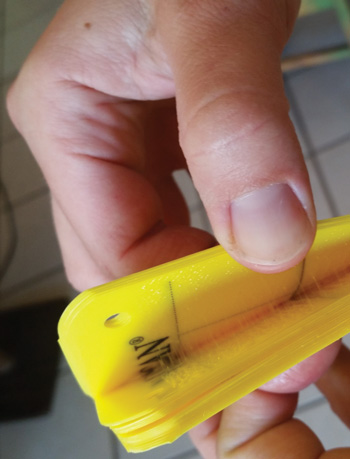
Below: Sticky cards are more effective than any pesticide at killing adult flying pests. The author recommends three brands with extra-thick glue that won’t need to be replaced frequently. Photos courtesy of Karin Tifft.
Electrical tape: This is really useful if you are growing tomatoes because (eventually) you’ll have a Russetmite problem, but I’ve also used it to quickly repair leaking irrigation tape. Press a 2 or 3 inch piece of electrical tape into the stem towards the top of the area you suspect to have RM. Living RM will keep moving up the stem, so if you sample too low, you could think you’ve killed the infestation when it has only left the area. Use your hand held microscope to observe these mites on the tape. When sticking to the tape they are more likely to be moving and thereby be easier to determine if they are living or dead; however, RM do not actually need to be moving to be alive, but simply need to be plump and not desiccated
Flagging tape: Have two colors of easy-to-write on (smudge-proof) tape. I mark pest hot spots that need to be treated in one color and plants that need to be sampled and anything else such as a leaking pipe with the other.
Zip lock baggies and containers: I carry these with me in my scouting bag so I can quickly collect samples. Some things need to be sent to a diagnostic lab, and some things just need to be held in the office to see how they develop.
Digital camera: Be able to take close-up photos as well as full images of the plant or pest of concern so that you can track the problems in your own documentation. It can also be helpful to send off with your sample for pest or disease identification.
Computer Graphing program: I find it easiest to make my own scouting sheets based on the pests I see in the greenhouse over using any programs available on the market. Now that you can enter data directly into these programs with your smart phone, it is so much easier that it was just a few years ago. You can also link the data in your weekly scouting sheet to the 6 six-month overview sheet to see patterns, thereby saving time in analysis and speed up reaction time. Remember, if you’re not going to do anything with the data, why take the data at all?
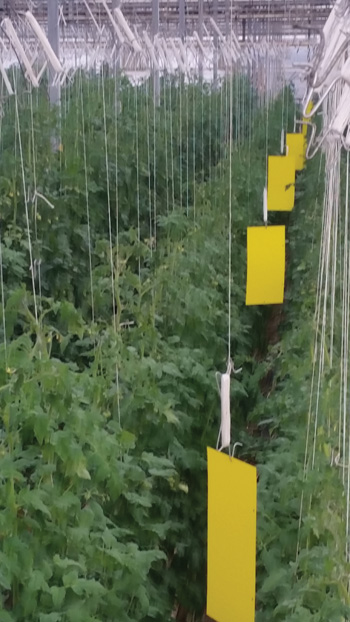
Below: Yellow sticky cards used in a tomato greenhouse.
Tools for taking action
Sticky cards: While I do use these for monitoring, I also use them for trapping flying pests such as whitefly and psyllids. One client enthusiastically told me “they’re worth their weight in gold!” For organic growers, these are more effective at killing adults than any pesticide, and even in conventional greenhouse operations, I recommend using these before using a pesticide to kill adults. Look for sticky cards that have a thicker glue so you can catch multiple layers of pests and leave them suspended for months. In my opinion, Koppert (Horiver), Syngenta Bioline and Biobest have the best sticky cards. Remember, labor is expensive. Therefore, less expensive cards that do not have the thick glue will work, but for not as long and will need to be replaced sooner.
Spray Equipment: Be sure to have general-purpose backpack sprayer such as the Solo 4-gallon deluxe piston pump on hand (less than $100). This can be used to apply both insecticides and fungicides. Never ever use an herbicide sprayer for anything but herbicide. Herbicides can mess up the plant at parts per trillion. Clearly label the herbicide sprayer.
Larger operations may want to consider making equipment by using a spray tank and pump on a cart or even building your own sprayer with T-jet nozzles. American greenhouses tend to be just in that “right niche” where we often have to make our own gear.
Safety equipment to have on hand: Many of the products available for use in greenhouses do not require any special Personal Protective Equipment (PPE) when mixing or applying the product. Still, I always recommend an extra set of clothing be available, or a lab coat or Tyvek® suit worn when mixing and applying chemicals in case it is spilled. When using sulfur, I would recommend either a lab coat or Tyvek® suit as smell of the sulfur will get into the clothing and shoes, effectively ruining them for regular, casual use. Additionally, even when not required by the label, I would insist that all pesticide applicators wear gloves and glasses, goggles or a face shield. You just don’t know if someone has an unusual or unidentified allergy to the chemical or the carrier used. You are actually more likely to have the chemical contact your skin when mixing, not applying, so be sure to wear your PPE then.
Standard safety measures include:
Long-sleeved shirts
Pants
Socks and closed-toed shoes
PPE to use when mixing and applying:
Goggles, glasses, or a face shield
Dishwasher gloves
Lab coat, coveralls or Tyvek® suit
Products to keep on hand: The pesticides allowed for use depend on the crop, location (CA and NY have additional restrictions), and some are specifically not allowed in greenhouses. In general, OMRI pesticides are the most generous in their labeling, as in they tend to be allowed on the most crops and without greenhouse restrictions. Non-organic products have many more label restrictions and it is very common for a pesticide to be allowed on ornamentals but not on food crops. It may be allowed for tomato seedlings to be treated with a certain product, but not tomato plants growing for food production. Be aware of the Pre-Harvest Interval (PHI) which is the time between when the product was applied and when it can be harvested. For example, some products have a 7 day PHI on tomatoes, so in a typical tomato greenhouse where we are harvesting 2-3 times per week, that product can only be used up to a week before the plant starts being harvested.
The Restricted Entry Interval (REI) is the time between when the treatment is ended and when an area can be entered without wearing the PPE. If the PPE is nothing special, just long sleeves and closed-toe shoes, this probably won’t interfere with normal operations.
Remember, “The Label is the Law.” Always check the label before purchasing and using to make sure it fits in your operation. With that said, here is the list of effective pesticide with rather broad labels that can be useful to have on hand in most greenhouse operations. You always want to have some tools on hand to at least suppress an outbreak, even if another specific product has to be ordered and used.
Karin Tifft, MS Entomology and BS in Horticulture, has been working in greenhouses for close to 20 years. In her experience, she has learned that you can’t have plants without having insect and disease challenges. Karin can be found at www.greenhousevegetableconsultants.com and is available to provide personalized consulting for your specific crop, location and market.
Copyright Growing For Market Magazine.
All rights reserved. No portion of this article may be copied
in any manner for use other than by the subscriber without
permission from the publisher.