










A down and out looking area on the border of one of the most affluent, influential cities in the world is the birthplace of an effort to change the way local food is sold. The Crossroads Farmers Market in Takoma Park, Maryland, was organized with the intention of making it accessible to a low-income population.
If you drive north of the United States Capitol in Washington, D.C., on New Hampshire Avenue, you will eventually cross into Maryland. Parts of the first suburb you enter – Takoma Park – look respectable. As you move further, into Langley Park, the complexion of the area changes dramatically. People new to this country from South and Central America, Africa, the Caribbean, Vietnam and China, live in cramped apartments and know what it is to work hard for their livelihood.
The Crossroads Farmers Market, founded in 2007, had some hard beginnings because it was set up as an alternative to markets proliferating around Washington. Takoma Park has a flourishing Sunday farmers market, where crowds throng and quickly give up large amounts of money.
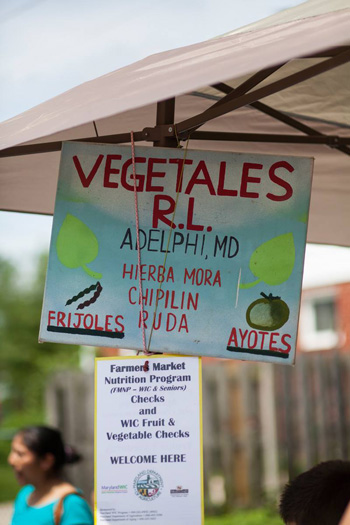
Below: A stand at the Crossroads Farmers Market.
Crossroads was one of the first markets in the country to raise private money to supplement food stamps and nutrition assistance grants. It received money from the National Watermelon Promotion Board to help finance its start.
The market uses a Fresh Checks program, which allows participants to get double their money for purchases. So if a buyer wants to spend a dollar on a tostada, a pupusa, chipilin or another vegetable common to their home country, he or she can get two dollars in value when they make a purchase.
Getting the market to the place it is now wasn’t easy. The first year few people wanted to be vendors, because most were more familiar with large market crowds, and more willingness by customers to spend money. But by 2015, a solid group of vendors had begun participating. And over the last decade, $361,000 in Fresh Checks have been distributed to customers.
Two people familiar with the agricultural system in the United States, John Hyde and Gus Schumacher, worked to get the market started. At first the United States Department of Agriculture told Hyde that setting up a Fresh checks program wouldn’t work, because it would conflict with USDA regulations. Technically, USDA officials said, the federal way of distributing coupons in the Women, Infants and Children (WIC) program had to stay the way it was. After a round of conversations and negotiations, the USDA backed off.
Hyde wrote a book on Henry A. Wallace, who was U.S. Secretary of Agriculture under President Franklin Delano Roosevelt. Wallace, who went on to run for President in the Progressive Party in 1948, had founded Pioneer Hybrid and traveled the world, advancing principles of the green revolution. Hyde passed away in 2009. Schumacher had been Under Secretary of the Farm and Foreign Agriculture Services division at the USDA.
The system Hyde set up to distribute coupons to farmers market customers at Crossroads is a type of enhancement program markets across the United States are now adopting.
An added plus of the establishment of the Crossroads Market is that a local church, the Takoma Park Presbyterian Church, is re-configuring space to be built into a commercial kitchen that individuals can use to start learning correct food production techniques. Recently there was a groundbreaking for construction of the new kitchen space, which is in a building adjoining the sanctuary and office area of the church.
The idea is that some of the people who are vendors at Crossroads could use the kitchen to make more foods that would be of interest to customers who go to the Wednesday market. Crossroads officials refer to the commercial kitchen as a “micro-enterprise” program that will allow graduates to use their new skills to expand their businesses.
The Takoma Park Presbyterian Church has long been one that works with its community and makes extra space available for private use. For a time there was an office in the church for CASA de Maryland, which is a group that provides help to Latino people new to the area. The organization helps people find jobs and work through problems they might be finding in trying to get established in the Washington suburb.
The pastor of the church, Mark Greiner, is familiar with obstacles the church faced in its attempt to put in an enhanced commercial kitchen. The church is on the corner of Tulip and Maple streets in Takoma Park, and that is a prime residential area two blocks from the commercial park of the suburb.
Greiner says the effort to set up the kitchen so users can enhance their opportunities is “absolutely brilliant and culturally appropriate.”
Training has been set up so that people who use the kitchen will be knowledgeable in safe food handling. The church has had help from members of the Latino community and uses people who are bilingual in training sessions, said Greiner.
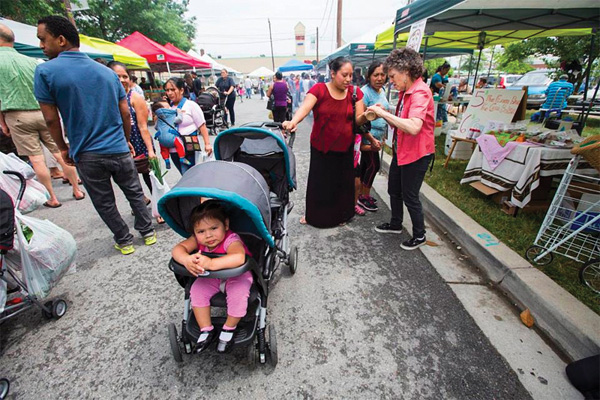
Below: A scene from the Crossroads Farmers Market.
Before the market got started, founders met with a variety of groups to get a sense of the types of problems people new to this country are facing. A meeting at the Bethel World Outreach Church was attended by people from a number of different countries.
Greiner said people interested in getting help are not in “advanced places on the totem pole” and suffer from “significant” poverty. He said seeing how people have responded to the market is “wonderful.” There is a “vibe” and real festivity in how people use the market’s services.
Usually there is music at the market, and smells from food being prepared waft to the nearby streets. The market is in a corner of the Langley Park shopping area, just north of Takoma Park.
The operation is not run by vendors, but by a Takoma Park-based non-profit, the Crossroads Community Food Network. Crossroads accepts coupons from the Supplemental Nutrition Assistance Program (SNAP) and WIC. When the market first opened, it was across the street from a building where people go to an office and get their WIC coupons.
The Crossroads market recently celebrated its tenth anniversary, and founders and supporters of the effort participated in a celebration at a Takoma Park restaurant. There was a silent auction, where people could bid on a variety of donated items. One was a trip to a Guatemalan villa, donated by a supporter.
One of the originators of the market, Gus Schumacher is also one of the founders of Wholesome Wave, a group that works on access to food issues. He said the effect of the Crossroads programs have spread to other Washington, D.C., markets. People now line up an hour in advance of a market opening to be ready to purchase their foods. And the Crossroads Market has people of many colors, ages and backgrounds vying to pack their bags with fruits, vegetables, prepared foods and flowers every Wednesday.
Louise Swartzwalder is a grower for farmers markets (28 years in Washington, D.C., and now in Ohio.) She is also editor of the Bellville Star, a weekly newspaper.
Copyright Growing For Market Magazine.
All rights reserved. No portion of this article may be copied
in any manner for use other than by the subscriber without
permission from the publisher.