











By Anne and Eric Nordell
We have conducted several surveys of experienced teamsters to provide benchmark numbers for horse-powered market gardeners. These informal farm studies have covered everything from the economics of workhorse maintenance to the hours spent on fieldwork and harnessing. In this article, we report on a topic which may be of interest to growers who use tractors and hand tools: the effect of cropping systems on plant populations.
A recent survey of seven teamsters showed that row cropping can sometimes meet or exceed the plant populations of multiple-row systems. At Natural Roots in Conway, Massachusetts, David Fisher and Anna Maclay transplant lettuce 9” apart in 32” rows. Extrapolated for comparison’s sake, their 22,000 lettuce plants/acre falls halfway between the two multiple-row tractor examples shown in the plant density chart.
On the chart, Tractor I is based on the crop budgets in Richard Wiswall’s Organic Farmer’s Business Handbook. Tractor II includes lettuce and broccoli spacing from the enterprise budgets in Vern Grubinger’s Sustainable Vegetable Production and the onion planting system used by many tractor and horse-powered farms in Pennsylvania. No doubt, there are tractor, horse and hand operations that plant more intensively and extensively than captured in this casual survey.
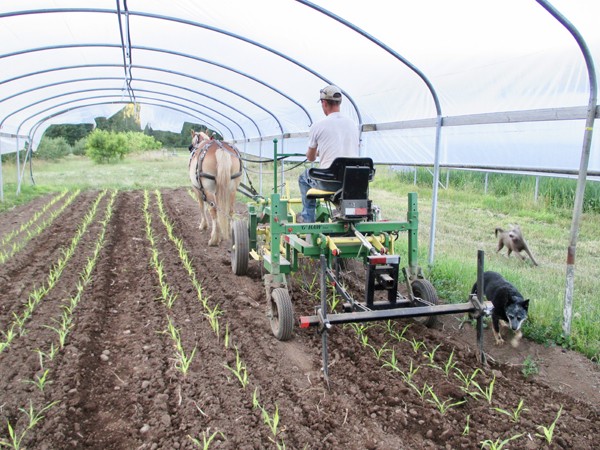
Stephen Leslie and Kerry Gawalt plant many of their crops on 36” rows at Cedar Mountain Farm in Hartland, Vermont. By setting broccoli plants 12” apart in the row, their plant density of 15,000/acre exceeds both of the multiple-row tractor systems. Like Natural Roots, the primary incentive for growing vegetables in widely-spaced, single rows is to accommodate the traditional, horsedrawn straddle-row cultivator equipped with pedal steering for precision cultivation. The teamsters in the survey also noted that row cropping facilitates in-row mechanical weed control and the use of crop shields. The extra room between rows also makes it easier to deal with obstacles such as stones and cover crop residue.
Ken and Martha Laing of Orchard Hill Farm, St. Thomas, Ontario, built a horsedrawn carousel transplanter for row cropped produce. It allows them to mechanically set onion plugs (three plants per cell) 9” apart as shown in their YouTube video viewable at tinyurl.com/ycmknc64. Although their plant density of 58,000/acre is lower than the hand-planted plasticulture examples, mechanizing transplanting and cultivation while dispensing with plastic represents significant labor savings.
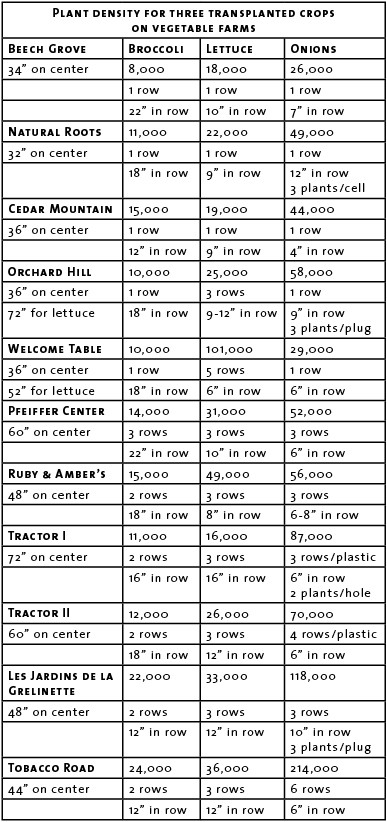
The Laings’ 36” row spacing for onions is a function of the wheelbase of their riding cultivator. Since 30” is the standard row spacing in many areas for row cropping with tractors (60” wheelbase straddling two rows), the plant density for onions using the Laings’ in-row spacing would increase to 70,000/acre, on par with the Tractor II plasticulture example. The row spacing could shrink to 24” or less using hand cultivation, bumping the plant population to 87,000, the same as Tractor I.
To save space and time spent on harvest, Martha and Ken employ multiple-row plantings for lettuce, dill, cilantro and green onions with a similar planting density as the multiple-row systems. They plant and cultivate these crops by hand, using a single horse and walking cultivator for weed control in the pathways.
At Welcome Table Farm, Walla Walla, Washington, Emily and Andy Asnus use the same horse and hand strategy for early spring lettuce planted at a super high density of over 100,000/acre, much of it harvested for cutting lettuce with select plants allowed to size up for harvesting as heads. To optimize growing conditions for each crop on their farm, they use a diversity of row spacings: 42” for corn and potatoes; 60” for tomatoes and melons; double-rows on 36” centers for peas, beans, carrots, beets, and sunflowers; six rows, 6” apart, for lettuce, spinach, radishes, Hakurei turnips, arugula and mizuna; and 36” single rows for everything else.

Mac Mead, the director of the Pfeiffer Center in Chestnut Ridge, New York, designed a semi-permanent raised bed system on 60” centers for his team of Haflingers. He uses a three-point hitch forecart with a 60” wheelbase to pull customized implements for forming beds, incorporating cover crops, and marking one, two or three planting furrows per bed. His system is compatible with standard tractor equipment, a benefit if a horse is sidelined by injury or illness. Lettuce spaced 10” apart, three rows to the bed, results in a plant density of 31,000/acre, almost as high as the new super-intensive, tractorless systems represented on the chart by Les Jardins de la Grelinette of Saint-Armand, Québec (as detailed in Jean-Martin Fortier’s book, The Market Gardener) and Tobacco Road Farm, Bryan and Anita O’Hara’s pioneering no-till market garden in Lebanon, Connecticut.
At Ruby and Amber’s Farm, Dorina, Oregon, Walt Bernard and Kris Woolhouse built a horsedrawn tool carrier similar to the popular Allis G cultivating tractor. Their farm’s Facebook page and website (workhorseworkshops.com) feature videos of the G Haw in action working beds on 48” centers with 1, 2, 3, and 4 rows of vegetables. Their plant population for broccoli exceeds the tractor examples and their 49,000 plants of lettuce/acre is significantly higher than the tractorless systems.
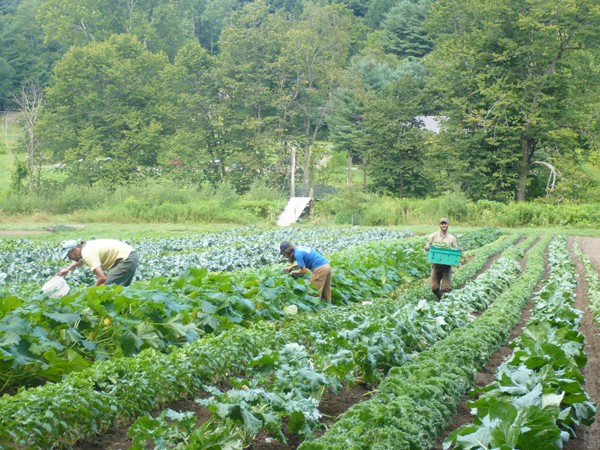
The wide range of plant populations on the chart suggests that maximizing planting density is not necessarily the goal for every crop on every farm. Our Beech Grove Farm is an extreme example. We intentionally give each plant plenty of space to provide a large reservoir of soil moisture, one aspect of our strategies for dryland market gardening described in the November/December 2017 issue of Growing for Market.
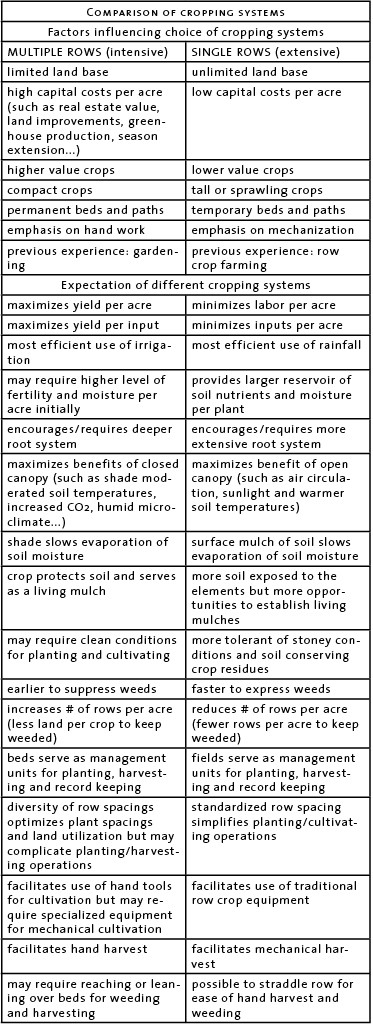
Harvest efficiency/mechanization, fertility management, disease control, and market requirements for crop size and quality may also influence plant density decisions. As for factors affecting the choice between row cropping and multiple-row systems, we conclude this article with an earlier survey of 15 experienced growers using tractor, horse and human power.
The complete survey reports with benchmark numbers can be found in the Small Farmers Journal in the articles “A Diversity of Cropping Systems” (Indian Summer 2016); “How many horses does it take to fertilize an acre of vegetables?” (Fall 2014) and “Portraits of four horse-powered farms” (Summer 2012). We revised the latter for Rural Heritage under the title “The cost of using horses,” beginning with the December 2014/January 2015 issue. It will be posted on our Cover Crops Incorporated blog at covercropsincorporated.wordpress.com.
Anne and Eric Nordell have been growing vegetables, small fruits and herbs in north-central Pennsylvania since 1983. They have self-published a booklet ($10 plus $3 shipping and handling) and DVD ($15 plus $3 shipping and handling) which describe how their integrated farm system has virtually eliminated weed pressure. Please send payment to 3410 Rt. 184, Trout Run, PA 17771.
Copyright Growing For Market Magazine.
All rights reserved. No portion of this article may be copied
in any manner for use other than by the subscriber without
permission from the publisher.