








Cultivating blooms on injured land
When farmers look for land to grow food or flowers, they generally seek out healthy soils. On the other hand, the flower farmers profiled below grow on land polluted by harsh industrial chemicals, or in one case, military firefighting foam that leached perfluorinated compounds (PFCs) into the groundwater, where the man-made chemicals may remain indefinitely.
Farming on brownfields can entail years of preliminary environmental studies, ongoing governmental approvals and intensive remediation before the first seeds or seedlings are planted. Flowers sometimes are grown to steer clear of crops headed for human consumption. Yet, the effects on insects through nectar, pollen, eating leaves or burying themselves in the soil often aren’t clear without research. More on that later.
Here, three farms share their distinct experiences.
What Cheer Flower Farm
During a sabbatical after selling a company she’d started, Anne Hillis Holland grew flowers in a community garden plot in Providence, Rhode Island. When her house was brimming with blooms, she started to drop off bouquets at the back doors of elderly neighbors. The joyous, tearful responses prompted Anne to co-found a non-profit with a mission to give flowers to folks in need of joy and healing.
Her vision included establishing a flower farm in urban Providence with easy bus access for people living in the city who have little access to fresh flowers. There were plenty of derelict factories in Providence’s urban core. “I literally would haunt commercial land sites, city hall development directors and brownfield sites that were going to be available,” she said.
In 2017, What Cheer Flower Farm zeroed in on the 2.7-acre site of the abandoned Colonial Knife Company with its windowless, dilapidated buildings and crumbling infrastructure situated around the corner from Providence’s bustling Olneyville Square, two blocks from a highway and one block from a major bus stop. The knife factory, which opened in 1926 in a former textile mill, once produced knives carried by infantry soldiers and Navy pilots during World War II. Business slowed in the 1980s, and they shuttered the operation in 2002. It sat abandoned until What Cheer Flower Farm took over.
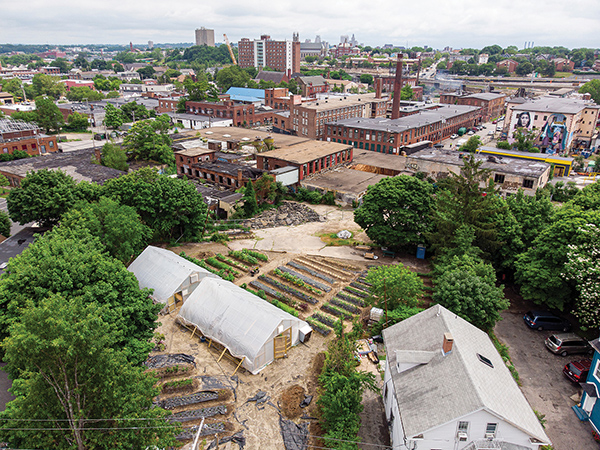 What Cheer Flower Farm operates in urban Providence, Rhode Island, at the site of the former Colonial Knife Factory. Photo courtesy of What Cheer Flower Farm.
Before they could buy the knife factory property, What Cheer raised $30,000 to test how polluted it was and determine if they could afford the remediation. Testing included drilling down 30 feet in various spots around the property. After deciding converting the old factory site was doable, What Cheer raised $535,000 to close on the property in 2018.
They had pollutants removed from the derelict factory next to an asphalt area designated for flower beds. They ripped up the asphalt (a giant pile sits in the corner of farm), and even though the area tested clean, they were required to lay a fabric barrier or cap before they trucked in gravel, soil and compost to create flower beds. They also were required to plant two feet above ground level.
“We are remediating the site bit by bit,” Anne said. To remediate each third of an acre costs about $10,000, including ripping up the tarmac, putting down the cloth, and bringing in gravel, soil and compost.
Today, they’ve converted two-thirds of an acre with plans to grow on two acres. Along the way, they received two brownfield grants — $50,000 in 2018 and $195,000 in 2019 — from the Rhode Island Department of Environmental Management. The grants require approvals and conditions and don’t payout upfront; instead the nonprofit is reimbursed after it pays out of pocket for expenses.
Anne cautions anyone considering brownfield grants. Developers who received them made it sound easier than it was, she said, consultants were needed to help with the paperwork and the timeframe for announcing winners can be years out. “Brownfields equals red tape, a long time, government oversight and not knowing how much things will cost,” she summarized.
The requirements can be burdensome. “They dictate every bit of soil we bring onto the site,” Anne said. In one case, the environmental agency took a year and a half to approve soil from an organic farm for a new field.
So why take on a brownfield? “Land is expensive in the city,” Anne said. “We were lucky to get a site that is so large.”
The two-foot-high raised flower beds dictated by the environmental agency are buttressed with stones dug up on the property, or wood, or creeping thyme along the sides of the beds. It takes the creeping thyme about a year to develop to the point where it helps contain the soil in the raised beds. The soil in the raised beds is warmer than ground-level soil, and the city landscape absorbs heat which makes the farm about 10 degrees warmer than Providence’s waterfront.
“Planning for harvest, everything is showing up too early,” Anne said. They irrigate the crops well and trial flowers to see which will withstand the conditions.
The farm grows zinnias, lisianthus, tulips, alliums, strawflowers, and loads of other varieties using organic methods. Plant choices also are not based on the aesthetics of designers or florists, instead, What Cheer selects bright, deep colors to elicit joy. All the flowers are donated, not one is sold.
They installed two high tunnels recovered from out-of-business nurseries and built a heated barn for propagation, a flower cooler, and processing for flowers and bouquets.
Currently, What Cheer Flower Farm is in the midst of a multi-million dollar fundraising campaign to demolish and remove all but a tenth of the 70,000-square-foot factory building, remove asbestos, dig up derelict oil tanks, and renovate the remaining section of the factory into a training center to prepare people for jobs in floristry and flower farming. They’ll have to cap the resulting open area and truck in more soil for new flower fields.
Their flower mission is impressive: provide free flowers every week or twice a month year round to every hospice, domestic violence shelter, homeless shelter, recovery center and food bank around the state. About a third of recipients want stems instead of bouquets so they can work hands-on with them therapeutically.
People from the city who have lost family members to violence come to the farm to arrange flowers, including prom boutonnieres. Every Thursday, What Cheer shows up with flowers at a recovery center for young mothers and helps them work with them.
“I was worried people would say, ‘why aren’t you growing food,’ but everyone gets it,” Anne said.
In addition to growing flowers, they collect flowers from regional flower farms, wholesalers and florists. Mansions in nearby Newport are popular wedding destinations, and What Cheer arranges ahead to collect the flowers as charitable donations after wedding events. They also rent out their own flowers for corporate events to raise money. Before the pandemic, they hosted pre-wedding get-togethers at the farm to teach participants how do their own wedding flowers and also hosted corporate team building experiences and birthday parties.
Individual donors are an important way to raise money. Anne cautions nonprofits from relying on grants.
What Cheer Flower Farm partners with the city of Providence for an annual flower festival centered at the farm. In August 2019, before the pandemic shut down the festival, more than 700 people attended. It featured an 18-foot flower wall as a selfie backdrop, floral crown making, florist displays, a judged floral art show, and all the trappings of music, food trucks and professional dancers.
Snaps and Sunflowers
Lucy Higgins and Becky Tiseert grew up in Cambridge, Vermont, and remember riding the school bus past the Bell-Gates Lumber Mill in Jeffersonville, a village inside Cambridge. Every time they went though town they passed it, with its stinky smells and trucks hauling stacked logs. Lumber was a big industry in that region.
The mill opened in 1920 and shut down in 2002. Eventually, all the buildings were torn down, except two old silos that were considered eyesores on the bare land.
Meanwhile, Lucy and Becky remained in the area and last year started a flower farm, Snaps and Sunflowers, on Becky’s family farm, Valley Dream Farm, in Pleasant Valley. Lucy was on Cambridge’s conservation commission from 2014 through 2017 and pushed several times to do something with the old lumber mill land but got nowhere.
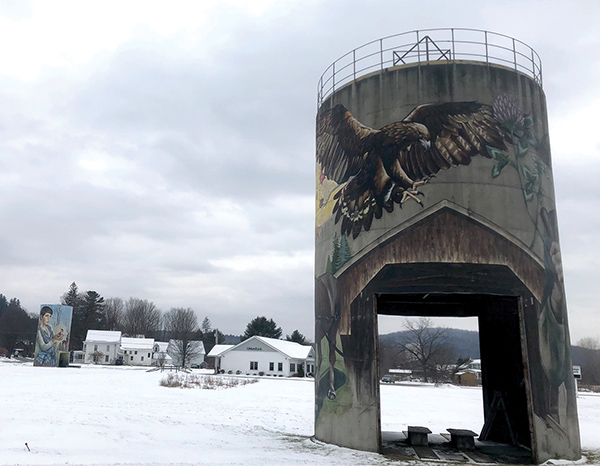 The farmers from Snaps and Sunflowers Flower Farm are creating perennial flower gardens at the site of an old lumber mill in Cambridge, Vermont. Photo by Lucy Higgins.
The town purchased the 2.98-acre property in 2014 with a goal of creating a public green space. Last year Lucy reached out to the village board again about establishing perennial flower gardens on the site and this time they agreed and provided some funds.
Enthusiasm for such a project grew after 2016 when artist Sarah Rutherford painted giant murals on the derelict silos. One representing the community’s past, features an old farmer and draft horses hauling lumber; the other represents the future and features a child in overalls holding the state bird, the hermit thrush, surrounded by red clover, an owl, deer and bee. The giant murals, a gateway to Cambridge, are drawing tourists.
“Now the community is so involved in that piece of property,” Lucy said.
They will start planting this spring, with a goal of having various native species in bloom during spring, summer and early fall. The path to this point has been smooth for the flower farmers because public officials and a previous owner who had planned to put a gas station there, did all the environmental studies and remediation.
The Vermont Department of Environmental Conservation, in a report certifying that remediation was completed, noted that the north-central part of property contained levels of polychlorinated biphenyls (PCBs) “above industry standards” two feet deep. Sawdust in the northern silo also contained PCBs. Polycyclic aromatic hydrocarbons (PAHs) “above residential levels” were found six inches deep throughout the property. Ground water tests were clear of contaminants above what is deemed acceptable.
The top six inches of soil were removed from the entire site and a geo-textile barrier was placed over the north-central area where PCBs were found before infill was spread. That area is supposed to remain completely undisturbed. An annual inspection is required every year to determine if soil was disrupted and if remediation is required.
Lucy and Becky plan to steer clear of the PCB area and are starting the public flower gardens around the silos. Until the perennials are established, they plan to plant some annuals. The land-use agreement stipulates that projects must be beautification only.
“My goal is to put a call out for community involvement to folks in town as well as farms in the area to see if they would like to donate any perennials from a list that we will curate,” Lucy said. “The goal is to create gardens that are majority native species that will remain established with minimal upkeep over the years.”
Gather Mountain Blooms
Venetucci Farm dates back to 1936 in Colorado Springs, Colorado, as a vital and beloved community institution in the shadow of Pikes Peak. In 2006, Pikes Peak Community Foundation took over the 200 acres of fields, a farmhouse and an iconic red barn from the Venetucci family. The foundation ran an organic vegetable farm there for the next decade.
Then in 2016 the community learned that foam used to fight fuel fires at neighboring Peterson Air Force Base had been leaching perfluorinated compounds (PFCs) at levels more than 1,000 times higher than a national health advisory limit into the groundwater and aquifer that serves tens of thousands of residents long before anyone knew it. The pollution disaster is especially mortifying because to date there’s no remediation for the toxic “forever” chemicals used in the flame retardant.
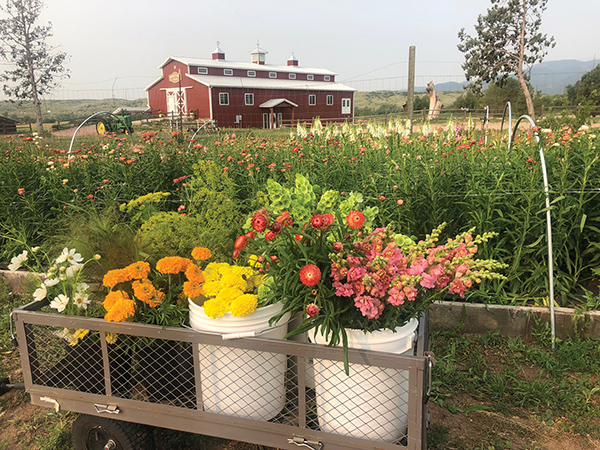 Gather Mountain Blooms farms at a site in Colorado Springs, Colorado, where the water is polluted by firefighting chemicals used by a nearby Air Force base. Photo courtesy of Gather Mountain Blooms.
“You can’t actually clean it up,” said Samuel Clark, executive director of the Pikes Peak Real Estate Foundation, which is overseeing the property. “It’s tough news for the farm and for the community.”
Not only are these man-made chemicals — also known generally as polyfluoroalkyl substances (PFAS) — an issue at Air Force bases, airports and other industrial sites, they’ve been used in many household products such as Teflon.
While the farm and local water district sued the Air Force to filter the wells and scrape the soil and replace it, Clark said the sticky chemical is likely still present in some form. There’s no chemical or mechanical way to clean the aquifer.
For a while the Air Force provided bottled water at the farm, and eventually the city hooked up the farmhouse to filtered city water to bypass well water for human uses. The city continues to regularly test the water and a community non-profit continues to solicit people to get tested for PFAS for ongoing research on the impacts.
Once they were aware of the toxic pollution, the organic farm operations were suspended. Tests showed PFAS in the soil, groundwater, and all the farm produce sequestered them on some level, with spinach and leafy vegetables sequestering the most, Clark said.
After the discovery, the foundation began the arduous task of figuring out how to use the land going forward. The Venetucci Farm land is preserved from development by a conservation easement. It was important to engage in even small operations on the land to keep the water rights intact as water allocations are based on previous water use. As the October 2021 GFM article on climate change in the Intermountain West emphasized, water rights are life and death for many farms.
The foundation contracts with an outside operation to grow hay and alfalfa on the property which maintains the fields, controls weeds and maintains the water rights. Meanwhile, crops grown on the farm can’t be consumed by people because of the farm’s contaminated water supply.
Other ideas generated by a study, included a wedding venue, pumpkin festival (pumpkins trucked in because they are potentially eaten) and a distillery. In the end, they decided on a flower farm as a non-consumable agriculture product that also brings in the community.
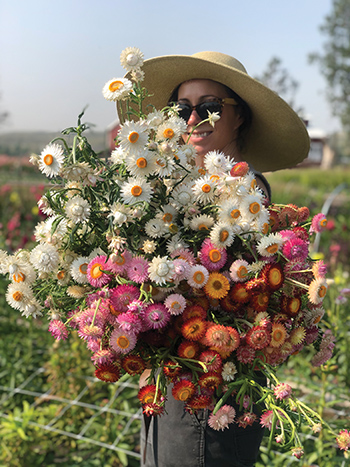 Leah Remacle, one of three sisters who run Gather Mountain Blooms, with strawflowers. Dried flowers are an important crop for them. Photo courtesy of Gather Mountain Blooms.
Enter Nikki McComsey, who did accounting and administrative work at Pikes Peak Community Foundation before she was sidelined by a concussion. She had no flower farming experience but was growing flowers in her backyard when she asked Clark what was happening at the Venetucci Farm. That led Nikki along with her two sisters, Leah and Abby Remacle, to start Gather Mountain Blooms at the farm in January 2021.
In a short time the sisters created a vibrant flower farm that invites community members to cut their own flowers, for weddings in the barn, workshops and a farm flower store. They reinstated the long tradition of a fall pumpkin festival (pumpkins trucked in). The cut-your-own operation on Saturday mornings has been the most profitable part of the farm, with 300 people coming the last weekend of August last summer.
Gather Mountain Blooms also sells through the Colorado Flower Collective, directly to florists and for events. Over the off-season, an NRCS grant allowed them to install five high tunnels. “We did it for hail protection,” Nikki said. “We get so much hail it’s not so much for season protection.”
Their farming practices aren’t different from other flower farmers, but they can’t grow edible flowers and are holding off on planting too many perennials since they’re leasing the land. They are currently in year two of a five year lease with an option to extend.
The flower crops are watered with the well water, that is, the contaminated water. Nikki says she hasn’t seen any effects on the flowers, and, of course, she and her sisters see multitudes of bees and butterflies on the flowers.
Pollution and pollinators
Aimee Code, Pesticide Program Director at The Xerces Society for Invertebrate Conservation, told me that the existing data on how PFAS harm pollinators is limited. “What data we do have is concerning,” she said. The PFAS that have been studied are generally considered moderately to highly toxic to honeybees, Code said, and affected reproduction in bumblebees.
“This issue seems ripe for research,” Code said. Farmers concerned about insects and pollution should reach out to extension services and local universities to set up research. If a farm can’t find researchers, Code said she and Xerces could try to link them up with their university partners.
There is some cause for optimism. “As PFAS remediation is a growing field, hopefully these farms will be able to take advantage of the newer remediation practices,” Code said. Some new research demonstrates potential to break the carbon-fluorine bonds. The Pikes Peak Foundation has been pursuing research on remediation options.
Jane Tanner grew cut flowers and specialty crops at Windcrest Farm and Commonwealth Farms in North Carolina, and helped manage the biodynamic gardens at Spikenard Farm in Virginia.
Copyright Growing For Market Magazine.
All rights reserved. No portion of this article may be copied
in any manner for use other than by the subscriber without
permission from the publisher.