







Agriculture is expanding in the subarctic and arctic of Alaska and Canada as temperatures in those northern latitudes rise two to three times faster than on the rest of the planet. Crops are started earlier and remain in the ground longer. In Whitehorse, Yukon, farmer Sarah Ouellette harvested field herbs and greens in the later half of September, a time when freezing temperatures historically already would have knocked out the plants. In Inuvik, the northern most point in western Canada, 200 kilometers north of the Arctic Circle, Raygan Solotki had chickens running around in the fall because it’s warm enough now. Solotki is executive director of Green Iglu, a nonprofit expanding agriculture far north by installing geodesic greenhouses.
Growing food locally is existential in these regions where all but a fraction of groceries are imported and very expensive. The import distribution channel is fragile and vulnerable to interruptions and collapse, which happened, for example, last fall with flooding in British Columbia.
Many rural Indigenous communities are embracing agriculture as wild sources of meat and fish shrink. The Aqqiumavvik Society in Arviat, Nunavut, built an educational greenhouse along with mini grow boxes for individual families to grow food. “We are monitoring climate change and one of the positive aspects was an increased growing season and improved nutrition for children,” said Shirley Tagalik, chair of the Aqqiumavvik Society, which focuses on wellness and maintaining Inuit cultural practices.
Inuit and First Nations communities tightly link agriculture and food sovereignty to nurturing and supporting children and young people who are a majority of these populations and suffer high rates of suicide and mental health struggles.
While opportunities to grow more food are welcomed, land clearing and warming soils accelerate climate changes. Rising temperatures melt carbon stored in permafrost and allow carbon dioxide and methane to escape into the atmosphere, prompting a feedback loop of more warming and melting. The permafrost, the frozen soil and ice covering the arctic and much of the subarctic (though not uniformly frozen), has been intact for hundreds of thousands of years. The thawing is causing mass erosion and the land to slump and buckle. Terrain is shifting, housing and infrastructure are collapsing, and movement and transportation are impeded.
Researchers in the far north are comparing clearing methods to allow more food crops while reducing permafrost thaw and release of greenhouse gases. German researchers buried and retrieved sensors on Sarah’s farm and other sites to study how changing forest to cropland affects losses of soil carbon.
Yukon — TH Farm
In 2014, the Tr’ondëk Hwëch’in First Nation established TH Farm on property skirting the Klondike River in Dawson City, Yukon, taking advantage of periods of continuous daily sunlight during the summer and fertile topsoil as the region eluded glacial erosion and benefited from regular flooding. Yet, increased precipitation and snow pack are triggering massive flooding that put the farm underwater, washed away top soil, damaged infrastructure and necessitated massive debris clean ups, said Derrick Hastings, TH Farm’s manager since 2017 after years of homesteading and farming in the Klondike.
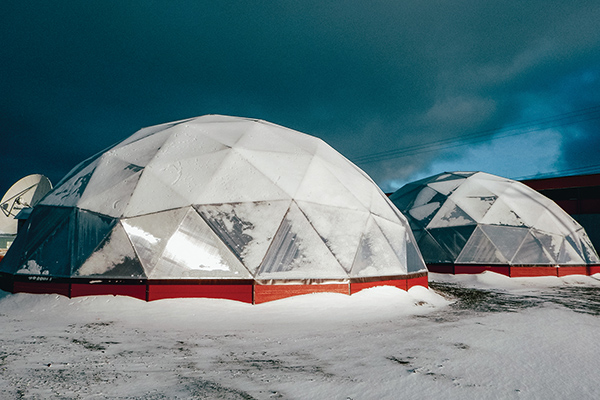 Two Green Iglu Grow Dome® greenhouses in Arviat, Nunavut, where growing local produce has become a priority. Photo courtesy of Green Iglu.
To repel flood waters, they built a 20-foot-tall dyke that runs 50 feet. Flooding, fires and temperatures are becoming more erratic. While fire season typically is in June, Derrick says they had fires in late July and August, one within five kilometers of the farm that prompted them to prepare to move all the animals.
In addition to a 2.5-acre market garden and half an acre in Saskatoon berries, they have laying hens, turkeys, ducks, rabbits and pigs on various parts of 80 acres. For years, they’ve also grown crops in a 30-foot-by-60-foot gothic-style greenhouse and started plants in a 16-foot-by-24-foot greenhouse made from scavenged materials and heated by a wood burning stove.
Indicative of the heightened importance of agriculture in the region, TH Farm won a $500,000 Arctic Inspiration Prize to build a 40-foot-by-80-feet, year-round cold-climate greenhouse along with a commercial kitchen and storefront. The government matched it with $500,000 more from climate change adaptation funds. The typical five-month growing season will be doubled, said Derrick, who is not a First Nations member but follows the guidance of Tr’ondëk Hwëch’in elders who want local food and the knowledge and labor to produce it available to the community. Their fragile imported food system starts in California and funnels through an Edmonton distribution hub. “We’re the end of the road, we’re the last people who get the food,” Derrick said.
Although the growing seasons are longer, substantial rains at the end of August impacted production. I spoke with Derrick at the end of October when temperatures were -1°C (30.2°F) to -5°C (23°F), much warmer than previous averages around -20°C (-4°F). “It’s easier to work, you can accomplish more in these temperatures,” he said. The farm produces cold-loving cabbage, and broccoli among other crops.
Young people learn to grow crops and animal practices through student positions and apprenticeships at TH Farm. “The farm plays an important role with youth, building confidence and work ethic,” Derrick said. It is a community base for employment, alternative justice and detox. It supplements the salmon, moose and caribou diet as wild stocks are depleted or change migration patterns as subalpine vegetation is supplanted by other plants.
Sarah’s Harvest
Sarah Ouellette was named Yukon’s 2019 Farmer of the Year by the territory government for her small-scale, certified organic farm, Sarah’s Harvest, near Lake Laberge in Whitehorse. It’s her eighth season farming in the Yukon where she grows a wide variety of vegetables and herbs for markets, restaurants and stores.
Sarah was accustomed to Yukon’s dry climate, but recently endured record-breaking precipitation. “I had crops rotting in the field,” she said. Two summers ago she seeded 10 successions of dill, but only harvested three. Others blackened in the rain. Last summer, she experienced a so-called 100-year flood from prior heavy snow fall and a hot summer that brought more melt and flooding. Her gardens and house are high and were spared damage, but late last fall Lake Laberge was still high.
Last fall was mild and she harvested kale and other crops for a September 23 market. “I never imagined I’d go to a market that late,” Sarah said. “I was astonished to be harvesting greens and herbs as late as we were. It’s devastating to get a frost mid-August but not usual.” On the other hand, the late harvest meant she had to push back prepping fields for winter. The previous winter’s heavy snowfall meant delays in planting spring crops.
It’s been a seesaw of heavy or low snowfall, late or normal fall temperatures. “How do you plan?” she asked. “I expect the unexpected.”
Since 2017, the added rain and warmer temperatures brought an invasion of cutworms, a pest previous farmers had not seen. She applied Btk (Bacillus thuringiensis var. kurstaki). “If I let my guard down, I get wiped out,” said Sarah, who added she applies it when larvae are small. Five successions of Napa cabbage were lost completely last year to what Sarah thinks were disease and root maggots. She’s going to try it again this year. “If I experience the same losses I’ll cross it off my list.”
She’s getting expert help from Yukon’s Agriculture Branch, which added her farm last year to a pest and disease surveillance study. Fields were systematically monitored for signs of pests and diseases, and samples were sent to diagnostic labs and entomology experts in Alberta for ID, said Kristine Ferris, Agriculture Policy Analyst with Yukon’s Energy, Mines and Resources Agriculture Branch.
“As this kind of work hasn’t been done before, we are likely confirming pests and pathogens that have been here for a while, therefore, correlating their presence to climate change wouldn’t be possible at this point,” Ferris said. “However, we can assume that as our climate changes and we potentially see milder winters and extended growing seasons, we will also see changes in pest and disease populations. We should be monitoring for this.”
Ferris said it’s not clear what wiped out Sarah’s Napa cabbage, but suggested the warmer temperatures during the long hours of summer sun caused rapid plant growth that comprised the ability to uptake nutrients, combined with rot entering wounds created by cabbage root maggots feeding.
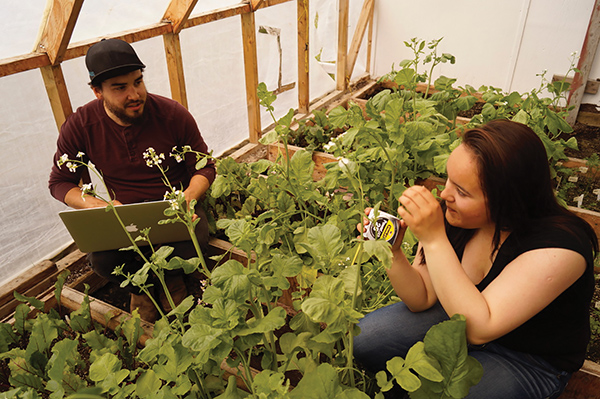 Young community members in Arviat, Nunavut, Canada, chart plant growth in a research greenhouse. Photo courtesy of Aqqiumavvik Society.
Many farms in the northern regions are created by clearing forests, and Ferris said she and her colleagues are trialing and comparing different clearing methods in terms of cost, greenhouse gas emissions and crop growth. In conventional clearing, trees are bulldozed into piles and burned. In another method under scrutiny, trees are bulldozed and chipped and applied annually as a surface mulch. The third approach uses a forestry mulcher and subsoiler, mulching and incorporating trees directly into the soil. Ferris said Yukon’s agriculture policy promotes an environmentally responsible use of timber and woody debris during clearing.
Last fall, Germany-based Thünen Institute of Climate-Smart Agriculture came to Sarah’s farm to retrieve sensors they had buried two years earlier in her market fields and adjacent forest to compare rates of carbon decomposition in agricultural soils versus forest soils. This study of the consequences of extending agriculture northward is dubbed “Breaking the Ice” and is scheduled to be completed this March. Dr. Christopher Poeplau, who is leading the research, offered initial results which point to avoiding converting areas with shallow permafrost soils into farms.
“We hypothesized that changing forest to cropland will lead to losses of soil carbon and that the loss will be more pronounced when the forest is influenced by permafrost in the upper ~80 cm of soil (roughly 31.5 inches),” Poeplau wrote in an email exchange. “If the forest is permafrost free in the upper 80 cm (that is the drier and warmer sites), we do not see a loss.”
He pointed out that farmers add carbon to the soil with inputs and crops. If agriculture is carefully established where soils are free of shallow permafrost, “initial losses after conversion are quickly compensated by cropping the soil.”
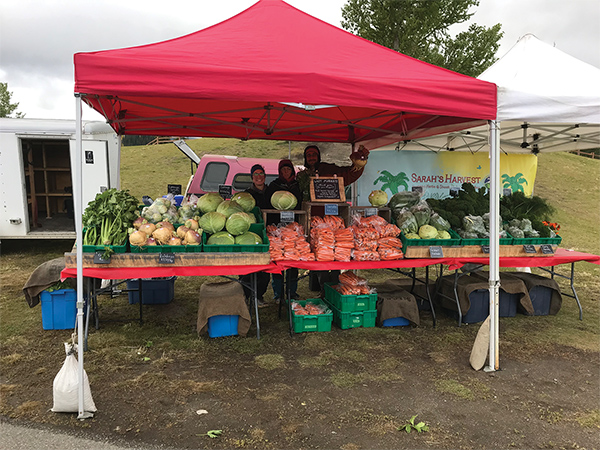 A surprisingly robust September 23, 2021, market stand for Sarah’s Harvest organic farm in the Yukon. Normally by that time of year hard freezes have taken out the crops, but climate changes brought a milder September. Photo by Paolo Nicolardi.
“But if the forest soil contains permafrost and is converted to agricultural land, the risk of losing carbon quickly is increasing,” Poeplau wrote, adding that increased greenhouse gas emissions (mainly N2O, Nitrous oxide) from agricultural soils, were not measured in this study.
Arviat, Nunavut, Canada
Leaders in Arviat are introducing more agriculture with a goal to improve nutrition among young people, Tagalik said. Two-thirds of the Arviat’s 3,000 residents are under 18.
“Kids are not eating the nutritious country foods (caribou meat, fish, seal, whale, geese, ducks) the way parents are,” she said, instead they eat microwaved burgers and processed foods. The Aqqiumavvik Society’s research greenhouse gave young people an opportunity to grow vegetable crops that were given away in the community. “This became quite popular, stores were noticing the demand for produce was increasing,” said Tagalik, a Montreal native married to an Inuk man. Her daughter, Kukik Baker, runs the youth hunting program at the Society.
Students researched the best way to improve inert soil with local inputs. They tried seaweed, worms, composting and animal waste and decided the most efficient was goose droppings from overpopulated geese. Lettuce, chard, spinach, radishes, carrots, beets and potatoes did well, but cauliflower and broccoli did not. They tried to hand pollinate tomatoes, but it didn’t work out. A high school produced seedlings for the greenhouse and family grow boxes. They used barrels filled with water warmed by sun to heat the greenhouses and a thermal covering over the greenhouse in the fall to retain warmth during the night.
The students also built the grow boxes, mini greenhouses, that were distributed around the community and they made home visits to teach families how to grow food. The wellness society promoted use of local berries by preserving them into jams.
Climate change has introduced new flies and parasites found in wildlife, but Tagalik says they didn’t notice these pests in the greenhouse or the family grow boxes when the plastic hoods were lifted in sunny weather.
There is much less precipitation now in the winter months when the region goes into a deep freeze. That translates into less snow protection of ice, Tagalik said, and rapid thawing in the spring. Meanwhile, in the last five years, big dumps of rain in September and October caused flooding and erosion.
While the Aqqiumavvik Society upped demand for vegetables, in 2018 the hamlet contracted with Green Iglu to build two greenhouses as a commercial venture to sell produce. “We did not want to be in competition with the hamlet, giving away produce away free,” Tagalik said. So they dismantled the research greenhouse and distributed the grow boxes to additional families, who have carried on growing from home. “We’d look at doing greenhouses again, if there were demand and if we were not encroaching,” she said.
Green Iglu, the Toronto-based non-profit with funding from government entities, foundations, fundraising and other sources, has built eight greenhouses under the trade name Grow Dome® with many more in the works this year in both subarctic and arctic locations. Solotki said $150,000 to $250,000 is the general range for constructing the Grow Domes® and training locals to run it.
Extensive insulation is installed underneath and around them to keep the permafrost from melting. The geodesic domes use a polycarbonate exterior, a solar-powered heat ventilation system, and thermal mass storage to maintain temperatures 30° degrees warmer than the external environment, entirely from sunlight. The greenhouses are equipped to withstand wind speeds of over 180 kilometers (112 miles) per hour and 2.1 meters (7 feet) of direct snow.
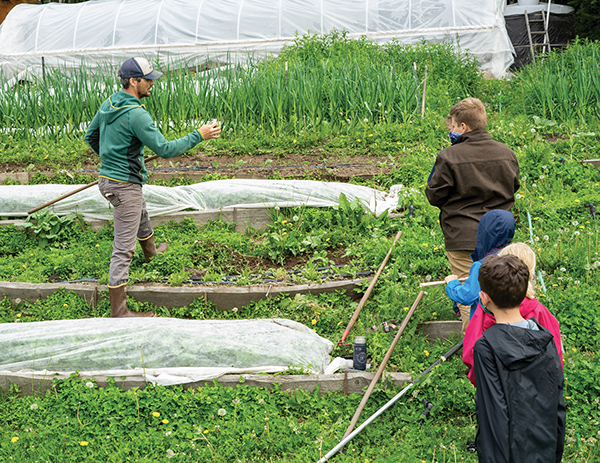 Calypso Farm and Ecology Center near Fairbanks, Alaska, educates young people about farming and the environment. Photo courtesy of Calypso Farm.
Initially, the domes were used to grow primarily leafy greens in hydroponic towers. More recently, after some tensions and a mea culpa, Green Iglu recalibrated its operation to align with requests from the Indigenous communities. “We are relearning,” said Solotki, who recently took over Green Iglu. They are transitioning away from hydroponics to soil-based raised beds and growing higher density foods — such as potatoes, tomatoes and squash — that are more expensive to truck in. They are focusing on wellness and healing for young people.
The two greenhouses in Arviat got off to a slow start. During COVID, a travel ban prevented the trainers from coming to instruct the locals, but it opened up last year.
“Climate change is making people consider more carefully their options to sustain themselves and for many that means growing their own food,” Solotki said. There are massive changes to the permafrost, she said. “Right now, I have wet damp snow, which is unusual,” Solotki said when we chatted last fall.
Fairbanks, Alaska — Calypso Farm and Ecology Center
Susan Willsrud and Tom Zimmer grow food on 2.5 terraced acres in Ester, Alaska, 10 miles west of Fairbanks for a 130-member CSA (and give away shares to more than three dozen families in need) and sell at a farmers market. They mentor and support the community with education and events around ecological growing, the environment and homesteading skills. Shetland sheep, dairy goats, bees and chickens are integrated into the farm.
There is no permafrost under their fields as there is in the nearby forest on north facing slopes. “We are in an area of what’s called discontinuous permafrost, so it’s in patches mostly in north facing areas,” Susan wrote in an email exchange as the phone signal can be inconsistent. “Our fields are all on south facing slopes with relatively warm soils.”
As farmers in this and other regions around North America have echoed, unpredictability is a key feature of climate change. “In recent years we’ve seen so many extremes, one dry season where it never rained until it snowed and we also saw the wettest season on record not many years later,” Susan shared. “We’ve seen the earliest start to season where we were able to start planting in the field in early- to mid-April and then the latest start where we couldn’t get into the field until the very last days of May and those were also just a few years apart.”
She said extreme weather events such as pounding hail, downpours and heat are now common. The wet has brought new mildew diseases. Wilts once common, now are rare.
In response to the changes, they are doubling down on fundamentals they practice and teach: Resilience and adaptability. “We plan for both early and late starts at the same time. We plan for water conservation and storage when water is limited as well as good drainage when there’s too much water. We are as prepared as possible for early and late frosts and ready to go in the ground early and extra backup heat in case temps stay unseasonably cold. We have backup plans on top of backup plans.”
Their dedication to biodiversity has help maintain stability and health on the farm. Prompted in part by climate change, they are dedicating an acre to seed saving and elevating its status on the farm. Calypso focuses on seed saving for the same reasons other farms do, to preserve the diversity of open-pollinated seeds and to improve varieties for growing in a specific place. It’s especially important in Alaska to reduce dependence on seed companies and shipping and provide seed stock locally to growers and to create a model of seed saving to share knowledge and resources to other growers.
“We can do this, we can and should support one another as we navigate the unknowns,” Susan said.
Jane Tanner grew cut flowers and specialty crops at Windcrest Farm and Commonwealth Farms in North Carolina, and helped manage the biodynamic gardens at Spikenard Farm in Virginia.
Copyright Growing For Market Magazine.
All rights reserved. No portion of this article may be copied
in any manner for use other than by the subscriber without
permission from the publisher.