








One of the keystones of organic growing methods is crop rotation. On a market farm growing many different crops, it can be a real puzzle to figure out effective rotations. Over the past couple decades I’ve worked on a number of market farms and set up rotations for numerous conditions. I’ve also modified rotations as things have changed for one reason or another.
Over the seasons, I’ve come to understand that there are a number of straightforward principles in setting up a rotation, but also complicating factors when it comes to implementing and maintaining a good rotation. The following offers principles I consider and benefits and drawbacks I’ve experienced over the years.
Why rotate crops?
When I first read about crop rotations the explanation was always about fertility cycles. The classic rotation went like this: The first year in a crop that builds fertility (a “giver,” likely a legume). The second year in a crop that needs a lot of fertility (heavy feeders like squash). The third year in a crop that doesn’t need as much fertility (light feeders like lettuce). Then, either a fallow to rebuild or back to a fertility building crop.
More common now is to hear crop rotations discussed in relation to breaking pest and disease cycles. Pests and diseases can build up along with their host crops. By planting a different crop that is not a host for one or more years after pests and diseases built up, you can reduce or even eliminate the problem in future crops.
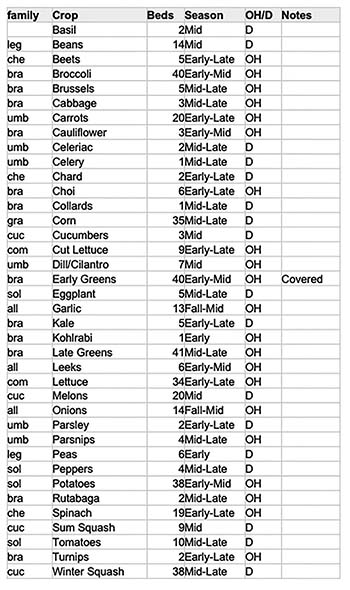 An example of a list of crops grown by the farm, including columns for family, crop, beds (quantity of space), season, and irrigation type.
For example, I’ve worked on multiple farms here in the Pacific Northwest, and with our low pH soils and large number of brassica crops, clubroot is ubiquitous. By planting brassicas only every fourth year and paying attention to other good growing practices, I can keep the clubroot levels low enough to keep it from impacting yields. If I replant a field in brassicas sooner than four years, I start seeing more losses and yields go down — sometimes to the point of complete crop losses.
Another benefit of rotating crops can be easier weed management. My introduction to this was an excellent presentation by Ann and Eric Nordell on their rotation systems at a 1990s Pasa Sustainable Agriculture conference. They nearly eliminated cash crop weeds with their system. While the specific method they were using didn’t translate well to the farms I was working on, the idea that crop rotations affected weed populations became the primary basis for my farm rotations. It also was surprisingly effective, even in the second year of a multi-year rotation plan.
When making a rotation plan, I pay special attention to whether weed pressure tends to be better or worse following a particular crop, and whether or not the crop that I’m planting is sensitive or tolerant of weeds. For example, in my systems the shorter maturing crops, like lettuce, tend to be both easier to keep clean of weeds, and give less time for any weeds that escape to actually make seed. Crops like sweet corn, on the other hand, are in the ground for much longer, and while they’re relatively easier to cultivate than some, they’re more tolerant of weeds, and any weeds that do get past early cultivation aren’t worth hand weeding out. This means they have plenty of time to make seed.
A crop like potatoes is relatively easy for me to cultivate so that’s a fine one to follow a crop like sweet corn that has increased weed pressure. I want to plant carrots, which are very sensitive to weed pressure, after a crop like lettuce that has helped to reduce weed pressure.
I also have different weeds at different times of year. Cool season weeds like chickweed and red dead nettle are my biggest problems in the spring and fall. Warm season annuals like pigweed and annual grasses are our biggest problems in the summer.
In the above example of potatoes following sweet corn, an added benefit of that particular rotation is that while the sweet corn does build up weed pressure, it’s primarily the warm season weeds. We plant potatoes while soils are still cool in the spring. By the time the soil is warming up enough for summer weeds to germinate, the potatoes already have a full canopy which nearly eliminates summer weed germination until after the crop is already senescing.
Dividing up fields
If you’re lucky, your farm is one big rectangle and all of your beds are the same length and your soil conditions are such that you can plant anything, anywhere, at any time. I’ve been lucky enough to farm a piece like this with well-drained soil, relatively flat ground, and essentially all in one big rectangle. In this case, I was able to immediately go to the step of figuring out what size block made the most sense based on the largest area of any one crop type I was growing.
Most market farms will have at least two separate rotation plans because these days most grow crops in the field and grow a separate subset of crops in one or more high tunnels. You may also have fields with different limitations, and thus, like a high tunnel, only ever grow a subset of the crops that the farm produces in those fields.
I worked on a farm where a portion of the fields were too wet to get into early in the spring, and were susceptible to erosion if they didn’t have a good cover crop by the time our fall rains came in earnest. That field had its own rotation of only short season summer crops. I would work the plan for that field first, and then everything that didn’t fit into that field went somewhere in the other fields.
I’ve worked on other farms where irrigation was limited in some sections of the farm, or where trees shaded the field for a significant portion of the early spring. There are lots of possible reasons why one farm might have multiple different rotation plans. Some crops might only show up in one of the rotation plans, others might jump back and forth between fields with distinctly different characteristics.
Grouping crops
My strategy for creating groups of crops and figuring out how large the rotation blocks within a field will be is to make a list of all of the crops I grow. I don’t break this up too much, mostly by broad types, such as lettuce, onions, tomatoes, peppers, potatoes and so on. For this list I don’t need to separate varieties or types.
I create the list on a spreadsheet with the first column a list of crops to make future sorting easier. In the next columns, I put other crop distinguishing features that make likely dividing lines. Typically this includes separate columns for the crop family and irrigation type (drip vs. sprinkler). Occasionally I’ve included others such as weed sensitivity and early/mid/late/full season.
I also include a column that tracks the approximate amount of space I plan on growing each crop type. I have a standard bed length so I use the number of beds I plan to grow in a season. On some rotation plans I’ve simply used the planned square feet or acres. As long as the unit is consistent it doesn’t matter what it is.
A great thing about using a spreadsheet and making the list in columns is ease of sorting. The first sort is by the amount of space planned for each crop. I usually sort by multiple columns at once, making the space the primary, the irrigation type or plant family secondary and tertiary. With a sort like this I can start to see what size rotation blocks will make sense.
Usually there are some crops, or groups of the same crop family, at the top that are similarly large and whichever one of those is the largest will probably determine the size of a standard rotation block. After that, I need to make groupings of the same quantity of space for the remaining crops. For those groups I’m trying to match irrigation and other growing preferences so that the rotation block can be treated equivalently.
One of the tricky parts, especially for smaller farms with limited space, is that there are often more crops than look like they will fit. Sometimes this can be worked around by double-cropping sections, or even triple-cropping if there are enough quick maturing crops and your season is long enough.
Double- and triple-cropping brings up another interesting conundrum: is it better to repeat crops in the same family in the same year, or to switch to something different? I’ve tried both approaches and my experience is that they both have different benefits and drawbacks. If you stick to the same crop family you can then stay entirely away from that family for longer, but if you’ve built up any pest or disease problems with the first round, your second round will suffer.
Deciding an order
Once I have the basic blocks identified the next step is deciding what should follow what. As I mentioned above, I typically focus first on what kind of weed pressure will follow a crop block. I’m trying to follow crops that help clean up weeds with crops that are sensitive to weed pressure when they are young, and crops that tend to build up weed pressure with crops that are relatively tolerant of weed pressure and easier to cultivate.
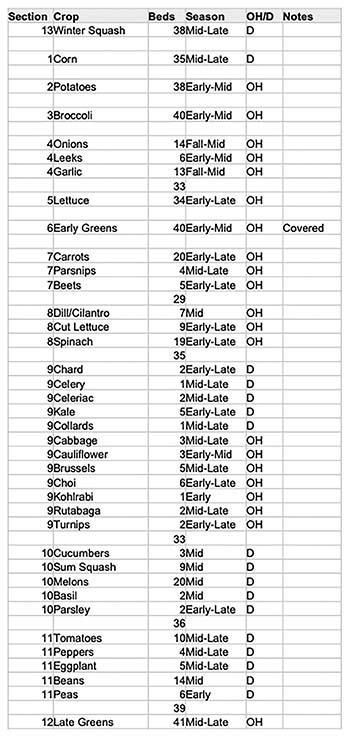 This is the same list as pictured above, after it was sorted and separated into likely rotation blocks. All images courtesy of the author.
I’m also paying attention to crop fertility needs, but secondarily to their relationship to weeds. In addition, there are some recommendations in a few older gardening books I have for crops that like to follow certain crops, and others that don’t, and I do feel like those recommendations have worked well when I’ve been able to fit them into the rotation.
For both companion planting lists and crops succession lists I often refer to the section on companion planting in How To Grow More Vegetables by John Jeavons; the section on rotation planning in The New Organic Grower by Eliot Coleman; and the appendices in the book available from SARE, Crop Rotation on Organic Farms.
Mapping in space and time
For really basic rotations, a grid showing fields by the year is all I need to remind myself what goes where the following season. Each year I detail my field blocks when I make my crop plan using the map in space and time that I mentioned in the March 2022 issue of GFM in the article, “Crop succession planning for even harvests.” This map is particularly good for tracking exactly what was where the previous season and lining up the individual crops within a mixed rotation block to take advantage of particularly weed-free beds, or beds that had soil building crops like legumes the previous season.
Stick with it or change it up?
A big advantage of having a crop rotation plan in place is that it makes my decision-making on what to plant where easier. This is true for the cash crops, and it’s also true for the cover crops. When I know, more or less, what crop is following in the next year, I can start to customize my cover crops to benefit the following crop.
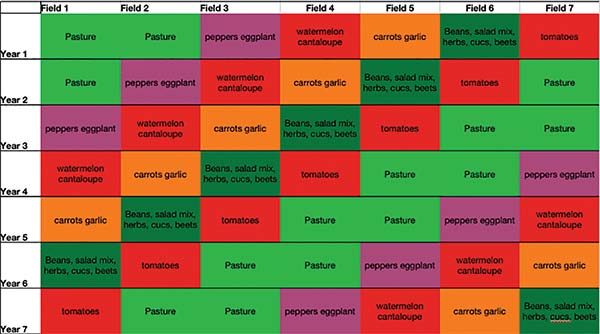 Another way to look at rotations is in grid form. In this example, you can see how two years of pasture is worked into the rotation. A two-year crop gets two blocks here, with one block planted every year, meaning there’s always one block coming out of the second year.
As an example, if I know that a field is going to be worked up early the following year for the first greens of the season, I’m not going to plant my standard rye-vetch mix, which won’t mature until later and doesn’t break down as quickly as a winter killed Sudan cover crop inter-seeded with crimson clover.
However, even after you’ve made an excellent crop rotation plan something unforeseeable is inevitably going to change. You’re going to have to decide, given the new conditions, if you should stick with the plan or change it. I always think of plans as practice rounds, helping me hone my decision-making skills so that when unanticipated conditions arise, I have the best chance of making a good decision about how to address it going forward.
Balancing push and pull
In his book, The Lean Farm, Ben Hartman talks about the potential inefficiencies of producing too much of something that buyers don’t really want and then trying to push that product on them. This concept is important to keep in mind, and is likely something that will change your rotation over time. But there’s also a balance of push and pull.
Part of that balance is introducing people to new crops, and those might be crops they just aren’t familiar with, but that are both good to eat and play an important role in your crop rotations. In this case, you need to actively generate pull, by pushing those products a bit. In the short term this is more difficult, but over the long term it can help maintain productivity.
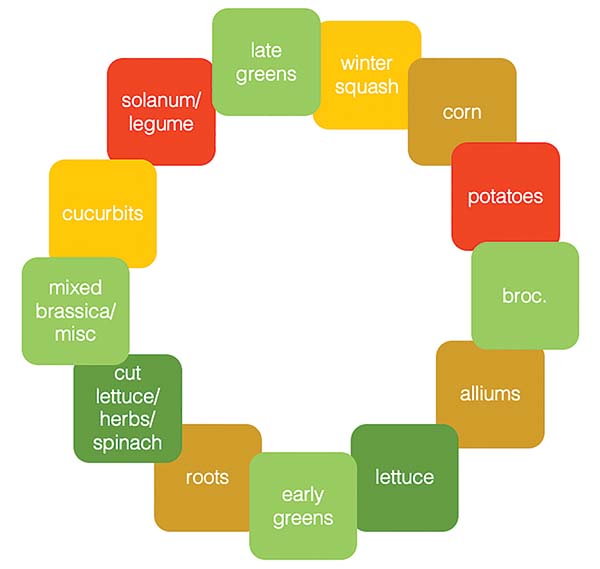 This rotation is shown in circular form with blocks progressing clockwise. Note that so many brassicas are grown on this farm that there are only two crops between some brassica plantings, but they are alternated between long season brassicas and short season brassicas (early and late greens).
I have a number of crops that I grow because I love them and they fit well in my rotations, even though they can be hard sells for some people, and less productive than my most productive crops. These are crops like popcorn, which doesn’t produce much per space, and radicchio, which (until recently) wasn’t well known by my customers, but provided a good alternative to brassicas in the colder seasons. For an example of an effective way to introduce your customers to a new crop, see the article, “Chicory salad mixes: Adding value to radicchio so you can grow and sell more” from the February 2022 GFM.
When I first started working with chefs who were excited about farm to table many years ago I thought they were going to tell me what I should grow for them if I asked them. What I realized over time was that the best ones were asking me what they should be cooking with at different times of year. With both top chefs and CSA members, having customers who trust you, the farmer, to balance the needs of the fields with what they see on their plates is the best way to make crop rotations sustainable in the long run.
Josh Volk farms in Portland, Oregon, and does consulting and education under the name Slow Hand Farm. He is the author of the book Build Your Own Farm Tools and Compact Farms: 15 Proven Plans for Market Farms on 5 Acres or Less, both available from Growing for Market. He can be found at SlowHandFarm.com.
Copyright Growing For Market Magazine.
All rights reserved. No portion of this article may be copied
in any manner for use other than by the subscriber without
permission from the publisher.