








Standout flower varieties in the key color
As the Slow Flower Movement picks up speed with international trade disruptions and climate change challenges contributing, locally produced flowers are getting more attention and sales opportunities are increasing. But what flowers should you focus on growing? Whether the main color or an accent, pink is an important color for many arrangements. After consulting other flower growers, I compiled this diverse list for those who want to know what the strongest options are for pink blooms.
This list includes annuals, biennials, and perennials. There are fillers, spillers, and thrillers (the structural, textural, and focal flowers of a bouquet). And while some plants are quite gracious, some challenging ones (for experienced growers only) are included as well. There was one commonality specified when I asked growers, including myself, about flowers for this list. These flowers must be particularly well presented in pink.
While my conversations and observations were many and varied, Laura Langford of Marygold Meadows in Bellevue, Michigan, was my chief and quotable correspondent; many of her thoughts are included below.
Filler
Versatile: globe-amaranth (Gomphrena globosa and G. haageana) is a favorite of old on our farm. This multi-branched, almost shrubby annual now seems to be gaining a much wider (and much deserved) sphere of appreciation and popularity. With flower heads often described as clover-like by intrigued market customers, globe-amaranths come in two species with slightly different growth habits and different colored flowers, each adding a different look to a bouquet.
G. globosa comes in light pink and rich pink, while G. haageana is available in a rather hot pink or carmine. Globe-amaranth plants have nodes to their “branches,” where the stems often bend. G. haageana varieties will produce comparatively large flower heads with long, straight stems and upright heads.
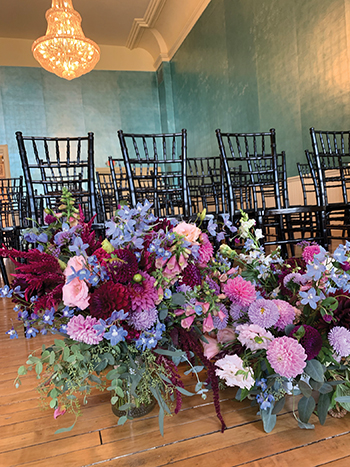 Arranged flowers with dahlia, foxglove, lisianthus, celosia, gomphrena, and more. Photo by Laura Langford.
You should test their maturity for cutting by feeling for any “nod” (the stem directly below the flower head is the last place to become rigid). G. globosa stems are not as long and often bend at the nodes; plus, it takes much longer for their heads to mature to the point that they lose their nods. Thus, G. haageana has forceful colors and an assertive posture. G. globosa offers more delicate colors and is picked with its twisting stems while flower heads still nod, creating a draping, relaxed effect.
Whimsy: Larkspur (Consolida ambigua) is easy to grow and so a good “spike” flower for beginners. The one caveat is that plants require a cold period or “vernalization,” where the plants stay above freezing but below 55°F (13°C) for the first six weeks of growth. Plants may not flower without this vernalization, so it can be a challenge in warmer climates.
Larkspur can be sown in the field in fall or winter (and plants will readily reseed if left to establish themselves). Picked when one-third of the flowers are open (the general spike flower rule), it is attractive fresh-cut and also a favorite dried.
Laura has found their color keeps best when they are dried in the dark. Larkspur is also a favorite with florists, adding beauty without fuss. Note that floral preservative is often used to achieve longer lasting blooms.
Pleasant surprise: Quinoa (Chenopodium quinoa) might sound odd, but it won’t seem odd when you see it. As well as being edible, quinoa can be quite decorative, growing and maturing to be covered in colorful flowers. Suitable varieties include ‘Brightest Brilliant Rainbow’ (a mix of different colors with many pink/red shades) and ‘Cherry Vanilla’ (which grows to a pretty, delicate pink). ‘Redhead’ will darken from a delicate blush to a light magenta and is a particular favorite. Quinoa has a long harvest window, as they hold well in the field, and a vase life of seven to ten days. Its cold-hardy seeds should be planted early in the year to allow sufficient time for this easy-going plant to “bear fruit.”
Perfect backdrop: Yarrow (Achillea millefolium), more growers are coming to appreciate and rely on the resilience of perennials to help them meet their flower needs. Offering an array of pinks (from bright cherry red to palest pinks and lavenders to earthy peaches and terra-cottas), yarrow will need to be divided every two to three years to keep plants at a productive and uncrowded 1-foot spacing.
With a respectable 24-to-30-inch stem, picking at the correct time is especially important with yarrow. If you clip stems too late, the impact of the petals is muted by the maturing flower centers. Clip too early and the clustered, compound flower heads will droop and be unusable. You must pick them when pollen is visible and flowers are bumpy, but not completely humped.
The workhorse: Zinnia (Zinnia elegans) though seen in many a garden, its ubiquitousness should not be viewed as a sign of mundaneness but rather popularity and adaptability. And why not? Easy to grow with low maintenance and a long season (just what beginners need), zinnias are a perfect choice for making up the bulk of a bouquet.
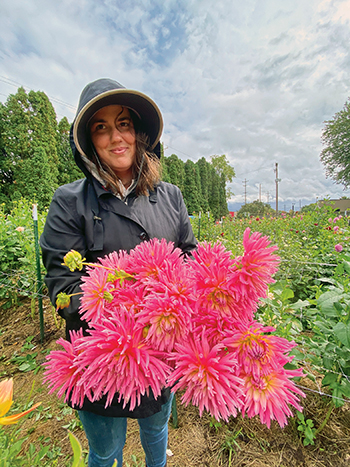 Laura Langford of Marygold Meadows with Pink Shirley Alliance dahlia. Photo by Martha Thawnghmung.
They have a lot to offer in terms of colors — carmine, rose, coral, bright pink, salmon rose. And some variety of shapes, too. Zinnia flowers can be large or small, single or double-petaled, even a “cactus” form with shaggy petals. Benary’s Giant series is reliable and traditional. The Zinderella and Queen series are some of Laura’s favorites, and truly some blooms are so spectacular that their appearance could move them from filler to thriller for less ostentatious bouquets.
Spiller
Extraordinary: Pink buckwheat (Fagopyrum esculentum ‘Takane Ruby’).To achieve the desired pinkness for this flower, we are looking at a specific variety of this species. ‘Takane Ruby’ is a buckwheat of incredible beauty because of its vivid pink flowers, red stems, and lime green leaves. With the growing disposition of all buckwheats (i.e., an exuberance for growth and a tolerance of most growing conditions except excessive dampness at germination time), it can give a bouquet either a delicate or a wild quality, depending on how it is used. Pick stems when their first few flowers are open and place them quickly in water. They will have a substantial vase life.
Top-notch: Celosia (Celosia argentea) is not quite so much “spill” as “launch.” Little can add eye interest to a bouquet the way celosias do, not least because they can do it in so many ways. Whether you grow the well-known head of the cockscomb celosia (C. argentea cristata), the wispy and feathery C. argentea plumosa, or the sturdier spikes of C. argentea spicata, these annuals are very agreeable during production, harvesting, arranging, and their generous vase lives.
Cockscomb and its more leggy counterparts come in shades of pale, purple-ish, and hot pink versions. Your selections from amongst the great variety of celosias can really help set the tone of a bouquet. And though we both use all types, Laura counts the robust cockscomb as her top pick, while I find the sturdy spikes of spicata of greatest versatility. In all cases, the removal of the central leader of a plant (whether by harvesting or pinching) stimulates the growth of side-branches, leading to a long and generous harvest. Also, transplants should be comfortably spaced (about 18 inches apart) as during their long growing season, the plants can get quite large.
Old-fashioned charm: Foxglove (Digitalis spp.). First, a reminder that all plant parts of foxglove are poisonous. However, if your flowers are not in danger in being browsed, this 3-to-4-foot-tall biennial can add luxurious blooms in grand bouquets, appearing to be spilling as it is laden with flowers. Laura says they just feel special; I agree heartily. If she were forced to plant sparingly this would be the spike flower she would have to keep. Her affection is greatest for the Camelot series as well as Pink Panther and Dalmatian Peach (a pink wannabe). The foxglove harvest window can be exceptionally long depending on your management of them (i.e., frequent deadheading), sometimes from June to October.
Delightful: Pink pussy willow (Salix spp.). Pussy willow can be pink and it is unforgettable. Though technically a bit too stiff to spill, the architecture of pussy willow catkins makes them tumble forth from a bouquet. As a shrub, the plant will be comparatively costly and will need to become established, but once this is achieved your troubles are over. Well, except for furry pests; deer and rabbits must be kept away when plants are small so that they are not killed.
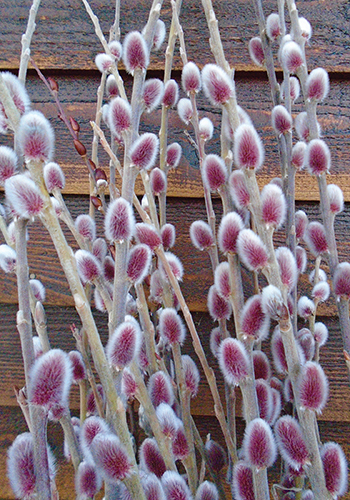 Pink pussywillow French Pink. Photo by Leah Smith.
Once established, browsing is not likely to kill plants but will certainly affect their spring harvest. Pussy willows like to grow in damp ground. If you are not familiar with picking them, it is important to note that they need to be cut well before the catkins are flowering and producing pollen. Experience will give you the eye to see when they are nicely sized and about to take off and ready for picking. They are also excellent candidates for forcing if you want to play with their timing. While I grow Pink Flowering S. caprea ‘French Pink,’ there are other fine options including Japanese Pink S. gracilistyla ‘Mount Aso’ and American Pink S. discolor ‘Rosea.’
Airy and wonderful: Delicate Shirley poppy or corn poppies (Papaver rhoeas), if sown successively, will flower from late spring through the summer, in a rainbow of pinks including salmon, light pink, coral, rose, and cerise, petaled as singles or doubles. Plus, after petals have fallen, their pods may be used in fresh arrangements as well. Though no longer pink, they can be used as excellent green contrasts in a pink bouquet.
Their vase life is incredibly short; it can be extended by searing stem ends with flame or boiling water immediately after harvesting, but not by much. Though often considered for purely domestic use, Laura promotes the view that they are simply, “too beautiful to last,” and their ephemeral beauty can be the final touch on a truly special (single day) occasion. She also adds that because of their small rooting structure they are excellent for top-seeding without disrupting their companions. She spreads some of her seed onto daffodil and tulip bulb beds.
Thriller
Extravagance: Dahlia (Dahlia spp.). The definition of “thriller,” dahlias really do sell themselves, a true customer favorite. These tender perennials must be dug up in the fall and stored in a cool (non-freezing) location for spring replanting. Laura says moving the tubers to a warmer location to “wake up” prior to planting helps to get a jump on the season.
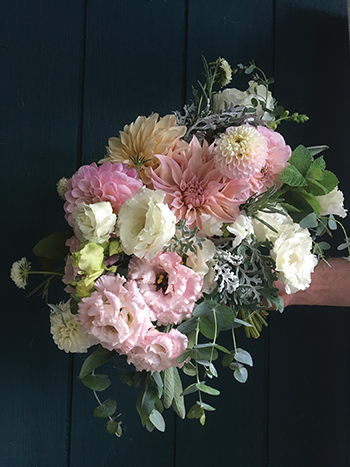 An arranged bouquet, heavy on the dahlias and lisianthus. Photo by Laura Langford.
Dahlias need 2-foot spacing in well-drained ground, as they are susceptible to molds, mildews, and wilts. However, it is likely they will require supplemental moisture during their potentially-quite-long season (if you keep up the harvesting and deadheading). So you may want to lay down irrigation at planting time.
Mulching for moisture retention may be required, though perhaps not until the cold and damp of spring begins to fade. This will allow optimum airflow for as long as possible, plus keep away a shelter for destructive slugs, snails, and earwigs from young plants, but do keep the Sluggo Plus on hand. Dahlias should be given a hard pinch (3 to 4 inches) once reaching a foot high to encourage lower branching and longer stems.
Also, Laura says, staking and netting is an absolute must and needs to be in place in a timely manner. Lastly, note that flowers should be almost fully open when harvested; they fail to open further after picking. A world unto themselves, dahlias are divided into 14 type groups, ranging from the simple collerette, peony-flowered, and single orchid to the dramatic anemone-flowered, ball, and pompon. Bloom diameters are small (2 inches, such as the striking ‘Burlesca’ pompon) to quite large (1 foot, ‘Otto’s Thrill’ Dinnerplate).
As for color, petals are bicolored, frosted, speckled, variegated, in double rings of distinct colors, and on top of that any shade of pink (or any other color) imaginable. Popular pink varieties include ‘Apple Blossom,’ ‘Café au Lait,’ ‘Castle Drive,’ ‘Emory Paul,’ and ‘Sweet Nathalie.’
Sweetly elegant: Lisianthus (Eustoma grandiflorum) is beloved by customers and florists who liken them to roses, gorgeous and long-lasting (in the field and the vase). Lisianthus plants offer different branching patterns and bloom times, with flowers coming in different sizes, petal densities, and types (including camellia and rose). Drawbacks? Many consider it the most challenging flower to grow.
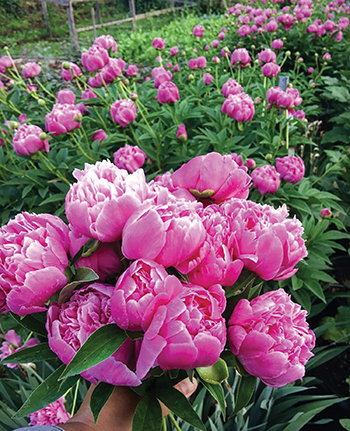 Peony Koppius. Photo by Martha Thawnghmung.
The first challenge is germination. In mid-December or early January, the delicate seeds must be kept in moist seeding trays between 70°F to 75°F (temperatures exceeding this trigger rosetting or a resting period that lasts indefinitely). The consensus among many growers is to overcome this by buying plugs instead. Once planted outside just prior to your frost-free day (and note the plants are very sensitive to being root bound, so keep your eye on their roots and the calendar), growth is slow so weeds must be combatted. Lisianthus needs fertile, well-drained ground in full or partial sun.
Use compost and, if necessary, foliar feeding (though do not foliar feed after flowering begins as it will discolor blooms). Encouraging a strong root system is critical, so amend the soil with calcium and magnesium, if necessary. As growth continues, you can either pinch terminal buds to stimulate sprays of simultaneously blooming flowers, or leave buds and opt for stems of sequentially blooming flowers. Be sure to harvest by cutting stems near the plant base to encourage a second flush.
Though the need for netting to support straight growth can be variety dependent (as some grow taller than others), Laura considers it a must and likes to get her supports out very early. As lisianthus has close relatives that are prairie wildflowers, it is no surprise that it blooms with comparative ease through the dry, hot summers nor that it dislikes humidity. However, with cooperative weather and well-managed plants, you may be harvesting from late June through September.
Striking: Lupine (Lupinus spp.). A stalk of lupine looks filled to overflowing, as the flowering spike is packed with pea-like blooms. However, they don’t have the best vase life. Flowers may shatter and subsequently drop from the stalk, meaning lupines may be best used in situations when this habit is permissible or goes unnoticed. This perennial greatly prefers sandy and/or acidic soil.
Establishing its deeply tap-rooting system (which must happen prior to blooming) will probably require two years — maybe more or possibly (and unlikely) less — depending on soil conditions. A light mulch helps lupines overwinter successfully, ready in spring for the cool, moist conditions they favor. I doubt you will go wrong with any of the appropriately colored Russell or Woodfield Hybrids, though Laura finds the Berry Pink varieties absolutely dazzling. Use lupines when you need something special and comment-worthy, they are icing on the cake.
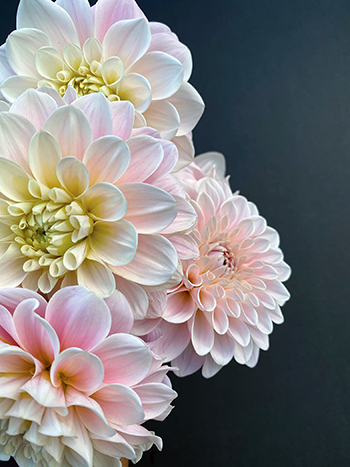 Sweet Nathalie dahlia. Photo by Martha Thawnghmung.
Perfection: Peony (Paeonia spp.).Though the Paeonia genus contains many species suitable for cutting, the Chinese or common garden peony (P. lactiflora) is, yes, probably the most common. Available in a variety of forms and with different bloom times, these tuberous plants are perennials which should be planted in the fall and blooming by their third year — no digging and storing.
As Laura says, they are for the patient grower; the best time to plant them was yesterday. With peonies, variety is very important in relation to vase life, which can vary from five to ten days. Some of the best pink peonies (averaging eight to nine vase days) are: ‘Mrs. Franklin D. Roosevelt,’ which is a blush or valentine pink; ‘Raspberry Sundae,’ possessing jazzy petals that are soft pink with cream tones; ‘Grace Batson,’ displayer of a richer, French pink color; and ‘David Harum’ (my favorite), sometimes classed “red” though it looks like a fuchsia/pink to me.
Laura is in love with the coral varieties, such as ‘Coral Charm’ and ‘Coral Supreme.’ She also points out that not only can vase life be maximized by harvesting peonies in the marshmallow stage (with buds loosening up and squishy), but you can greatly extend their seasonal availability by months with dry (wrapped, not-in-a-bucket-of-water) storage in a cooler. These grand plants need full sun, good drainage, 4-foot spacing, and support for their hefty stems and flowers.
Showstopper: Ranunculus (Ranunculus asiaticus), called “rose of the spring,” these tender perennials boast long stems, double-ruffled blooms, a light citrusy-rose fragrance, and high productivity (the larger the corms, the better). Their corms are lifted from the ground to avoid freezing, and a late-winter soaking and pre-sprouting gets them in a hoophouse or low tunnel (in the ground) or in trays for transplanting, roughly a month prior to the frost-free day. For more on ranunculus, see the articles “Early season income with ranunculus and anemones” parts 1 and 2 from the GFM archives.
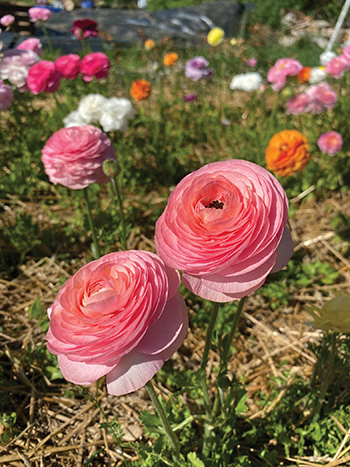 Ranunculus Elegance Salmone. Photo by Martha Thawnghmung.
Note that emerged plants can tolerate a light frost. Ranunculus prefers moist growing conditions, thriving on water, nutrients, and cool temperatures (thus the early start). However, they still require good drainage as they can’t tolerate being overly wet, which leads to rotting, especially during warmer spells. Once your plants begin showing green growth, water them adequately but not excessively; a light application of mulch can help maintain sufficient dampness. Higher soil fertility, preferred but not essential, is especially important if you wish to keep your own ranunculus corms for replanting rather than buying new. You will want to produce healthy planting stock as well as beautiful flowers.
Blooming for a four-to-six-week harvest window in mid-spring, the summer heat spells their departure. Laura views this comparatively short season, combined with the effort they require, their impressive vase life, and their beauty, as proof that ranunculus is something rather special. Admired at markets and events, she notes that, though typically grown in full sun, for her they benefit from partial shade (especially as dark colored blooms can actually get sunburnt).
Laura Langford has been operating Marygold Meadows since 2017. Though located on family acreage, it has been her conception to create a local, natural (no chemicals used) flower source in Barry County, Michigan. While focused on sales at farmers markets and for special events, she has recently been partnering with Martha Thawnghmung of The Big Bloom in Battle Creek, Michigan, on installation projects and unique agro-tourism events. Find Marygold Meadows on Facebook, Instagram, or at www.marygoldmeadows.com.
Leah Smith is a freelance writer and home and market gardener. She works on her family’s farm in mid-Michigan called Nodding Thistle, which was certified organic from 1984 to 2009, principally by Organic Growers of Michigan. A graduate of Michigan State University, she can be reached at noddingthistle@gmail.com.
Copyright Growing For Market Magazine.
All rights reserved. No portion of this article may be copied
in any manner for use other than by the subscriber without
permission from the publisher.