






Perennial alliums and good storage
August, September and October
This is the second of a quarterly series on alliums. The first appeared in GfM May 2022. In late summer and early fall, there are some perennial alliums that can be planted, and some that can be harvested. Various alliums already harvested will need curing, sorting and storing, and some will be ready to use. This is the time of year to order bulb onion seeds, along with other late summer seed orders, for fall planting. We are in central Virginia, so adjust the dates if you are in a different climate zone.
Planting August to October
Perennial leeks (Allium Ampeloprasum, Oepri, Perlzwiebel) and Egyptian onions (a hybrid of A. cepa and A. fistulosum), will be dry bulbs in late summer and can be divided and re-spaced into a larger planting for next year. Once they start to regrow you can make divisions and replant those. They may take 9-12 months to grow to a good size.
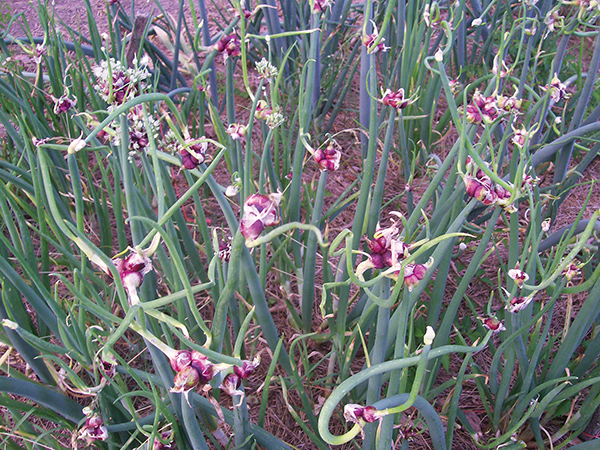 Egyptian onions.
Plant shallot bulbs between October and November, in zone 8 and warmer. Mulch them well. We tried to over-winter replanted bulbs, but we got lots of winter-kill. To save bulbs for replanting in early spring, refrigerate them. You can alternatively start shallots from seed in late January in zone 7.
Sow ramps in Aug and Sept
Ramps, (Allium tricoccum) are a native woodland perennial that can be found throughout the eastern United States, as far west as Oklahoma and as far north as the central and eastern provinces of Canada. Ramps (aka Wood Leeks or Wild Leeks) have some of the flavor components of leeks, onions, and garlic. They are a traditional and a newly-fashionable food.
If you have been wild-crafting ramps, this is time to pay the piper. Collect seed and scatter it over the patches you dug from. Ramps can also be cultivated in woodlands at home – without of course, taking too many away from places they grow naturally. Wild ramps have been seriously over-harvested. See the article on ramps in Modern Farmer. Buy seeds year-round and bulblets in late winter at rampfarm.com and mountaingardensherbs.com. In zones 3-7, sow ramp seed during August and September, and they will take 6 to 24 months to germinate, and the plants take 2-7 years to grow to harvestable size.
Read more in Growing and Marketing Ginseng, Goldenseal and Other Woodland Medicinals by W. Scott Person and Jeanine Davis of North Carolina, and Having Your Ramps and Eating Them Too by Glen Facemire. Also see online publications: NC State Cultivation of Ramps; NC State bulletin on ramps; Pennsylvania Extension: Emerging Research on Ramps; Ohio State University: Ramp Cultivation.
Potato onions
See Part 1 in the May 2022 GfM for an introduction to these traditional perennial multiplier onions, which are available from Southern Exposure Seed Exposure along with a 4 page Garlic & Perennial Onion Growing Guide (PDF).
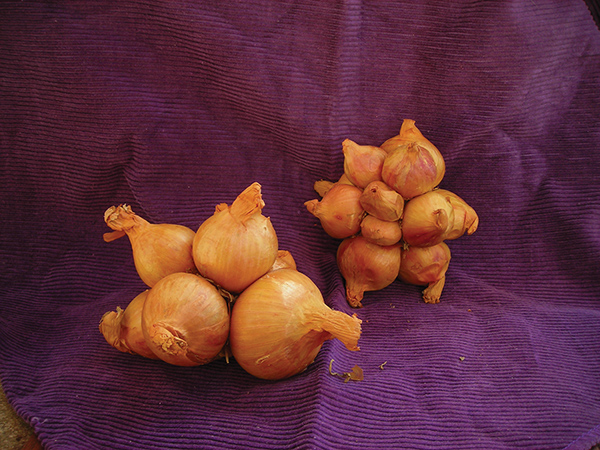 Two clumps of yellow potato onions. Photos by Southern Exposure Seed Exchange.
Jeff McCormack (the founder of SavingOurSeeds.org, who introduced potato onions to new growers) does not recommend planting before September. To store large potato onions (2-2½”, 5-6 cm) for planting, refrigerate them (they sprout easily), and plant in late September or early October. Plant the medium-sized ones in November, and save the small ones until January
For 100’ (30.5m) at 8” (20cm) you need 150 large bulbs plus 30%-40% spare: approximately 200 bulbs, or about 25lbs (11kg). Cover with ½-1” (1-2cm) soil, and add 4”-8” (10-20cm) of organic mulch. Individual large bulbs can be sold for growing indoors in a pot to produce fresh green onion leaves during the winter.
Large potato onions will grow and divide into a cluster of small potato onions, ideal for replanting to increase harvests. They are ready to harvest here in early June. Yields can be 3-8 times the weight of the seed stock, depending on growing conditions.
In early August at the third sorting of the potato onions, I separate the clusters, trim the tops and sort by size. Sorting by size helps me decide what to save for planting and what to sell. We sort smalls (<1.5”/3.8cm), mediums (1.5-2.0”/3.8-5cm) and larges (>2.0”/5cm). And compost material. The rack space required after this stage is only a third of what it was before trimming.
In late August, I sort again, and make initial plans about selling surplus as planting stock (better prices than as food). At the end of September, I make the decision about how much to keep back for planting. We used to store in net bags, but found we got better results if we left them on the racks (in a single layer). The small ones stay on the racks until late January, through alternating freezing and thawing conditions, and they keep in perfect condition. Ideal conditions are 32–41°F (0–5°C) or 50–70°F (10–21°C), and 60-70% humidity, with good ventilation. Instead of weighing all the onions, I now know how many racks of each size I need to save, allowing a margin for decay.
See my article It’s Time to Plant Potato Onions, in GFM in November 2007, but note that I have changed my planting dates and size categories in the light of experience since then.
Harvesting August to October
Egyptian onions produce tiny red-purple bulbs in the umbel instead of flowers. The larger bulbils can be pickled. In cooler weather, once the leaves regrow (September-April on our farm), the leaves of Egyptian onions and perennial leeks can be cut and used fresh. Once perennial leeks are large enough, you can harvest and eat those.
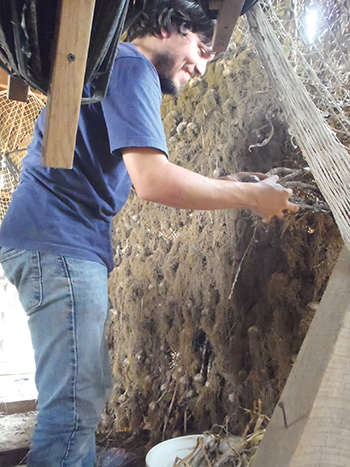 Garlic cured in vertical netting, being removed for trimming. Photo by Wren Vile.
Japanese bunching onions or Welsh onions (Allium fistulosum) are native to China, and are used as scallions. A. fistulosum has hollow leaves, scapes and does not develop bulbs – the leaves are the part that is eaten. Welsh onions are also known as cibol, chibbles (in Cornwall), escallions (in Jamaica), negi (in Japan), pa (in Korea), as well as green onions, salad onions, spring onions. These general last names are also used for other kinds of onions when the leaves are the part eaten.
Leeks (Allium ampeloprasum var. porrum) come in two main types: the less cold-hardy, faster-growing fall varieties, often with lighter green leaves, which are not winter-hardy north of Zone 8, and the blue-green hardier winter leeks. In the first category, we like Lincoln (50 days to slender bunching leeks, 75 days to mature leeks), King Richard (75 days, fast-growing) and Giant Bulgarian. Giant Musselburgh (105 days, aka American Flag) is bolt-resistant, for overwintering in milder climates. For winter leeks we like Tadorna (100 days), Jaune du Poiteau, King Sieg (84 days, a cross between King Richard and winter-hardy Siegfried, from Fedco) and Bleu de Solaize (105 days, very hardy).
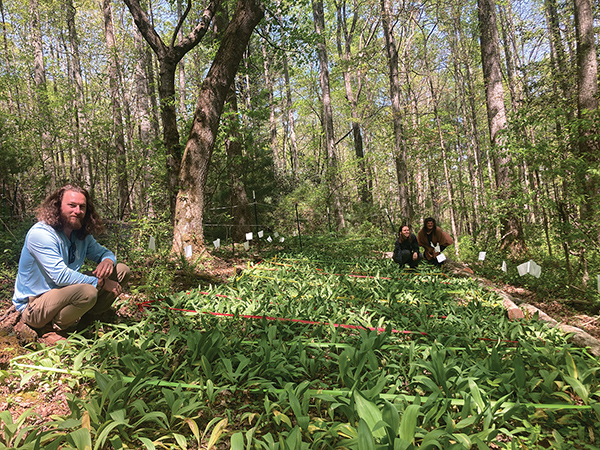 Researchers in the NC State ramps harvest study. Photo by Jeanine Davis.
Fall leeks can be harvested once they are big enough. We grow two beds of fall leeks and three of winter-hardy ones. To feed 100 people, we plan to have 1000 leeks for harvesting each month, from October to February.
When harvesting leeks, visualize how deeply you planted them. Put the fork vertically into the soil 2”–3” (5–8 cm) away from the plants. Step on the fork and lever back. Impatient pulling of unloosened leeks leads to broken ones. Chop off the roots, hold the plant upside down and cut the leaves in a V, making the tougher outer leaves shorter than the tender inner leaves. Pull off any damaged outer layers, and set the leeks in buckets. We put 1” (2.5cm) of water in the bucket to keep the leeks hydrated, then take them to the cooler. If the ground is frozen too deep to pierce the crust with the fork, you may be able to harvest a few leeks for immediate use by pouring boiling water along the row at the base of the plants. This does not seem to damage the leaves.
See my articles Plan for a Really Long Season of Leeks, in GfM March 2007 and Leeks: A Guide to the Versatile Winter Workhorse, in March 2022.
As well as fresh allium harvests in late summer and fall, we can, of course, use onions and garlic from storage. Use the non-storing onions and the hardneck garlic first.
Storing alliums August to October
In August we will be finishing up trimming, sorting and storing garlic, potato onions and bulb onions. During the fall we will be inspecting onions and garlic at least once a month, removing bulbs which are sprouting or rotting. If at all possible, do not store alliums with fruits, including squash, as these exude ethylene which promotes sprouting. As temperatures cool, and space becomes available in our cooler, we move bulb onions and garlic from warm storage to cool storage.
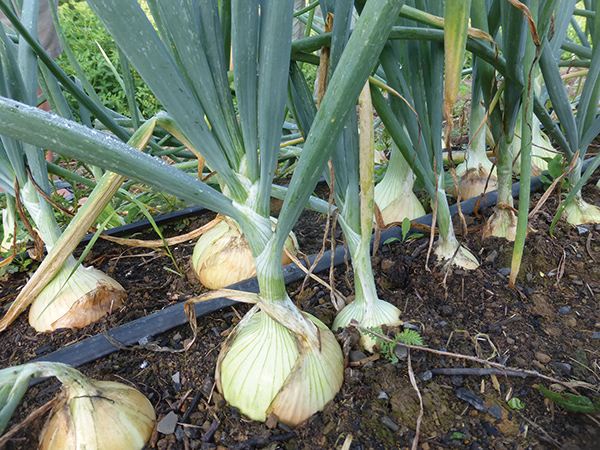 Walla Walla onions. Photo by Southern Exposure Seed Exchange.
Bulb onions can safely be stored at 60°F-90°F (16°C-32°C) if they have not been refrigerated at all. This applies only to fully cured onions with dry necks. For cured dormant onions it is very important to avoid the 45°F-55°F (7°C-13°C) range, because that’s when they sprout. Do not freeze onions, they will be damaged at 31°F (-0.5°C).
In our climate, with a long period in the danger zone temperatures, we keep alliums in the warmer storage range in a barn or basement until ambient temperatures drop close to 55ºF (13°C), and then move them to a refrigerator at 32°F-41°F (0-5°C) and 95-100% humidity. For storage, onions and garlic do best with a humidity of 60%-70%. Refrigerators are usually more humid than ideal. If you have a building with the right temperatures, that will work better for long-term storage.
Garlic storage
See Part One in the May 2022 Growing for Market for more about curing and storing garlic
Commercially, garlic is stored in the dark at about 32°F (0°C) and 65% humidity, where it may keep six months or more. I have heard that garlic can be stored for up to nine months at 27°F (-2.7°C), but I have not tried that myself. It does not freeze until 21°F (-6°C). Do not store peeled garlic in oil, as garlic is low in acidity and the botulin toxin could grow.
Store garlic at 60–90°F (15.5–32°C), if it has not been cooled at all, or below 40°F (4.4°C). Garlic will sprout in a temperature range of 40–56°F (4.4–13°C), or if it is allowed to get cold then warm. So long as temperatures remain over 56°F (13°C) you can store garlic almost anywhere with good air circulation. Most varieties store reasonably well in a cool room if hung from the ceiling in mesh bags, or spread on shelves in a layer less than 4” (10cm) deep. When ambient temperatures drop close to 56ºF (13°C), we move our garlic to the walk-in refrigerator at 32–41°F (0–5°C), 95–100% (more humid than the ideal 60%–70%). The low shelves in the cooler near the compressor are damper and do not work well. We use the higher, drier shelves.
Storage of seed garlic
It’s usually easiest to select your seed-stock bulbs at the same time as trimming. We store our seed garlic on a high shelf in a shed, at quite variable ambient temperatures, where it does fine until early November when we plant it. Seed garlic does not require long-term storage conditions! The ideal storage conditions for seed garlic are 56-65°F (13-18°C) and 65-70% relative humidity. Storing in a refrigerator is not a good option for seed garlic, as prolonged cool storage results in “witches-brooming” (strange growth shapes), and early maturity (along with lower yields). Storage above 65°F (18°C) results in delayed sprouting and late maturity, although we’ve never noticed a problem.
Growing garlic in tropical regions
In part one I mentioned research on garlic I did while in Jamaica. Softneck garlic varieties are more heat tolerant than hard-neck varieties. If you are buying seed stock of known varieties, Thermador or Lorz Italian softnecks are recommended as more heat-tolerant.
Hardneck garlic begins bulbing when the day-length is increasing above 13 hours, the air temperature is above 68°F (20°C), and the soil temperature is above 60°F (16°C). In hot climates you only have to consider the daylight length. In Jamaica in May, the day-length increases from 12h 46m at the beginning of May to 13h 06m at the end of May. It reaches 13 hours roughly on May 27. This is the date at which you want big strong 12” (30cm) tall green leaves, plenty of them. Each leaf will provide one wrapper on the bulb, protecting it from damage.
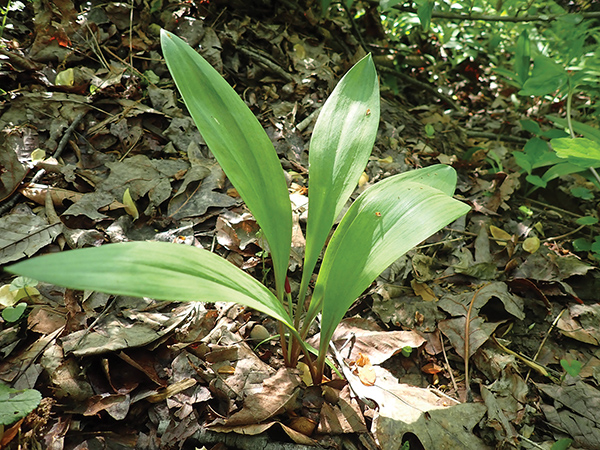 A single ramp plant. Photo by Jeanine Davis.
To get enough vernalization to start garlic sprouting (growing), refrigeration must be used, as ambient temperatures are not cool enough in tropical regions. Separate the garlic bulbs into individual cloves (this helps to initiate sprouting too). Keep the biggest cloves for planting, and put them in paper bags (better than plastic), Label them clearly and refrigerate for 10-12 weeks before your planting date. The fridge temperature should be below 40°F/4.5° C, but not freezing. Some sources suggest a shorter time, but I’ve read reports that shorter times did not always work. Check from time to time and throw out any unhealthy cloves.
As for the planting date, I’ll come back to that in my next article, but the answer is somewhere in the November to January range.
Resources on harvesting, curing and storing alliums, from UMass: Garlic Harvest, Curing and Storage; Onion Harvest and Curing; Alliums, Post Harvest and Storage Diseases
Choosing bulb onion varieties
I wrote Understanding Onions at 38°N in Growing for Market in October 2005. (Since then, I discovered we are at 37°N, not 38!) There I described the three phases of growth of onion plants and the environmental triggers that cause the transition from one phase to the next (mostly day-length and temperature). To grow large bulb onions, it is important to have large healthy plants before the vegetative stage gives way to the bulbing stage. If plants are small when bulbing starts, only small bulbs can result.
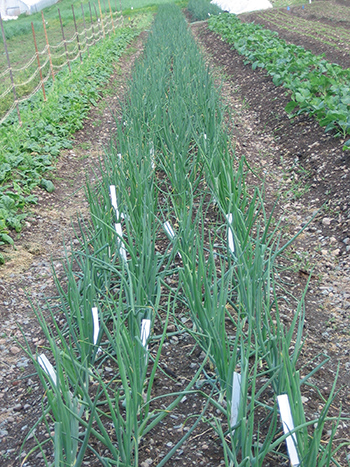 A bulb onion variety trial. Photo Kathryn Simmons.
In our location the best conditions for sowing bulbing onions are early November, in our hoophouse. After over-wintering, we transplant them outdoors at the very beginning of March. (More on sowing onions in Part 3.) If you want to sow in November as we do, now is the time to choose varieties. Factors include latitude, temperature, flavor preference and whether or not you hope to store onions or only grow for fairly immediate sales.
Be sure to choose varieties suited to your latitude, because onions are day-length sensitive. Varieties are classified as short day, intermediate day, or long day types, depending on the daylight length at which they start forming bulbs (assuming suitable temperatures): 10-12 hours, 12-14 hours, 14-16 hours. Onions bulb earlier at warm temperatures than at colder temperatures. More catalogs are now including the information on the latitude adaptation of their varieties. Johnny’s has a Full-Size Onion Comparison Table.
The further north you are the more hours of daylight you have in summer. Here, our longest day (summer solstice) has 14 hours 46 minutes of daylight. We have 14 hours of daylight six weeks earlier, on May 6. A few varieties of long-day onions can be grown here, but those requiring 15 or 16 hours of daylight will never form bulbs at this latitude. South of their ideal growing region, long-day onions don’t start bulbing until triggered by the very longest days (near summer solstice) and the bulbs get too hot in July as they mature.
Short-day onions start bulbing at 10–12 hours of daylight, if temperatures are warm enough. If short-day onions are grown too far north (where it is too cold to overwinter them, and they must be started in spring) they will bulb before much leaf growth has occurred, and so the bulbs will be small. At our latitude neither long-day nor short-day onions are ideal. Welcome intermediate-day varieties! Some seed companies offer “day-neutral” varieties, intermediate-day varieties under a different name.
The trigger to transition from bulbing to flowering (bolting) is temperatures below 50°F (10°C) for three to four weeks, after the plants have six leaves or more (pencil size). This is especially true when rapid growth is followed by a period of cool weather. The chilling effect appears to be cumulative over time. Hence you can see that to avoid bolting it’s important your seedlings don’t get too big too early in the winter. And that you give them extra protection if there is a long cold spell in spring before you plant them out. Day-length does not affect bolting.
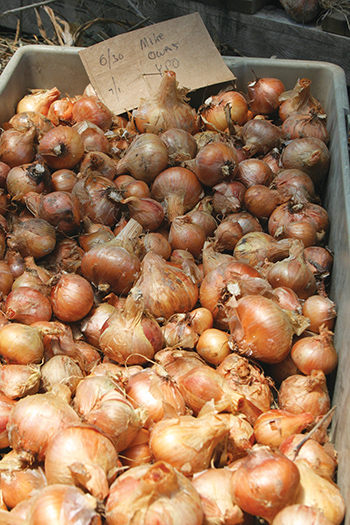 A bin of yellow potato onions. Photo by Southern Exposure Seed Exchange.
For us to succeed with bulbing onions we need to produce transplants the thickness of thin pencils (\” or 1 cm) on March 1, our earliest possible date for planting outdoors. This gives the plants time to grow large before bulbing is triggered. Starting from seed in January didn’t give us time to grow big vegetative plants, therefore not big bulbs either. Starting plants in the fall and keeping them in coldframes or outdoors under rowcover gave us too much winter-kill. Once we discovered the method of using our hoophouse to keep little onions alive over the winter we were very happy. We have sown bulbing onions for growing to maturity in the hoophouse, and, more often, we have grown onion seedlings for planting outdoors.
Choosing onion varieties
See my book Sustainable Market Farming for more on onions in general, including diseases.
“Days to maturity” numbers in catalogs are generally for spring planting once conditions have warmed to the usual range for that crop. When growing over the winter, precise calculations go out the window!
Beware of white onions, which can get sun-scald if growing to maturity in a hoophouse or a very sunny hot climate.
Varieties for storage and fresh eating
We have to accept that hard storing onions cannot be grown in the south. At 37°N, some varieties that worked well for 6-month storage for us include Gunnison, Frontier, Copra as the best three, then Patterson and Prince. Prince has since been replaced by Pontiac, a large onion with strong skin, thin necks. We had only 50% success with Red Wethersfield and Cabernet. Some non-storing good ones for us include Ailsa Craig (OP aka Exhibition, Large, high yielding), Walla Walla, Olympic, Bridger (replaces Olympic), Expression. Varieties come and go. Some of these are now labeled as long-day varieties. It’s a continuum rather than three distinct categories.
Copyright Growing For Market Magazine.
All rights reserved. No portion of this article may be copied
in any manner for use other than by the subscriber without
permission from the publisher.