











Our farm is a mystery — one farm, but also three farms — like a holy farming trinity. I jest, but what I mean is this: on the land we lease, three different farming operations have shared the land and infrastructure to suit their needs. Together we are able to afford the significant rent while saving money by sharing materials, equipment, marketing networks, and our farming knowledge. Here’s how that happened, and how it’s going.
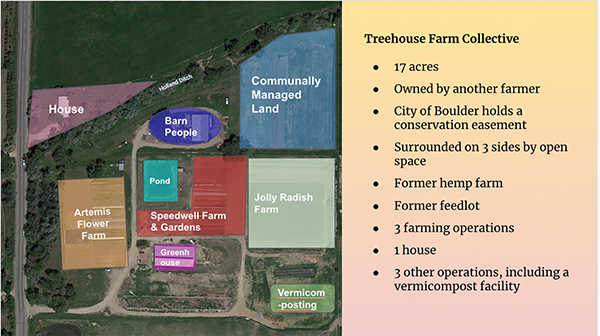 An overview of how the Treehouse Farm Collective land is used. All images courtesy of the author unless otherwise noted.
SCENE: October 2020, mid-pandemic. Boulder, Colorado.
Farm 1: Cody Jurbala and Melissa Ogilvie were running Speedwell Farm & Gardens on a small plot on the northern edge of the city of Boulder. Land issues were forcing them to look for a new place to grow after many years of moving their farm.
Farm 2: Helen Skiba and partner Nelson Esseveld were working at a large vegetable and flower farm. They were also the owners of a cut flower and wedding floral design business called Artemis Flower Farm that was without land. Helen and Nelson were looking for a new start as their own bosses again, perhaps on land of their own.
Farm 3: Matt Kuebbing, field manager at the same vegetable farm as Helen, had many years of experience farming in Colorado and on the East Coast. He was finally leaving the large farm after years of service, with a mission to provide good food to more people of limited means.
Farm 4: Alice and Karel Starek of the Golden Hoof, an established animal operation including cattle, hogs, ducks, chickens, sheep, and more. They own a second property, a feedlot they have been rehabilitating for four years, adding irrigation systems, creating a greenhouse from an old cattle barn, and regenerating the degraded land. For those years, their tenant had been a hemp company, but it went bankrupt along with many others when the CBD bubble burst, leaving them with many unpaid bills and a big farm to maintain.
MATT: Dudes, have you seen this request for proposals that Alice and Karel put out?
HELEN: Yeah man, but we really want to buy our own land. Leasing feels so impermanent. Plus, we found this great place on 10 acres that might have water rights and there’s a 50-year-old mobile home on it. We could buy it if we mortgaged our whole lives and gave up our first born child.
MATT: Wow, that sounds terrible. Why don’t you take a look at Alice and Karel’s place? It’s pretty baller. Great water rights and a sweet irrigation system.
HELEN: Yeah ok, maybe.
… 2 months later:
HELEN: Dude bro, I am writing the proposal for that property, but I’m all alone and I don’t think I can pull it off by myself. Should I even keep doing it?
MATT: You have to meet Cody and Melissa. They’ve got a rad proposal and they need another farmer.
I’ll spare you more of my terrible playwriting, because the rest is history. We met Cody and Mel over tacos, the only food, and it was love at first sight. Our ideals and values aligned, our needs for space were similar, and it made sense to partner. Plus, our conversation was easy and full of laughter. So we slapped my proposal onto theirs, and submitted it right at the deadline.
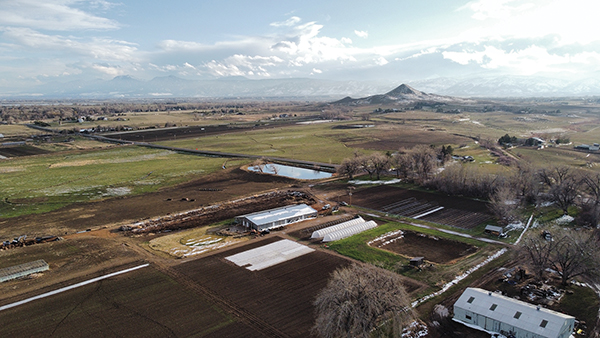 The Treehouse Farm Collective from the air. By Matt Kuebbing
They got back to us quickly, saying we were one of two farms they were considering as lessees. So Cody, Melissa, Nelson, Matt and I spent hours cooped up reworking the proposal and answering their questions, developing a structure for sharing the lease that would allow our farms to operate independently and collectively. During this second round of working together, love at first sight gave way to trust and admiration. We all had different skills we brought to the property, from Matt’s machine and management experience to Cody and Mel’s regenerative growing ethos, to my administrative (I like spreadsheets) brain and my unique flower product.
Within an hour after submitting our amended proposal, Alice and Karel wrote back to say we’d won the lease for a starting term of five years. We took over the property in January 2021. We spent the first month cleaning up hemp stalks as big as tree trunks from the previous tenant hemp company that went bankrupt, along with well-used drip tape and bedraggled plastic mulch.
So how did we organize our businesses and why? What is a farm collective?
We created what could be called a “shell company,” though that term makes us sound nefarious. In short, we registered an LLC called the Treehouse Farm Collective and we established a bank account for it. The property is leased from the Golden Hoof to the Collective. As a legal entity, the Treehouse Farm Collective doesn’t do much, except funnel rent payments from our farm businesses, subtenants, to the landlords. It also pays the farm utilities.
The only members of the LLC are Nelson, Cody, and Melissa, and I, although there are now seven subtenants, each of whom holds a sublease agreement with the Collective. In fact, I hold two subleases with the Collective: one as my business, and one as an individual for the house we live in on the farm.
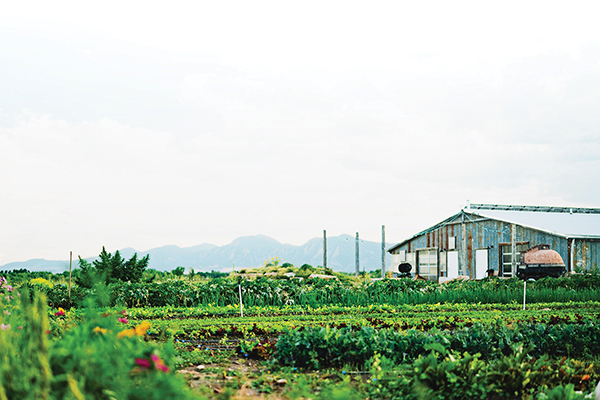 The land that the Treehouse Farm Collective farms.
This structure gives us many advantages, but my favorite is that our businesses remain separate from one another like tenants in an apartment complex. We each conduct our own affairs and have sovereignty over our business decisions. At the same time, because we are separate and because we are farming on the same land, we can offer one another advice, support, and constructive criticism without affecting our own business operations.
This advice and support is the best we could receive, coming from friends who are farming and dealing with the same problems on the same land and infrastructure. The structure works because each of us already had our own farm business, with our own procedures, growing practices, and clients. It would have been a bit of a nightmare to try to meld all of that into one farm after just meeting one another.
We did an interview with Jackson Rolett of the Collaborative Farming Podcast, and I think he summed it up best: “You fulfill two different parts of what most everyone needs: a sense of autonomy and a sense of community, or even to release a little bit of responsibility to other people—you may have hacked a human need there.”
Absolutely. We are each responsible for our own schedules, days, employees, and sales, but we can commiserate about the pests, or the weather, or the emotional difficulty of our times, and we can collaborate when it makes sense, or separate when we need to.
Case in point: This season, I offered a pick-up bouquet CSA alongside Cody and Melissa’s on-farm vegetable pick up. I also sold bouquets and flower bunches that were not reserved, to Speedwell’s clients. It wasn’t a lot of money each week, but every bit helps. In return, I always tell my clients to buy a CSA share from Speedwell.
Also this season, transitioning for the first time to no-till, I had (yet another) August breakdown. I felt like everything in my field was suffering, like I was doing a bad job, comparing this season to others past. The soil was so tough I couldn’t even do my Plan B — cover crop and let it rest.
I couldn’t get enough tilth for the seeds to go in. I was distraught and stuck in fear and catastrophizing. When Cody and Mel noticed, they immediately jumped to my defense, holding me, telling me it was okay and that they were struggling with the same things, and offering gentle advice on how to proceed. What would I have done without them?
As farmers, we are so often siloed in our own operations, uncertain and alone in our decision-making. In our Collective, that is not so. The emotional support we receive from our partners, who get it because they are also business owners and farmers, is priceless, and is a fair exchange on its own for any of the difficulties we face as a group.
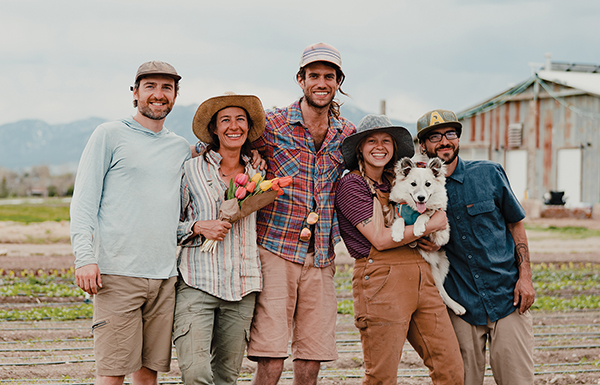 Treehouse Farm Collective farmers. Photos by Nelson Esseveld.
Another of my favorite benefits is that our businesses remain separate from the landholding business. The Treehouse Farm Collective decides which subtenants to accept, and we can set the limits of sublease terms. That means that even if there is strife among the subtenants, our own individual businesses and livelihoods are not affected — only the Collective is.
For me, this adds another layer of protection, the way an LLC protects its members from personal liability: our businesses, as subtenants of the Collective, are doubly shielding us from personal liability. I think. Anyway, it feels safe, and that counts for a lot. If one farmer’s life completely changes and they are no longer able to farm, we don’t have to find tenants for the entire property; just for the one vacancy.
Other aspects of this structure lift heavy burdens from our new businesses. We share labor, which means we can offer workers more hours at the same location, making those positions more desirable than part-time jobs. By pooling the expense, we buy tools at half or one-third of the cost and share them. For example, we are buying a walk-behind tractor at a fraction of what it would cost to buy on our own. We buy materials in bulk to save on shipping costs. We share watering and maintenance responsibilities if one of us is sick or forgetful. We take vacations without worrying about the farm, because someone will be there.
Perhaps the most powerful, and the most effortless benefit, is that we expand our networks of clients, mentors, and allies simply through our association with one another. When someone comes to buy flowers, they always hear about the vegetable operations from me, and vice versa, so simply being on the same land helps us reach more and different buyers. Because of our expanded networks, we have all been able to build our businesses faster and with less debt and fear than we otherwise would.
Is this picture too rosy? Well, it’s not always unicorns and butterflies. The land itself, of course, is the ultimate limit to our success and expansion. Of the 17 acres we lease, about 7 are useful farmland. Artemis Flower Farm is on about 1.25 acres, while Speedwell Farm & Gardens uses nearly the same amount of space. The Jolly Radish Farm (Matt’s farm) is on about 2 acres, and there are 2.5 acres held and managed in common that no one is currently farming intensively. This gives us room to grow our operations, to an extent, but if we all decide to start growing on a lot more land, the structure of the Collective would have to change and we may lose members.
In addition, it’s hard to rotate our fields because each of us uses a different cultivation system and layout. Artemis is set on 4-foot wide beds with 18-inch pathways, while Speedwell uses 30-inch bed tops and 18-inch pathways. The Jolly Radish uses tractor cultivation, with a 4-foot bed top and 12-inch pathways. Because we are no-till, our beds are permanent, so transitioning to another field would mean overhauling our cropping systems or breaking our no-till progress.
Finally, there is only so much indoor space available to each operation. We have a large greenhouse, but even with a good 3,500 square feet of nursery space, we will all eventually step on each others’ feet. We built a very large cooler, but as the saying goes, always build it bigger than you think you’ll ever need.
We sometimes disagree about what to do with certain parts of the land, or we have different goals for our communally managed parcels. Because the property is beautiful and well-endowed with infrastructure, it’s a great place for events and workshops, but these can feel overwhelming or can actually interrupt our farming operations.
We have to consciously include the other partners when we are making decisions that affect them, so we are less quick and nimble than a solo business owner. We are also, I might add, less likely to make bad decisions, because we’ve asked for the opinions of our peers. We have different standards for cleanliness, organization, and the ‘leanness’ of our operations, which can irk the more minimalist among us. Sharing tools sometimes means that tools get more hours more quickly, so they wear out faster.
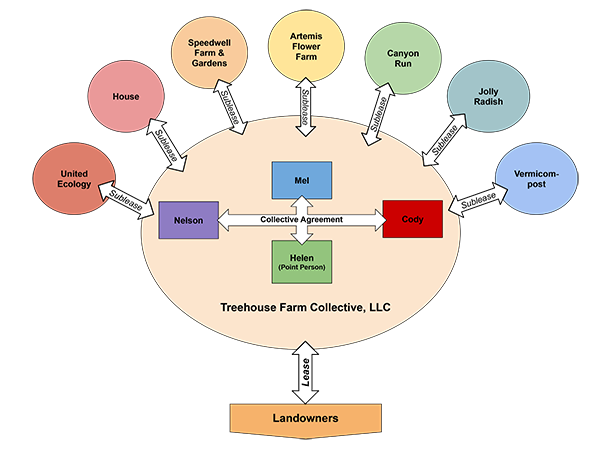 This diagram shows how the lease and subleases are structured. Only three subtenants are farm operations — the others lease space to house various businesses, including a landscaping company and a startup vermicomposting operation. Rent payments flow through the LLC to the landowner.
Those are all difficulties that come along with doing anything in community, but I would argue that conflicts make us clarify our needs, our goals, and our values, and that in doing so, we become better able to realize them. They push us to create solutions that make life better for all. Sometimes we need to have meetings (ew), and sometimes those meetings bring up difficult or thorny subjects, or things we disagree on, or that irritate us about one another.
But we commit to making time for those meetings for discussing things that are important because we commit to the success of the farm and its success depends on the achievements of each individual business. We make time to air out grievances so they don’t fester, and we’ve each committed to becoming more clear and forthright communicators. We make time to dream with each other about what the future of the farm could be, and how we can help each other always be better.
Some of the most honest and illuminating conversations of my life have come out of this farm collective. I can’t wait to see how the Collective grows over time. I know that as part of it, my business will grow and I will too. I am so grateful to have this opportunity and amazing friends by my side on this most difficult road. This October 1, we celebrated Cody and Mel’s wedding at the farm, adorned with flowers from my field, and vegetables from theirs and Matt’s. I can only imagine all the things we’ll be celebrating in the years to come as we build our dreams together, side by side, in the resilience of community.
You can find out more about the Collective by listening to our episode on the Collaborative Farming Podcast, and even more if you watch our video with No-Till Growers. Thanks so much to Jackson Rolett and Jesse Frost for interviewing us.
Helen Skiba runs Artemis Flower Farm with her partner Nelson Esseveld. Artemis offers subscription bouquets, wedding arrangements, on-farm workshops, wholesale blooms (working mostly with the Colorado Flower Collective hub), tulip bulbs imported by Nelson’s family in Holland, and dahlia tubers. Helen can be reached at helen@artemisflowerfarm.com, and you can find out more about the farm at www.artemisflowerfarm.com.
Copyright Growing For Market Magazine.
All rights reserved. No portion of this article may be copied
in any manner for use other than by the subscriber without
permission from the publisher.