











This is the fourth of four quarterly articles on the many types of alliums that can provide some onion-family flavor all year-round. Alliums are a staple ingredient in so many cuisines that farmers who can grow or store them all year long will always have a market for them. The spring season can include alliums in all stages of development: some to sow, some to transplant, some to harvest, some to use from storage, and many to weed.
Planting
In January or February here in Virginia in zone 7a, we can sow scallions and shallot seed for transplanting later. We transplant our two sowings of outdoor scallions in late March and mid-April. We can plant shallot bulbs and small potato onions (less than 1.5” (4 cm) diameter) in early February, if not January. For more on this, see Part 3 of this series in the September GFM.
Plant soft neck garlic cloves or bulbs for garlic scallions anytime in February or March, maybe later. Softneck garlic varieties can make worthwhile growth for scallions even if planted after January. Some growers find they can get better income from garlic scallions than from bulb garlic so they extend the garlic scallion season. So far, we have only planted small cloves for garlic scallions in early November immediately after planting our main crop garlic. Some growers have experimented with replanting small bulbs of garlic, not even dividing the bulbs into separate cloves. This could be a good way to salvage value from cull bulbs.
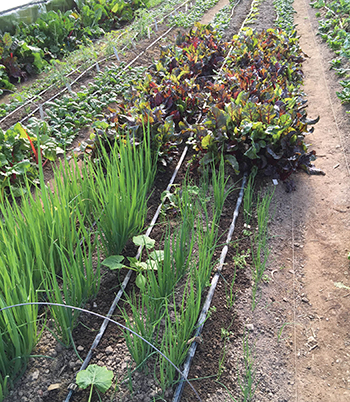 Hoophouse scallions (and new squash plants) in April. Photo Cass Russillo.
During March and April, we can divide and replant Egyptian onions and perennial leeks. Cipollini seedlings can be transplanted in March. For cipollini, we sow cells in January, planting planting them out as clusters. They form small bulbs and mature in early July here. (See the September GFM for more details.)
Sow leeks in plenty of time
In the March issue of GFM, I describe how we used to sow in an outdoor nursery seedbed, but now prefer open flats in a cold frame. Calculate how many leeks of each variety you want to harvest, and add a margin. Each of our 90 foot (27.5 m) raised beds takes four rows of leeks, with plants 6” (15 cm) apart. That’s 720 plants per bed. We sow in 24” (60 cm) long flats, aiming for three seeds per inch (<1 cm apart). With six rows per 12” (30 cm) wide flat, we need 1.67 flats/bed with no extras. We’ll call that two flats per bed.
We don’t need heat to start the leek seedlings, only time, so we put the seeded flats directly into the cold frame. The minimum temperature for leek germination is 35°F (2°C), the optimum 65° to 85°F (18° to 29°C). They take eight to 16 days just to germinate even at the ideal temperature. Alliums are so slow. I always allow at least 10 days. As with most seeds, adding heat to keep them into the ideal range will speed up germination.
Leeks take 10 to 12 weeks to grow to transplant size. We sow ours March 21 for June 1 transplanting, which is only 10 weeks. When we grew them in an outdoor raised bed, it took 12 weeks. We like to use “Lincoln” and “King Richard” leeks in October and November and “Tadorna” for over-wintering in December to February.
Transplanting onions
In late February or at the very beginning of March (as early in spring as possible), we transplant them outdoors. The ideal transplant is slightly slimmer than a pencil, but bigger than a pencil lead. Onions sown after the new year should be transplanted once they have at least three leaves (four or five is better). The final bulb size is affected by the size of the transplant as well as the maturity date of that variety. Onion seedlings are slow-growing: even in spring they take seven to nine weeks to reach a size suitable for transplanting.
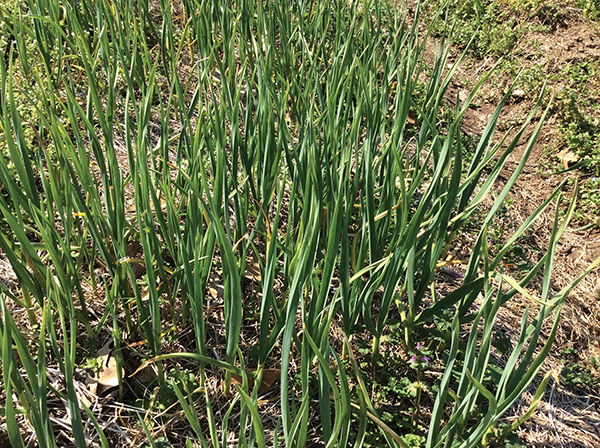 Garlic scallions in late March. Photo Pam Dawling.
Some books recommend trimming the tops at transplanting time, but I used to avoid this because I believed it reduces the yield. I forced myself to test out this idea one year, and found I got the same yield from trimmed and untrimmed onions. Trimmed ones are easier to plant because the shorter tops don’t stay tangled with the other plants when you try to separate them. Transplant 4” (10 cm) apart for single seedlings or 12” (30 cm) for clumps of three or four (not more than four). Tops can be trimmed with scissors, or electric grass or hedge-style trimmers can make quick work of trimming the tops.
Set plants with the base (stem plate) 1/2”–1” (1.3–2.5 cm) below the soil surface. Don’t plant too shallowly. Give plenty of water to the young transplants: keep the top 3”–4” (8–10 cm) of the soil damp for the first few weeks to prevent the stem plate from drying out.
Harvesting February-April
Harvest entire perennial leeks September to February. Harvest cut leaves of Egyptian onions and perennial leeks September to April. Harvest winter leeks December to March. (See Part 3 for more on this.)
When the soil is frozen there are two risks with trying to pry leeks out of the ground. One is breaking the frozen leek. The other is breaking your digging fork. If you only need a few leeks, there is a less risky method. It’s still less risky for larger quantities, but also less practical.
Gather your digging fork, trimming knife and a container for the liberated leeks. Boil a kettle or two of water and pour the water on the soil around the leeks. If you still can’t dig the leeks up, go boil more water. If two trips with boiling water doesn’t work, I’d give up at that point. Obviously this isn’t going to work in climates with solidly frozen ground, until warmer weather arrives. But at some point it will get warm enough to use this trick and enjoy the leeks you’ve been craving.
Harvesting scallions
For a continuous winter and spring supply of scallions, we grow three hoophouse sowings and two outdoor plantings. We harvest our first hoophouse sowing (9/6) until the beginning of February; then, the 10/20 sowing later in February, and the 11/18 sowing from mid-March to mid-May. Our outdoor scallions will be ready for harvest in May and June.
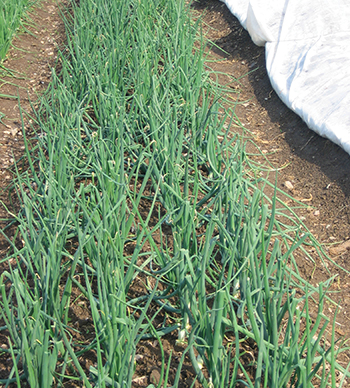 It is important to keep alliums free of weeds, like this onion bed in late March. Photo Kathryn Simmons.
Harvesting ramps in early spring
Ramps (a native perennial allium) can be wild-harvested sustainably for one month, starting when tree buds appear. Ramps are a spring ephemeral of deciduous forests. By late May, the leaves die back and a flower stem emerges. Wild ramps are being over-harvested. It is important to make sure that these wild culinary delights do not vanish and are still able to find their way onto plates in a sustainable fashion. Only 5 to 10 percent of the ramps in a patch should be harvested each year to ensure their future survival. For more on ramps, see the other articles in this series and North Carolina Extension Horticultural Specialist Jeanine M. Davis’ blog on sustainable wildcrafting at tinyurl.com/thu9panx; and Bjorn Bergman’s Wild Delicacies Under the Forest Floor at tinyurl.com/yjcvz7pb, and Sustainable Ramp Harvesting at tinyurl.com/522tsr5f.
Harvesting garlic scallions
With a last frost date of April 20 to 30, we harvest garlic scallions from March 10 to April 30 in central Virginia. Harvesting is simple, although depending on your soil, you may need to loosen the plants with a fork rather than just pulling. Trim the roots, rinse, bundle, set in a small bucket with a little water, and you’re done.
Some people cut the greens at 10” (25 cm) tall and bunch them, allowing cuts to be made every two or three weeks. We tried this, but prefer to simply lift the whole plant once it reaches about 7”–8” (18–20 cm). The leaves keep in better condition if still attached to the clove. We have a short spring (less time for regrowth) and usually plenty of garlic scallion plants, so a single harvest works well for us. If you do have more than you can sell in the spring, you could chop and dry them, or make pesto for sale later in the year.
Allium storage February to April
Use softneck garlic from storage once all the hardneck has been used (softneck stores longer). Use bulb onions from storage, including bulbils from Egyptian onions if you stored those. Read more about garlic and onion storage in Part 2.
Weeding February-April
All overwintered alliums will need weeding in March and once a month after that until harvest. Mulched crops can be weeded during wet weather, and the pulled weeds can be discarded on top of the mulch where they stand a much better chance of dying than weeds discarded on bare soil. It is helpful to have a list of tasks that can be done when the soil is wet to make good use of the conditions. Perennial crops and annuals with mulch are the main jobs for this list (along with tool repair and sharpening).
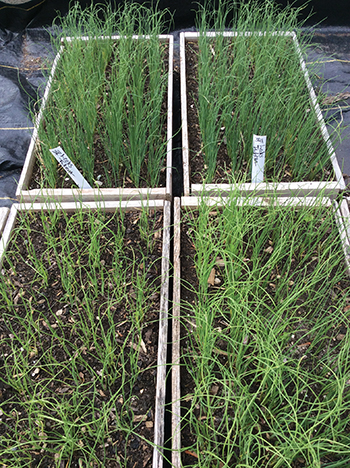 Open flats of leek seedlings in early May. Photo by Pam Dawling.
Newly planted alliums in bare soil will benefit from hoeing during dry weather before the weeds get very big at all. Hoe every one to four weeks as needed until harvest. Because of their vertical tubular or strap-like leaves, alliums do not compete well with broadleaf weeds and can easily become stunted in high weeds. We learned the hard way one year when our leek beds grew very big weeds. Even though we did pull the weeds, the leeks never grew very big. As well as the competition for light, we think our huge weeds pulled too many nutrients from the soil. After that, we acknowledged the wisdom of growing fewer leeks and taking care of them better, rather than over-extending ourselves.
Factors influencing onion bolting
My October 2005 GFM article Understanding Onions at 38N, the Bulb Onions chapter of my book, Sustainable Market Farming, and the second article of this series offer more on bolting. Here are just seasonal reminders. Onions have three phases of growth — vegetative, bulbing and flowering (bolting), with environmental factors controlling the switchovers from one phase to the next. Success depends on understanding what onions need during each of the three phases.
The first phase is vegetative growth (leaves and roots). To grow large bulbs, you must have large healthy plants before the vegetative phase switches to the bulbing phase. If your plants are small when bulbing starts, you will get only small bulbs. Cool, but not cold, weather and adequate irrigation encourage heavy leaf growth.
Part two of this series discusses the importance of growing varieties suited to your latitude. Onion varieties are classified as “northern/long day” or “southern/short day.” The dividing lines between short day (south of 35°N) and long day (north of 38°N) varieties leave a gap where neither type is ideal. There are some “intermediate day” types and a few genuinely “day neutral” varieties.
Onion plants start bulbing when the day length reaches the number of hours critical for that variety and the temperature is warm enough. In cooler northern regions, the day length trigger may be reached before the temperature trigger. In these places, bulbing is delayed until summer, and onions are harvested in the fall.
Farther south, the temperature trigger is reached before the day length trigger, so bulbing starts as soon as the days are long enough and finishes early in the summer. Below 35° N to meet the challenge of growing a large-enough vegetative plant before the bulbing trigger, short-day onions are sown in September or October, grown through the winter and harvested in May.
Farther north, onions cannot be overwintered and must be started in spring. It’s a waste of time sowing short day onions, because in spring they have an impossibly brief time (January to early April) to grow decent sized plants before bulbing is triggered.
The optimum temperature for rapid bulb development is 75°F–85°F (24°C–29°C). The rate of bulbing is more rapid with bright sunlight and warmer temperatures. Soils dry out fast under hot conditions, and if water supply is insufficient, growth will be stunted.
The third growth phase, flowering (bolting), is the one we hope to avoid. Onions are biennial, which means that they normally grow leaves and produce a bulb in the first year. When winter comes, they go dormant. When temperatures rise, they start growing again, and send up more leaves, followed by a thick hollow flower stem, if the plants were large enough when cold weather arrived.
Smaller seedlings with a diameter less than pencil (3/8” or 1 cm) and fewer than six leaves will usually not bolt, but will simply resume growth after being exposed to cold temperatures. If sowing in the fall, don’t sow too early. If the seedlings are thicker than pencils when winter closes in, the plants are likely to bloom in the spring rather than forming big bulbs.
Avoid exposing plants to extended cold spells after they are thicker than pencils. A moderate microclimate, such as a hoophouse, reduces the rate of bolting. In colder zones, a slightly heated greenhouse might work better for overwintering.
Pam Dawling works in the 3.5 acres of vegetable gardens at Twin Oaks Community in central Virginia. Her books, Sustainable Market Farming: Intensive Vegetable Production on a Few Acres, and The Year-Round Hoophouse, are available from Growing for Market. Her weekly blog is on her website and on facebook.com/SustainableMarketFarming.
Copyright Growing For Market Magazine.
All rights reserved. No portion of this article may be copied
in any manner for use other than by the subscriber without
permission from the publisher.