











The first of 3 articles on the business, growing techniques and opportunities
My neighbors, mentors, and dear friends, Sandy Roth and Dick Kenton, started Plant Works native plant nursery in 1996 in La Grande, Oregon. I will share their story, extensive experience, and spirit for growing and restoration. We hope these articles encourage others to consider starting native plant nurseries.
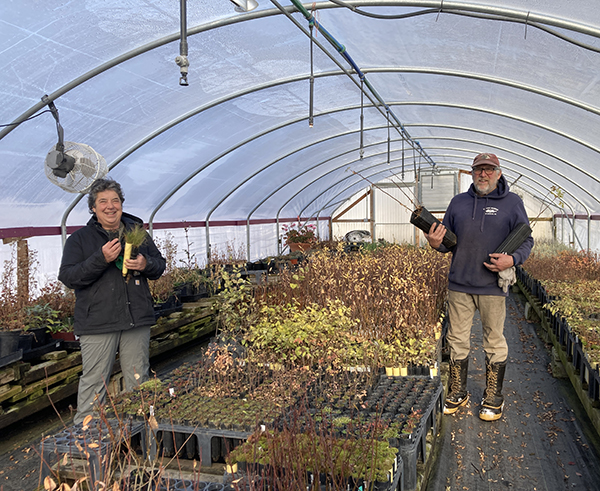 Dick and Sandy with overwintering plants.
Before shifting to native plants, Sandy and Dick ran an interior plant care business for local offices along with a market garden for the local farmers market. When a friend who ran local Nature Conservancy projects suggested they grow native plants for her restoration project, they gave it a try. They successfully grew snowberry, cottonwood, and willows, and wanted to learn more.
“We went to a native plant conference in Boise, Idaho,” Sandy said. “We realized that no one at the conference knew more than us.”
Some folks would have been intimidated to start in a new field that was just beginning to see its techniques and cultural practices come into the mainstream. But seeing as they knew as much as anyone around them gave them confidence. They created a niche for themselves, focusing on shrubs, deciduous trees, wildflowers, and grasses, sedges, and sage. Others in the business at the time were “conifer people,” as Dick put it, from the forestry and tree-planting world.
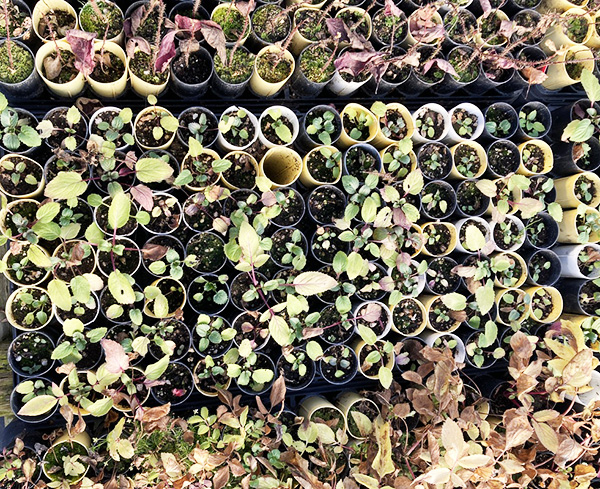 Ten cubic inch tubs overwintering in the greenhouse.
Their operation started at their house on 2/3 of an acre and one greenhouse. “The back 1/3 acre was pure black soil,” said Sandy. “Dick said we had to buy that property because of the soil. He didn’t care about the house.” Family and friends helped get their business started. “Everyone pitched in and helped us build it. Then we had to learn how to grow.”
“We learned at the college of hard knocks,” said Dick.
“I had to learn how to have attention to detail and I learned the hard way,” said Sandy, who notes she was raised by an artist. She recounts the nursery’s history with her signature laugh and smile.
In 2008, Plant Works outgrew its space and moved down the road from me. They now have four heated greenhouses, a hoop house, and are putting in two more heated greenhouses this spring.
Native plants challenges
Attention to detail is important in growing any plants, but growing native plants from wild-gathered seed and cuttings is particularly tricky. Native plants haven’t been bred by humans to work for us. The genetics are highly variable and viability is unpredictable. In our high desert eastern Oregon climate, native plants aren’t used to “easy” conditions, ample water or the humidity of the greenhouse. Damp off is a constant worry and a quick killer. While I plan for 10 to 15 percent loss in my neighboring market farm, Sandy and Dick must over-plant by 30 to 50 percent to ensure enough plants to fill restoration contracts.
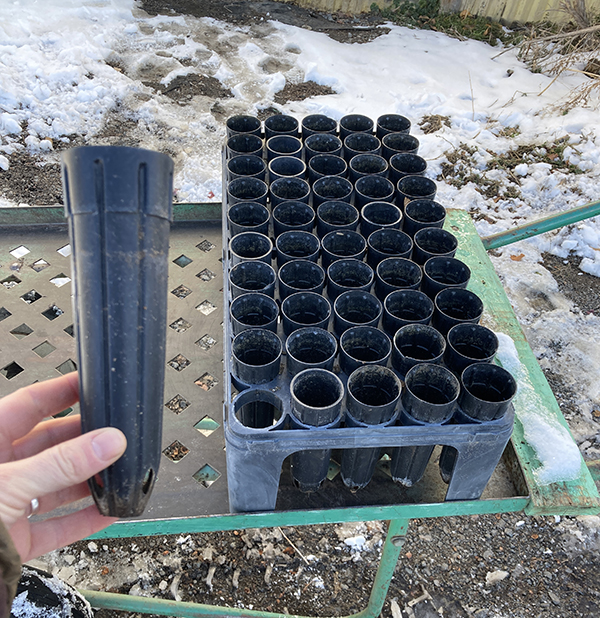 Sixteen cubic inch tubes.
Plant Works plants are propagated from cuttings and wild-collected seed. “We collect seed from the restoration project local area for seed provenance and genetics,” Dick explained. “We have found that seed needs to be collected at the elevation the plants will go.” Otherwise, plants have a lower survival rate.
They prefer starting from seed rather than cuttings because seed is easier to collect and store and has a lot more genetic diversity. “We are trying to keep things as variable as possible for the highest survival rate,” Dick noted.
The wild seed they collect is not germ-tested except the sink-or-float method. Viable seed tends to sink. But there is really no way to predict whether the seed is good from a particular year. “You may have a plethora of seed and very little germinates,” said Dick. Weather, heat and other stresses affect viability. To reduce this risk, Plant Works collects, cleans, dries and stores seed every year and keeps a lot of extra on hand because of lessons from the school of hard knocks. “We couldn’t collect chokecherry seed for three years,” said Sandy. There just wasn’t any.
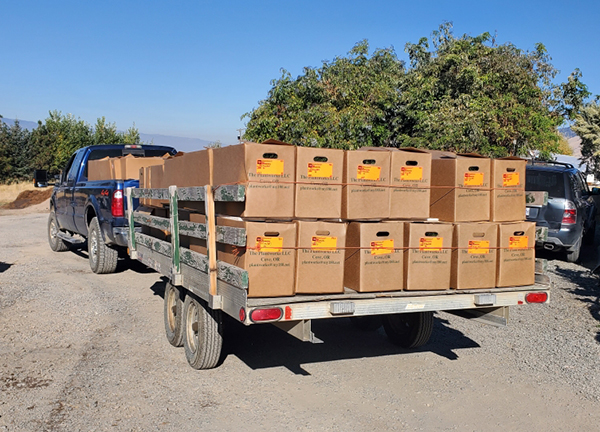 Shipping plants out.
When starting vegetable seed, I put one or two germ-tested precious babies in each plug. When I’ve helped seed native plants, it is more like a pinch of seed in the hopes something will come up.
Besides collecting wild seed, they choose not to thin plants for size. “We make it more random by thinning for the center plant in a tube” Sandy said. “Because of the wild seed genetics, some plants are small, some big, but small plants might have good roots.” They acknowledge that in the wild, they have no way to know which plant has the best chance of survival so selecting for size just doesn’t make sense. They select for diversity by taking the human bias out of selection.
One of the biggest differences between my vegetable business and their native plant business is the length of time plants are grown and the contracts. Many of us have perennial plants, flowers, and herbs, but Plant Works grow exclusively perennial plants on contract. Contracts come from organizations like The Nature Conservancy, Trout Unlimited, the U.S. Department of Fish and Wildlife, First Nation tribes, Idaho Power, Oregon Department of Transportation, and others. “You can’t grow on speculation in this industry,” said Dick.
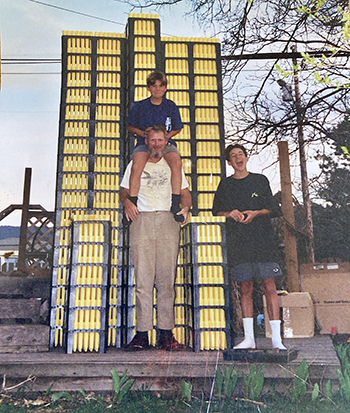 Dick and Sandy’s sons and Dick’s father 1996.
They sell one- and two-year-old plants that they hurry along in greenhouses with fertilizer and water. This means a significant hold time where plants are taking up valuable greenhouse space, must be overwintered, and pay day is a few times per year. Their business is more like raising livestock than plants in terms of cash flow.
Contracts vary in size and scope. Small projects for local landowners may be as few as 100 plants. A medium size project is 5,000 to 10,000 plants. Large projects are 100,000 plants or more. The most impressive project I have seen at Plant Works was over 250,000 sage started, grown, thinned (which was miserable) and packed out between February and October.
Plant Works grows plants in 10-, 16- and 40-cubic-inch volume tubes that are long for better root development. The size depends on the terms of the restoration contract. If a contract requires larger, older plants, they are transplanted up to 1- or 4-gallon pots and are overwintered.
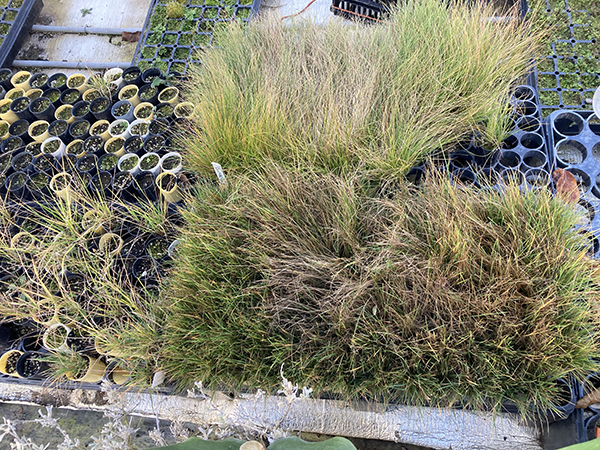 Idaho fescue.
Of course, overwintering plants is expensive, and it leaves room for more things to go wrong. “Once I had the most gorgeous red osier dogwoods ready to go and it was sold,” said Sandy. “I was so proud and thought we’d be fine. I pulled the plants [from the tubes] and they were all full of weevils.” Now, most plants she overwinters either go to the outside growing areas for the winter or are de-tubed, wrapped in biodegradable cellophane, and stored in the walk-in cooler. The temperatures outside and in the cooler knock down pests as well as the cost to keep the greenhouses heated and plants watered.
A year at Plant Works
To get a sense of the rhythm of a native plant nursery, here’s a timeline of the year.
December: Seed preparation for spring. Seeds are rehydrated and cold stratified with apple slices to break seed dormancy. Some species require a long cold stratification for three months. Sandy and Dick have experimented for over 25 years learning the particular needs of each species, trying to mimic nature. They have found there are limits to pushing plants with heat and light. “Nothing will start before winter solstice,” said Sandy.
January: Winter break.
February: Greenhouse prep and ordering, including soil, mycorrhizal products, pellet fertilizer, pest control, and so on. Start seeding pines.
March through April: Seeding and transplanting overwintered plants. The goal is that everything is seeded, transplanted, and growing by summer solstice. Cuttings, such as for willows, also are collected before they break dormancy. Packing and shipping of spring planting projects.
June: Plant thinning and heat preparation. Plants are thinned to one plant per tube. Depending on weather, greenhouse sides will be rolled up and shade cloth will be put on for water conservation.
July: Thinning and pruning. Plant thinning continues and plants are also pruned to keep dominant plants in racks from shading out the others. Plants are pruned to a 1:1 shoot to root ratio. Everything is sorted and consolidated as dead plants are pulled from racks. July is always water crunch time in our climate.
August: Seed collecting and cleaning begins. August also is generally hot and smokey so the main goal is to keep plants watered, weeded, and alive.
September: Pack out of plants begins. Plants are de-tubed, wrapped in biodegradable cellophane, and packed in boxes for shipping to restoration projects. Wash and sterilize growing containers for re-use through November.
October: Pack out and shipping.
November: Overwintering prep. All 10-cubic-inch plants are de-tubed, wrapped, and stored in the walk-in cooler to overwinter.
Thanksgiving through January:Down time.
Why grow native plants
Sandy and Dick are 69 and 70 years old and have been growing native plants for more than 25 years. They are expanding this year and shifting more management to employees. “We are getting calls for hundreds of thousands of plants — Douglas fir, bitterbrush, sage,” Sandy said. “There’s a lot of money for restoration out there right now.”
In the West, devastating fires, endangered species concerns, habitat restoration, reforestation, and the effects of climate change are all driving demand for native plants. But they say it has been an up and down business. “Like in the rest of small-scale agriculture, you aren’t going to get rich,” said Dick. “But I have gotten spiritually rich from it.”
“It has been very rewarding,” said Sandy. “I love learning how to grow.”
“Yeah,” said Dick, “You’ll learn till you die — that’s what’s fun about it.”
“Why should others grow native plants?” I asked them. Sandy laughs, “The only reason to get into this business is if you believe in restoration, climate change, and you love plants. If you believe in repairing the earth, grow native plants. We stuck with it because we love it and I believe in it. We thought it was important.”
Nella Mae Parks farms on her family place in Cove, Oregon, growing vegetables for her on-farm farmstand, the farmers market, and wholesale outlets in the region.
Copyright Growing For Market Magazine.
All rights reserved. No portion of this article may be copied
in any manner for use other than by the subscriber without
permission from the publisher.