











Part I: Overview, Land, and Markets
The market farm I manage has been, like all farms, significantly shaped by programs in the Farm Bill. Some impacts are easy to trace. Our high tunnel, where tomatoes yield three times better than our field tomatoes, and our 8-foot fence, which presents a thin line between lush lettuce beds and deer drool-soaked nubbins, were both funded through the Farm Bill-authorized Environmental Quality Incentives Program (EQIP).
Through the bill’s Conservation Stewardship Program (CSP), we get paid for mixed-species cover cropping and no-till bed preparation. When we eased off tillage, I leaned heavily on research funded through the Sustainable Agriculture Research and Education (SARE) program. The Organic Cost Share program reimburses us half the cost of our organic certification fees.
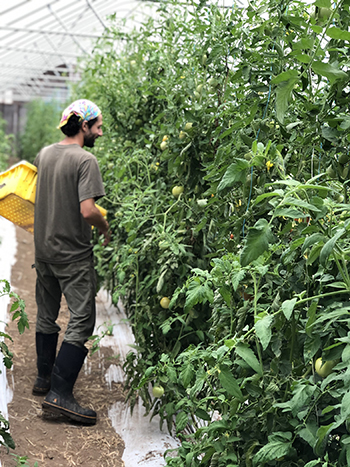 Harvesting tomatoes in the Adamah high tunnel, which was purchased with a federal grant authorized via the Farm Bill.
Other impacts are more obscure. When customers experience sticker shock at the price of our fresh produce compared to packaged goods made from processed corn and soy, there are unseen connections to commodity crop subsidies, crop insurance programs, and credit options inaccessible to diversified small farms like ours. The fact that the racial diversity of the general population is not mirrored among my market farming colleagues is directly related to discrimination in access to federal lending and other programs.
Many of us have heard of the Farm Bill but we don’t really know what’s in it or how it relates to our farms. This two-part GFM series will orient you to what the Farm Bill is, where we are in its legislative cycle, and some of the Farm Bill programs that are most relevant to market farmers. The more we know about the support opportunities available to us, the more we can use them to strengthen our farms and, perhaps, weigh in on the need to expand them or create new ones.
Overview
The Farm Bill is a very large package of federal legislation. Programs in the bill cover everything from crop insurance to farmers market startup funding; irrigation efficiency incentives to food safety training; operating loans to research grants; fresh produce vouchers to conservation easements.
Every five-ish years Congress reauthorizes the Farm Bill. The 2018 bill will expire this coming September, so legislators, lobbyists, and grassroots advocates are deep in the weeds this winter of shaping the 2023 Farm Bill.
“The time is ripe to call for a 2023 farm bill that advances racial justice across the food system, levels the playing field for small and mid-sized farmers, invests in healthy communities, and builds a climate-resilient future,” says Sophia Kruszewski of the National Sustainable Agriculture Coalition (NSAC), an alliance of grassroots organizations.
What’s in the Farm Bill?
The Farm Bill includes the following titles (like chapters): commodities, conservation, nutrition, credit, rural development, research and extension, forestry, energy, horticulture, crop insurance and the helpfully named “miscellaneous.”
While this article series focuses on the market-farmer-relevant bits of the Farm Bill, there are two additional program areas that won’t be much explored but deserve specific mention here due to their size: the Supplemental Nutrition Assistance Program (SNAP) and commodity subsidies.
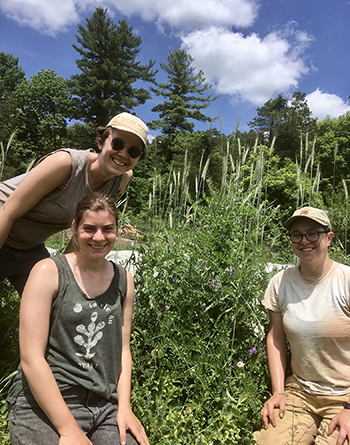 Mature mixed species cover crop at Adamah, one of the farm’s conservation improvements that receives CSP funding via the Farm Bill.
SNAP is a grocery purchase support program for anyone with a qualifying income. According to the Food Research and Action Center, an organization addressing nutrition and hunger, its inclusion in the Farm Bill plays a significant role in poverty reduction.
Commodity subsidies are price and income supports for growers raising widely-produced and traded crops including corn, soybeans, wheat, rice, dairy and sugar. According to NSAC’s 2023 Farm Bill platform: “Commodity support programs that help protect farm viability are a legitimate function of government… (but the current version of the safety net)… encourages land price inflation, soil depleting farming practices and systems, farm consolidation, and declining farming opportunities.”
What’s not in the Farm Bill?
There are plenty of issues that directly relate to farming that aren’t in the bill because they fall outside the jurisdiction of the House and Senate agriculture committees. A few of these issues include farmworker rights and protections, public land grazing rights, irrigation water rights, and most pesticide laws.
How the Farm Bill becomes law
The Senate and House agriculture committees each draw from marker bills that have laid out potential Farm Bill provisions in order to write, argue about, amend, and vote on a draft of the Farm Bill. Next, each draft goes through a similar process on the floor of each chamber. Once the Senate and House each have a bill, the differing provisions are negotiated in conference committee, then voted on, and, if passed, signed, or vetoed, by the president.
Are we there yet?
Nope! Once the bill becomes law, the U.S. Department of Agriculture (USDA) agencies develop “rules” to implement Farm Bill provisions, inviting public comment — a process that takes anywhere from a few months to several years. USDA agencies that market farmers may find themselves intersecting with the most include the Farm Service Agency (FSA), the National Resource Conservation Service (NRCS), and the Agricultural Marketing Service (AMS).
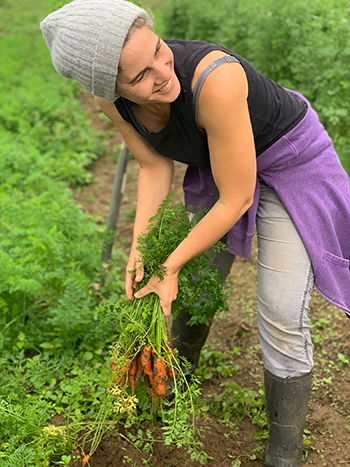 The author harvesting carrots at Adamah, the market farm in Falls Village, Connecticut that she manages.
Finally, unlike the Farm Bill process or its implementation, which happen on a multi-year cycle, every year, House and Senate Appropriations Committees and their Agriculture Subcommittees pursue the annual appropriations process, through which programs without mandatory or entitlement funding are awarded amounts up to the maximum levels allowed by the Farm Bill.
If a Farm Bill program that benefits market farmers has been authorized, funds have been appropriated, and it is available from the USDA, but no market farmers use it, does it make a sound?
Nope! It is worthwhile for all farmers to sync up with local FSA and NRCS offices to find out about grant, loan, technical assistance and other opportunities. NSAC has a useful guide that you can find online “Growing Opportunity: A Guide to Sustainable Farming Programs.” Read on for a non-comprehensive summary of programs most used by market farmers.
Land
Every successful market farmer I know has accessed land via sources beyond the limits of their farm income, a challenge reflected in national research.
The National Young Farmers’ Coalition (NYFC), an organization that seeks to “equitably resource a new generation of working farmers” found that the number one challenge among the over 10,000 young farmers they surveyed in 2022 was access to farmland. Black farmers, Indigenous farmers, other farmers of color, and immigrant farmers face a particularly stacked deck due to legacies of slavery, land dispossession, and discrimination. According to NYFC, 98 percent of U.S. farmland is owned by white people.
The crisis is not a lack of farmable acreage, it is a paucity of access. American Farmland Trust, a national conservation agriculture organization, has found that over 40 percent of farmland is expected to change hands by 2035 and that 18 million acres of land are “likely to be paved over, fragmented, or converted to uses that jeopardize agriculture” in a similar timeframe. The New York Times recently reported USDA findings that “nationwide farmland values increased by 12.4 percent between 2021 and 2022”.
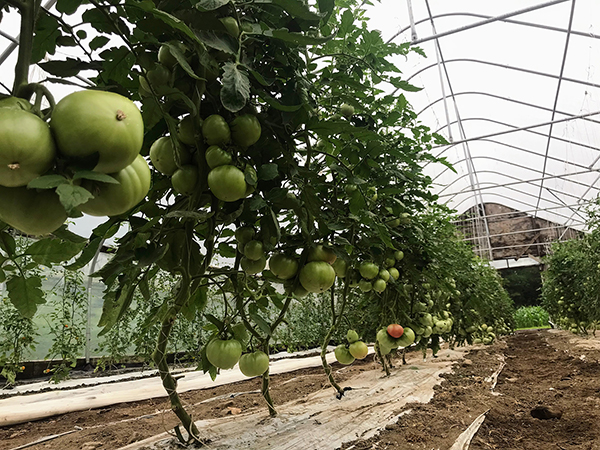 Tomatoes growing in the Adamah high tunnel, which was purchased with a federal grant authorized via the Farm Bill.
The establishment and evolution of FSA’s Microloan program over the past 10 years are a direct result of grassroots calls for small and beginning farmer appropriate USDA lending in the Farm Bill. These loans can be used toward farm ownership or for operating expenses including farmland rental costs, making it a relevant program for farmers looking to purchase or to lease farmland. The microloan program is the most frequently used FSA program by the young farmers surveyed in NYFC’s 2022 survey but it continues to be underutilized.
Other outcomes of Farm Bill advocacy on behalf of farmers underserved by commercial lenders include FSA’s Direct or Guaranteed Farm Ownership Loans and First Time Farm Buyer loans. In addition to the microloan program, farmers leasing land can also access credit toward rental costs via Direct or Guaranteed Operating Loans.
The Land Contract Guarantee program facilitates land ownership transitions between retiring farmers and beginning farmers as does the CRP Transition Incentives Program in the case of land expiring from CRP contracts. (More on CRP in the conservation section.) The Agricultural Conservation Easement Program enables private landowners, land trusts, and other entities to preserve working farms through long-term easements.
For farmers who have inherited land without a clear title or documented legal ownership, a circumstance that applies to more than a third of Black-owned land in the South, the Heirs’ Property Relending Program provides access to credit to resolve succession issues and allow access to USDA programs. The program, established in the 2018 bill after direct advocacy by groups like the Federation of Southern Cooperatives, aims to “address a leading cause of land loss among Black farmers” according to Leah Douglass of the Food and Environmental Reporting Network.
Markets
I’ll never forget the words of my first farming mentor after we’d triumphantly harvested the first vegetables from her newly established market farm at the bottom of a steep mountain in eastern Washington, “We’re only halfway there.” There was still the washing and packing and stocking of the farm stand to do; the question of whether the carrots would sell before their tops went floppy; the electric bill to pay for the display coolers.
As we toiled away on our acre, our landlords’ orchard business bustled above us on the hill with the labor of maintaining thousands of heavily pruned, heavily sprayed apple trees. Bulk bin after bulk bin made its way to the apple packing shed down the valley for wholesale at whatever the set price was. As a young farmer who was in it for the soil contact and not the salad bagging, I spent hours behind the farmstand counter sifting through the relative merits of setting our prices and being connected to our customers versus being done once the crop left the hillside.
No matter which way you dice it, getting paid for crops is hard and tenuous. Direct marketing has its business advantages, but it is expensive and market farmers need all the help they can get with the costs.
Farm Bill programs that make loans available to support direct-to-consumer marketing include the Microloan program, already mentioned in the ‘land’ section, which can be used for operating expenses including market-related ones. There is also the Farm Storage Facility Loan program, which was recently amended to better help fruit and vegetable producers finance cold storage, washing and packing sheds, and portable storage equipment.
Farm Bill programs that make competitive grants available to support direct-to-consumer marketing include The Farmers Market and Local Food Promotion Program. (FMLFP). FMLFP grants apply to crops sold within 400 miles of where they were grown and are available for direct-to-consumer outlets like farmers markets, CSAs, and roadside stands and to local and regional food business enterprises like food hubs and wholesalers. Value-Added Producer Grants can be accessed by individual producers or groups of producers, including cooperatives, to fund marketing plans and feasibility studies, improve food safety practices, or to acquire working capital to operate a VAP business venture or alliance. Farm to School Grants are available to schools, state and local agencies, Native American tribal organizations, non-profits, and farmers or groups of farmers for local food procurement and educational agriculture and gardening.
For Native American market farmers in select areas, there is a new contracting opportunity for tribally led sourcing authorized in the 2018 Farm Bill. The Food Distribution Program on Indian Reservations Self-Determination Demonstration Project is a pilot program through which eight tribes are purchasing directly from commercial vendors for food distribution to income-eligible community members. Tribes with existing contracts have prioritized all local/Native produced products, according to Carly Griffith Hotvedt of the Indigenous Food and Agriculture Initiative. Indigenous food sovereignty advocates are looking to expand the program in this next Farm Bill cycle.
The Gus Schumacher Nutrition Incentive Program (GusNIP) is another particularly elegant, though relatively small, Farm Bill program at work for market farmers. GusNIP supports programs that increase the purchasing power of farmers market customers whose income is below the poverty threshold. Many of us market farmers find our businesses hindered when we run out of local community members who can afford the prices we need to charge. GusNip and other healthy food access programs like the Senior Farmers Market Nutrition program are the results of a successful alliance between nutrition security and local food advocates.
Feel like you could handle reading the words ‘program,’ ‘access,’ and ‘grant’ a few more times? Stay tuned for Part II of this series in the next issue of GFM. We’ll explore Farm Bill programs that address infrastructure, risk management, conservation, and climate.
Janna Siller is the Farm Director at Adamah, an organic production farm and educational program in Falls Village, CT. She also represents the nonprofit organization, Hazon, as a member of the National Sustainable Agriculture Coalition.
Copyright Growing For Market Magazine.
All rights reserved. No portion of this article may be copied
in any manner for use other than by the subscriber without
permission from the publisher.