











Potting mix, called “potting soil” in the United States and “potting compost” in the United Kingdom, often contains no soil, no compost, and is not even always used in pots. Instead, the material farmers mix themselves or buy in bulk every winter is actually a sterile, soil-less mix of organic and inorganic materials meant to offer plants a perfect goldilocks place to put down roots. Depended upon by backyard gardeners, farmers, greenhouse and nursery growers, botanists, landscapers, foresters, conservationists, and biotechnologists, potting mix is a ubiquitous, quiet part of everyday life that is surprisingly exotic — made from mosses, fibers, and minerals that originate all over the globe, from Sri Lanka to India to South Africa, Greece, and Canada.
The carbon footprint is enormous. The mining and harvesting of these materials is damaging for the environment. And many of the ingredients pose serious threats to human health. Market farmers are increasingly fastidious about avoiding pesticides, developing healthy soil, limiting tilling, limiting plastics, and making their operations as regenerative and harmonious as possible. So how and why have so many of them continued to pump through bags and bags of potting soil for so long without ever questioning what it is and why we use it?
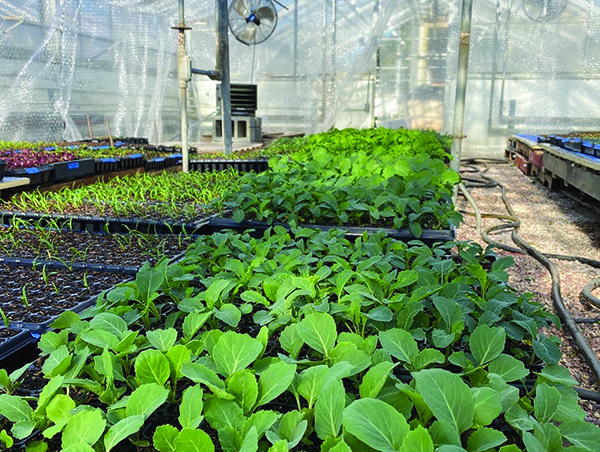 Kale, collard, and spinach sprout in Summer Creek Farm’s HiDra 2 potting mix. Summer Creek’s soil dries from the top down rather than the bottom up like most potting mixes. This allows the grower to better identify when a flat is beginning to dry out. All images courtesy of the author.
Guilty as charged. I began to question potting mix only after a decade of using gobs of it myself. My reawakening began when I relocated from South Carolina to Virginia. I was figuring out new seasons and schedules, new types of soil, new vegetable varieties, new purveyors. And as the manager of a greenhouse for a small CSA farm, I was scrambling around to find the cheap vermiculite I’d grown so dependent upon in South Carolina.
I had used the stuff liberally to amend heavy potting mixes and sprinkle over seeded flats. I’d dumped bulk bags of coarse vermiculite in with compost and straw to lasagna-layer raised beds to their brim. I’d even used it raw from time to time to root cuttings. I mixed half peat half vermiculite as a quick and cheap mix for teaching seed-sowing to kids.
Once I began growing in Virginia, I couldn’t find vermiculite anywhere. I perused nursery centers and landscape suppliers. I asked other gardeners. I called store after store. I finally resorted to calling the customer service phone number for the brand of vermiculite I’d bought so often in Charleston. The woman who answered the phone mmhm’ed in a deep Southern murmur. She was kind and very helpful as she confirmed my deepest greenhouse fears: there were no stores anywhere near me that carried their product. Plus, the only way they’d ship was if I bought enough vermiculite to top every flat I would sow for the rest of my life.
“Well,” I finally asked out of exasperation, “where exactly is the vermiculite from anyway?”
“It used to all come from Montana,” she replied.
“And now?”
“Mostly South Africa,” she said.
“That’s wild!” I burst. “Why so far away?”
“Well,” she stated matter-of-factly, “because of the asbestos.”
We chatted through my next 10 incredulous questions as I pulled up article after article on my laptop. Nursery growers, fellow farmers, and landscapers had always told me that vermiculite was safe as sand — just “rocks from the earth that had been popped at a high temperature.” Yet, here I sat 10 years later wondering whether I’d spent the last decade exposed to asbestos. I also quickly realized that I couldn’t control my exposure simply by giving up my search for bulk bags of vermiculite. Vermiculite, as an ingredient, was already mixed into almost every brand of potting mix I’d ever used.
My hunt for one amendment turned into a bigger and more important question: What else am I not seeing? What is potting mix anyway?
“Why don’t we just dig up backyard soil?” I asked Bill Fonteno, the botanist-turned-horticulturist who co-founded the North Carolina State Horticultural Substrates Lab almost 50 years ago. Fonteno patiently explained to me that raw soil is “the worst thing you could possibly put in a pot.” Sometimes this is due to plant-wilting pathogens, sneaky weed seeds, or hitch-hiking pest insect larvae. But the less-understood disadvantage has to do with physical properties: the pot is too confining; the soil is too dense.
Plant a seed directly into the ground and rain can hydrate and drain, earthworms and micro-animals can cultivate, fungi can ward off harmful pathogens, roots can sprawl wide and deep seeking water, air, nutrients, and stability. Put that same soil and seed in a pot and it will either become an “overwatered bathtub,” or settle into a dense compacted brick with little wiggle room for air or water, let alone roots. Container growing is all about physics.
Many labs study the chemistry of substrates, analyzing soil in terms of fertilizer, salt, toxins, and nutrients. But the NC State Horticultural Substrate Lab is one of the very few that studies the physical properties of growing media — like absorption and density that become especially important when people cannot grow plants directly in the ground. These days, that’s just about everybody.
Urban soil contaminants and lack of land access make many gardeners dependent upon containers like pots and raised beds. Container-growing is also essential for greenhouse production, nursery sales, rooftop installations, ADA-compliant gardens, and native and edible plant propagation. Nurseries and greenhouses are the fastest-growing industries of U.S. agriculture and are entirely dependent upon containers and the “soilless substrate,” or potting mix, with which they are filled. As we attempt to improve food security and move towards more localized food systems, nurseries, greenhouses, and urban gardens will only multiply.
Since the first peat-based potting mixes were developed at UC Davis and Cornell in the 50s and 60s, growers have continued to experiment, tweaking and fine-tuning the perfect mediums for growing out of the ground. Peat was a bit too acidic so they added dolomitic lime. The peat was also low in nutrients so they sprinkled in fertilizer. Then, perlite for aeration. Vermiculite for nutrient retention. Maybe a bit of sand. Gypsum. Some azomite.
Eventually, we wound up with modern potting mix: a suite of increasingly exotic materials combined to form a clean, consistent, neutral, uniform growing medium that exhibits “excellent porosity,” meaning it is unnaturally light and fluffy, riddled with infinite tiny pockets of air. Porosity is important. In fact, a good potting mix is, well, almost nothing: 85 percent pores and only 15 percent solids, sometimes even less. Brian Jackson, a horticulturalist and the current director of the NC State Horticultural Substrate Lab, likens potting mix to potato chips: “Open the bag and it’s mostly air,” he says. “You’re buying spaces, not particles.”
This spacious porosity can be achieved with a wide range of different materials. Everything from bamboo fiber to leaf litter will do the trick. But few materials are available in large enough quantities to keep up with demand. The global potting soil and mixes market will likely reach $3 billion by 2027, with a growth rate comparable to that of the global coffee market. On one hand, this is a good sign — indicative of green urban spaces, new outdoor recreation facilities, a boom in local agriculture, and the continued care of the gardens and indoor plant sanctuaries that sprung up in the wake of COVID-19 lockdowns. But this unfathomable desire for potting mix requires an equally unfathomable amount of affordable, available, and accessible ingredients.
Consumers have shown some interest in more environmentally responsible options, but their preferences have yet to hamper the increasing consumption of potting mix’s most common inputs, namely sphagnum peat moss, coconut coir, and vermiculite. It only takes a few internet searches to learn why these ingredients are so harmful to the health of the planet and ourselves. Vermiculite requires destructive mining and can cause mesothelioma. Thanks to tractors, one-thousand-years-worth of peat moss growth can be erased in just a decade. And coconut coir operations involve hazardous work conditions, low wages, and child labor, all before the product is shipped thousands of miles overseas.
Here’s the bad news: although they are starting to become more common, there aren’t that many alternative potting mixes that are affordable or widely available. The good news? There is an abundance of good potting mix ingredients. The best advice I have for other growers (after this long trip down the rabbit hole) is to take some time to grasp what you’re trying to achieve regarding porosity, absorption, nutrients, etc. Then, question your suppliers, express desire for new alternatives, take some risks.
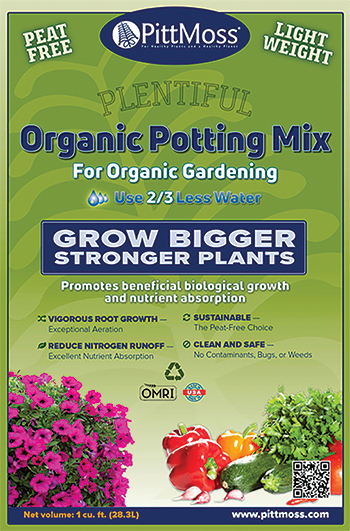 This cardboard and paper potting mix is sold under the brand PittMoss.
Consider making mixes on-site out of locally sourced amendments. We know wine exhibits local terroir. We know that tomatoes from Virginia, pork from Ohio, radicchio from Oregon, and specialty grains from Colorado each exhibit their own unique terroirs, too. Places and people are appreciated for the beauty of their own local eccentricities. We know the benefits of local clothes, local building materials, local businesses. Wouldn’t it make sense for individual growers to locally source their potting mix, too?
I’m dismayed to add one more hat to the modern farmer’s resume. It’s enough that a farmer these days must also be an accountant, a salesperson, marketer, human resources manager, biologist, coroner, and researcher. Must they also be a potting-mix-artist? Maybe, yes? Or maybe the more we share this discussion the more we’ll discover some Rick Hoods in our midst — soil-curious farmers who might make the leap from growing salad mix to mixing soil.
The first person to introduce me to wood fiber as a potting soil medium was Rick Hood of Summer Creek Farm in western Maryland. Hood and I met at the Virginia Biological Farming Conference in 2019 where, to my over-eager relief, he led a round-table discussion on potting mix. Hood began farming vegetables in 1984 and over the years grew increasingly disappointed in the potting mix options he’d found in his area. He began experimenting with new mixes in 2001 and was excited to develop a blend with coconut coir that eliminated the need for peat. Originally intending to make professional mixes for other farmers, Hood was surprised to discover a growing retail demand from gardeners who were looking for peat-free raised-bed mix.
The sale of Summer Creek Farm’s raised-bed mix now encompasses about half of Hood’s sales. He also sells seed-starting mixes, soil block mixes and specialty blends to farmers, landscapers, nurseries, you name it. Hood’s mixes were once made primarily of wood fiber, coconut coir (rehydrated with collected rainwater) and par-boiled rice hulls (a by-product of Arkansas’s many rice farms). But Hood has decided he no longer wants to rely on coir. “Usually 80 to 90 percent of potting mix ingredients are imported,” Hood told me last year, “but with rice hulls and wood fiber, I think we can develop something 90 to 95 percent domestic.” Now available, Summer Creek Farm’s newest living soil mix, HiDra 4, is made from 95 percent U.S.-based ingredients, performs just as well as their coir mix, and is even 15 percent cheaper. Wood fiber for the win.
None of this is news to the crew at the Substrates Lab, who’ve been marveling at wood fiber for years. Although it has long been avoided due to its propensity to “steal” nitrogen from growing plants, new research and technology has revealed that wood is in fact, a very promising substrate. Processed into two sizes, it can work as an alternative for both peat and perlite. “Wood,” Bill Fonteno says, “is the next big thing.”
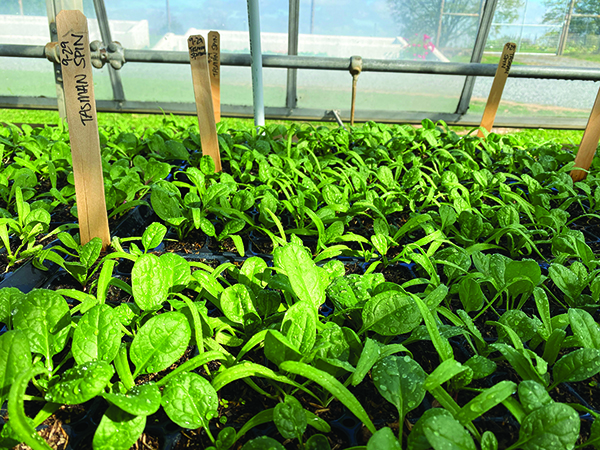 Rice hulls speckle the surface below spinach seedlings grown in Summer Creek Farm’s HiDra 2 potting mix.
Wood fiber is less expensive to produce, requires less watering, can exhibit up to 98 percent porosity, can make use of wood waste products, and it’s local. All conifer species, especially Loblolly pine, have shown promise as inputs for horticultural use, meaning wood fiber can be grown and processed locally in every region of the United States and in innumerable places abroad. French manufacturer Florentaise is one of the largest potting mix companies in the world and touts completely peat-free, wood-fiber-based media.
Garver Akers, an agroecologist and farm manager at the Rodale Institute’s Southeast Organic Center, appreciates the potential of wood fibers, but admits that wood is not always a flawless alternative. Much of the growing wood fiber industry in the states will rely on quick-growing pine. And we already have too much. The abundance of pine available in the “wood basket” of the South is, Akers explains, evidence of an “agricultural tragedy in the history of our country.” Many Southern pine farms are not original woodlands but essentially large monocrops, planted by tree farmers for the last few centuries.
The planting of such large swaths of pine has altered climate, affected native soils, and taken up land that was once virgin deciduous rainforest. A growing wood fiber industry could only exacerbate this situation by encouraging land owners to plant even more pine where it was never growing before. Perhaps, Akers points out, Americans should be investigating other neglected resources, like native bamboo and biochar, for the production of wood-based media. To learn more about biochar, I spoke with the ever-zealous Chad Massura.
“Ninety-five percent of gardeners I’ve talked to have no idea about the problems with peat,” says Massura, the founder and CEO of biochar-based Rosy Soil. “There’s a lot of intention to do the right thing, I just think there’s a lack of awareness of what that means.”
Massura’s solution is to use indoor potting mix as a vehicle to educate consumers about responsible alternatives like biochar. Biochar, a highly porous charcoal-like substrate made from pyrolyzed plant waste, is praised for its ability to hold water and foster healthy plant growth all while sequestering carbon. Like wood fiber, biochar can be processed into different particle sizes to recreate the physical roles of both peat and perlite. Unlike wood fiber, biochar stores CO2 instead of emitting it, locking away three tons of carbon for every one ton of biochar produced. Massura mixes biochar with aged compost and mycorrhizae to achieve microbial activity and diversity that, he says, “better supports plant systems than a sterile mix.”
Massura’s skepticism of sterility echoes a growing body of voices throughout the science world. Sterility, why? Dieticians continue to applaud the power of a kimchi-happy gut microbiome. Immunologists have verified increased immunity in children who are exposed early to rural native soils. Organic farmers mulch, cover-crop, reduce tillage, and apply compost to purposefully increase the populations and diversity of soil-dwelling biota, fungi, and bacteria in their fields. “You have to have the habitat that allows the beneficial microbes to win against the bad ones,” explains Microbiologist and founder of the Soil Food Web School, Elaine Ingham.
For decades horticulturists have focused almost exclusively on soil’s physical and chemical components, reducing the study of biology to the elimination of pathogens and pesky molds. By developing only sterile mixes, Ingham says, we are omitting our “champions in the soil,” the microbes, bacteria, fungi, protozoa and nematodes that boost a plant’s immune system and allow it to grow in a way that is balanced and normal. “If you have really good sets of microorganisms in your soilless mix, you don’t need perlite,” Ingham says. Microscopic bacteria and funguses can actively bind minerals into aggregates and build porosity just as efficiently. “We need to understand,” Ingham says. “We need to make mixes of really good sets of organisms and organic matter, using compost that you make from the surrounding indigenous sets of organisms.”
An advocate of hyper-local, living soils, Vermont Compost Company blends up to 75 percent of homemade compost into their mixes, collecting local inputs like manure, food scraps, and tree waste — all within a 100-mile radius of their facility. They utilize biofuels for processing, offer employees full benefits, and do some work with draft animals instead of tractors. But Fort Vee, their widely beloved all-purpose potting mix, still includes coconut coir, vermiculite, and sphagnum peat moss. Willing to explore, but admittedly superstitious about changing their recipe, they have yet to find a reliable source of wood fiber, or another peat alternative that offers that same “extraordinary amount of internal space,” says owner and president Karl Hammer.
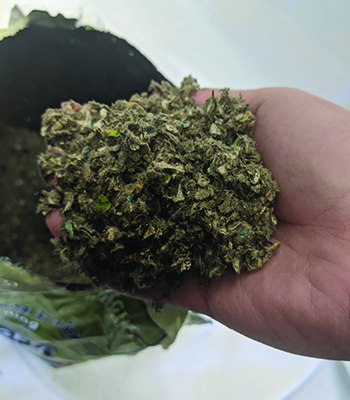 In Pittsburgh, Pennsylvania, the team at PittMoss is hoping to loosen dependence on peat with their new substrate: a soft, speckled blend derived from recycled cardboard and paper. PittMoss’s patented technology reduces landfill waste and requires two-thirds less water than peat and its system is replicable anywhere with cellulose fiber or wastepaper to spare. If all goes well, PittMoss will continue to build facilities domestically and internationally so that paper-based potting mix can be produced from local paper waste anywhere.
Just two states south in Pittsburgh, Pennsylvania, the team at PittMoss is hoping to loosen dependence on peat with their new substrate: a soft, speckled blend derived from recycled cardboard and paper. PittMoss’s patented technology reduces landfill waste and requires two-thirds less water than peat and its system is replicable anywhere with cellulose fiber or wastepaper to spare. If all goes well, PittMoss will continue to build facilities domestically and internationally so that paper-based potting mix can be produced from local paper waste anywhere.
In 2020, consumers who chose PittMoss instead of peat helped to prevent the extraction of 81,111 cubic feet of peat. In terms of CO2 emissions, that’s the equivalent of 900,000 pounds of coal or 91,269 gallons of gas. Quick note: we used PittMoss to grow patio peppers last year and it performed great. We especially loved it for its water conservation and fascinating mulching effect.
Charles Bethke, a consultant for PittMoss and a lifelong soil scientist, believes that on the stage of potting mix, we’ve moved into the third act — from dug-up sterilized soil, to peat-based everything, to the new world of reused plants. Wood bark, recycled paper, hemp, miscanthus grass, willow, cork, nettles, rice hulls, biochar, compost — the possibilities are endless.
The farmers at Dalefoot Compost in the U.K.’s Lake District kill about 20 birds with one stone, making their award-winning peat-free potting mix out of perennial comfrey, wool sheared from their free-ranging sheep, and composted bracken — a native fern that became invasive due to deforestation in the 17th century. “We must shift our thinking from ingredients and components to properties and parameters,” says Bill Fonteno. “Air space and water content and porosity, that’s kind of universal. The key is to take local or endemic materials and make them as efficient as they possibly can be.”
Caitlin Fisher is an organic farmer and writer for publications like National Geographic Magazine, the Local Palate, the Essentialist, and Gourd Magazine. After managing greenhouses in the foothills of Virginia and an island farm off the coast of South Carolina, she’s glad to be farming back home with her husband on Maryland’s marshy Eastern Shore.
Copyright Growing For Market Magazine.
All rights reserved. No portion of this article may be copied
in any manner for use other than by the subscriber without
permission from the publisher.