











This final article in a series of three about a native plant nursery business focuses on equipment, labor, pricing, opportunities, and restoration projects. As with the January and February 2023 GFM articles, it centers on my neighbors, mentors, and dear friends Sandy Roth and Dick Kenton who started Plant Works in 1996 in rural La Grande, Oregon. We hope these articles encourage others to grow native plants and work in restoration.
Equipment
Like many small businesses and small farms, Plant Works started off pretty hardscrabble with rehabbed junk for equipment, advice from other growers, and enough ignorance and enthusiasm to keep going. After almost 27 years in business together, spouses and business partners Sandy and Dick still laugh about their argument about their first big purchase.
“We saw a pallet jack at the hardware store for $100, and I knew we needed it,” said Dick. Meanwhile, Sandy said, “Dick! Where are we going to get $100 for a pallet jack?” So, they left the store to go meet up with one of their wholesale native plant customers. “They all teamed up on me and guilt-tripped me, so we went back and bought the pallet jack,” laughed Sandy.
“Now, I don’t even think of purchases in terms of hundreds of dollars,” she said. “Everything seems to come in units of $10,000.”
The first $10,000 purchase was a used soil mixer. Dick had been mixing soil in small batches in a cement mixer, which they still have and I have borrowed to mix cement. “Somehow, Dick was able to convince the bank to loan us the money for the soil mixer,” said Sandy.
Other critical equipment for the nursery includes carts, racks and tubes, tray covers for filling racks and tubes, the boiler, greenhouse heaters, forklift, box stapler for shipping plants, and the conveyer belt for packing plants. The conveyer belt caused an uproar with employees.
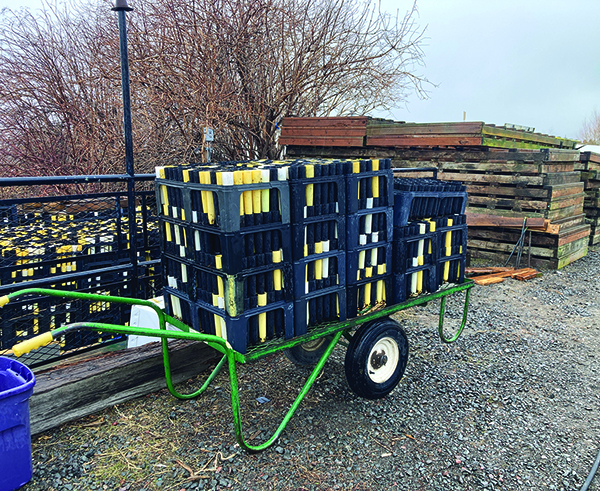 Cart with racks and tubes for deep-rooted plants. Carts are the workhorses at Plant Works. All images courtesy of the author.
“They said, ‘We don’t want to be like Lucy in the bon-bon factory,’” said Dick, referring to the classic “I Love Lucy” sketch.
“My philosophy is I do things conservatively but also I get what we need,” Sandy said. “It costs money to run a business, but in the end it usually pays off. It pays off in either labor or it saves your body.”
While machines can save labor, Dick said he prefers to rely on people. “We could buy a used flat filler for $10,000 or we can have two people filling flats by hand,” he said. “You can fill a lot of flats for $10,000 and it gives someone work.”
Contracts and pricing
Since Plant Works is in a rural county of 26,000 people and far from large cities, Sandy and Dick have focused on wholesale contract production rather than retail. “The beauty of growing wholesale on contract is you know what you’re growing and don’t have to guess,” said Sandy.
Instead of spending a lot of time marketing plants, they spend time bidding on projects with government agencies, environmental organizations, and private landowners. They try to bid on contracts with one or two years lead time so that they can collect seed or take cuttings from the region where the plants will be planted.
In terms of pricing, Plant Works sets wholesale prices by calculating their per plant costs and knowing the general going rate. “We know it takes 15 minutes to transplant a rack of plants. We know the cost of the soil and amendments,” said Sandy.
“After that, we just use a per square foot greenhouse cost to account for water, space, heat and other costs,” Dick added.
As discussed in the previous two articles, native plants have a high mortality rate in the greenhouse. They have to account for a high rate of loss, overplanting, and replanting when bidding on contracts and setting prices as well. “We estimate a third of plantings will die or will be too small to ship,” said Sandy.
Right now, based on other nursery’s rates and their costs, one-season plants are selling for about $1.85 each.
Plant Works emphasizes the importance of personal relationships with customers, or “partners in restoration” as they call them. They work with government agencies including the Natural Resource Conservation Service, Bureau of Land Management, the U.S. Forest Service, state forestry, and local Soil and Water Conservation Districts. They also work with tribes, power companies, private landowners, The Nature Conservancy, and Trout Unlimited. For growers interested in getting started in native plant production, Dick and Sandy recommend getting to know your local agencies and wildlife and environmental organizations to see what their needs are.
Restoration success
While Plant Works doesn’t plant out their plants on restoration projects, they are keenly aware of what it takes for plants to survive. “We have chosen to do our own restoration project on our land,” said Sandy.
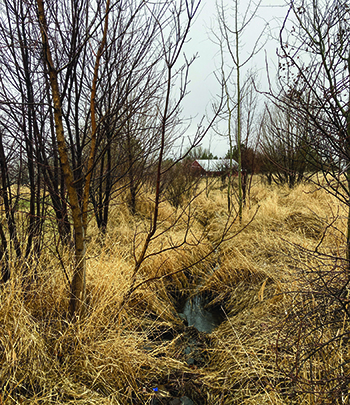
A CREP restoration project at Plant Works. They fenced out cattle from their creek and began planting native plants from their own greenhouses. They have been able to study the plants’ success over the last 10 years and use that information to improve their process.
Through the Farm Service Agency’s (FSA) Conservation Reserve Enhancement Program (CREP) program, they fenced out cattle from their creek and began planting native plants from their own greenhouses. They have been able to study the plants’ success over the last 10 years and use that information to improve their process.
“We make sure to add mycorrhizal amendments to the soil mix for root extension and grow everything for a fall planting,” said Sandy.
They used to grow for spring planting projects, but plant survival has been better when plants go out in dormancy. Site preparation is also key, which is why they encourage customers to order one to two years in advance.
In the West, fencing out cattle is important for plant survival. Fencing out deer and elk is a much bigger endeavor but has a huge impact on woody plant survival. “We can show customers in our own restoration project the impact of deer on plants,” Dick explained. While their CREP project keeps out cattle, the deer easily jump the 5-foot fence and really have impacted plant growth.
Other important site prep includes mitigating competing vegetation. While restoration projects used to use plastic weed barriers, sprays, and plastic tree guards, most of Plant Works’ customers are moving away from these strategies. Now fencing and scraping the soil free of vegetation before planting is preferred to reduce plastic and chemical use.
Expansion and opportunities
This winter Plant Works has taken on a huge expansion project to meet the increased demand and opportunities in native plant production. The devastating wildfires in the West in 2020 showed the urgent need for additional native plant production and greenhouse space. After the Labor Day fires ravaged state, private, and tribal lands in Oregon, restoration efforts were hindered by a lack of plant availability.
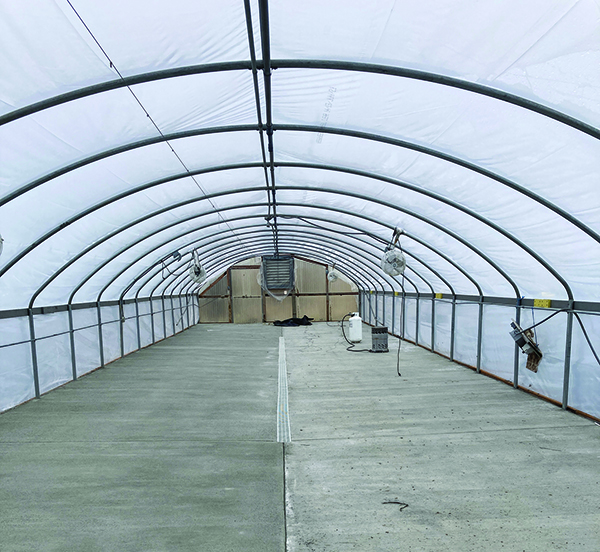 Greenhouse floors are now concrete with center drains for the nursery’s new water reclamation project.
The state of Oregon invested in longer-term solutions by providing grants for growers to expand operations. Plant Works was awarded money and started a big expansion this winter. The project has two interconnected phases: water reclamation and greenhouse expansion.
“We realized the only way we could expand greenhouse capacity (square feet) was to reclaim water,” Dick said. “By reclaiming water, we figure we have enough for the original four houses plus two new ones. We expect to be able to reclaim over 40 percent of the water.”
Plant Works has limited groundwater and relies on junior creek and spring water rights. Growing in pots and tubes, they use overhead watering, which means a lot of water just hits the ground unused. To reclaim the water, they concreted the floors in all the greenhouses and added a center linear trough drain. The drain flows under the houses down to a reservoir at the bottom of the property. Once in the reservoir area, water will be filtered, UV light used to kill bacteria, and then pumped back up to a water storage building at the top of the property for reuse.
The water reclamation system will allow them to add two more 90-foot-long greenhouses and grow conifers and other plants needed for post-fire restoration. “We’re also buying a new 90-percent-efficient condensation boiler to heat the floors,” Dick said. “Do you know where our current boiler came from?” he asked me. “Bohnenkamps,” he said, referring to a flagship local furniture store that burned down in our town when I was a kid.
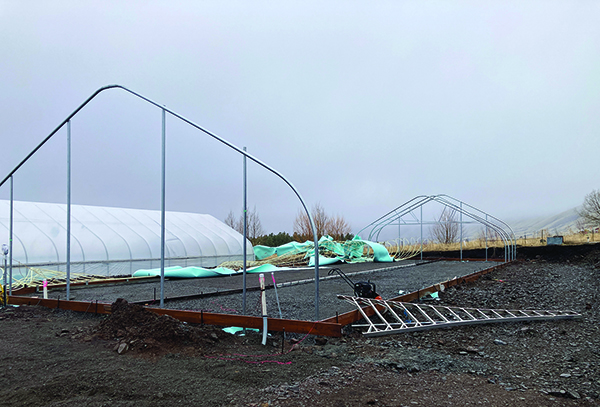 New greenhouse expansion project. The tubing is PEX (cross-linked polyethylene) for in-floor heating.
“Yeah,” said Sandy. “But it came from Bohnenkamps after the fire.” Turns out they had scrounged the boiler from the burned-out building and rebuilt it. I was shocked. That boiler, along with their resilience and dedication to restoration, has powered their nursery for almost 30 years.
Nella Mae Parks farms on her family place in Cove, Oregon, growing vegetables for her on-farm farmstand, the farmers market, and wholesale outlets in the region.
Copyright Growing For Market Magazine.
All rights reserved. No portion of this article may be copied
in any manner for use other than by the subscriber without
permission from the publisher.