











Conservation and climate, risk management, research and infrastructure
If you missed the first part of this series in February’s GFM, we highly recommend you revisit it. You’ll find an overview of what the Farm Bill is, where we are in its legislative cycle, and an exploration of what market farmers should know about Farm Bill authorized programs related to land access and markets. In this installment, we’ll run through some market-farmer-relevant programs related to conservation and climate, risk management, research, and infrastructure.
Conservation and climate
So many of us take on the costs of ecological management practices that don’t have a one-to-one market payoff. Soil health measures, erosion control, maintaining wildlife habitat, water conservation, energy efficiency, species diversity, carbon storage and sequestration — it becomes second-nature to build our farms around these priorities. We find some compensation through resource-use savings or when consumers are willing to pay a higher price for organic or other labels.
There is certainly an increase in long-term farm business viability associated with ecosystem health that pays off. Feeding soil microbes today decreases fertilizer costs five years from now, maintaining diverse habitat for beneficial insects today increases pest predation and pollination, and thus marketable yields, for years to come. But there are associated costs with these practices that aren’t always recouped. In an interconnected world, the carbon we keep in the ground, the biodiversity we encourage, and the water we conserve are valuable beyond our acreage, just as pollution, GHG emissions, and aquifer drainage by other land managers are detrimental beyond theirs. (See the October 2022 GFM for carbon credit programs that are exploring compensating for field crop carbon sequestration and farm biodiversity.)
The goal of conservation incentives is to take public responsibility for farmers’ conservation expenses that are a boon to all co-habitants on planet earth. These incentives can help with expenses like cover crop seeds, hedgerow plantings, reduced tillage equipment, and perennial plantings. Despite the enormity of the investment—they are the single largest federal investment in conservation on private land, making up about one-twelfth of overall Farm Bill spending— farmer demand outstrips funds allocated to the conservation title by an order of about 3 to 1, according to the USDA.
I know many market farmers who would be eligible for federal conservation programs but don’t apply, either because they don’t know about them, the process is too much of a hassle, they’ve experienced racial or other discrimination from USDA before, or they can’t convince their agent from the Natural Resource Conservation Service (the USDA agency responsible for these programs) to do the work of matching small-scale farming practices with programs that were designed with bigger farms in mind.
“With the $20 billion in new funds that soon will be available under the Inflation Reduction Act (IRA), ease of access to USDA conservation programs will likely improve,” says Cathy Day of the National Sustainable Agriculture Coalition. The funds spent under the IRA will directly target mitigating greenhouse gas emissions, which can include a range of practices including agroforestry, silvopasture, and management intensive rotational grazing.
Typically, the Farm Bill is the mechanism that shapes federal conservation programs, but the IRA was a unique opportunity for legislators to use existing programs to meet climate change mitigation targets. Stay tuned for the results of this investment; USDA is still in the process of managing these increases, and congressional debate over the 2023 Farm Bill, happening now, may have an enormous impact on how those funds are allocated.
The best way for farmers to access these programs is to get in touch with their NRCS agent and ask about them. Unfortunately, it doesn’t work well to describe your farm and then ask, “What have you got for me?” It is much more effective to talk to your NRCS agent in terms of ‘resource concerns.’
Do you have a particular market opportunity to integrate agroforestry onto your farm? Grow a lot of flowering crops that require a robust pollinator habitat nearby? A pasture with a rapidly expanding gully running through it that needs to be addressed? Name these concerns to your NRCS agent to get the ball rolling. Asking about particular programs is also helpful, so let’s run through in a bit of detail two of the most market-farmer-relevant ones, EQIP and CSP.
The Environmental Quality Incentives Program (EQIP) is perhaps the federal conservation program most widely accessed by market farmers. At Adamah, we have used EQIP grants and technical assistance for a high tunnel, deer fencing, erosion control, well and irrigation development, and making high water table sections of the farm arable.
A successful EQIP project example: Adamah was already registered with NRCS from previous contracts when in 2010 we approached our agent with a concern about road and upslope runoff running from a culvert through the middle of one of our veggie fields. An engineer came out and designed a system to pipe the runoff underground to a wetland downslope of the farm. NRCS paid for 100 percent of the approximately $10,000 cost of the project, opening up about an acre of veggie land that previously was too difficult to deal with.
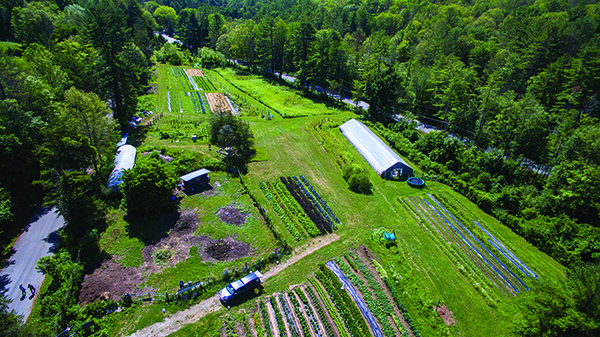 Adamah Farm gained the entirety of the far veggie block seen in this photo thanks to an NRCS funded EQIP project to redirect culvert runoff.
Another: In 2020 we launched a silvopasture project, planting 200 chestnut saplings in a pasture for our flerd (flock + herd) of goats and sheep. We determined that the easiest way to water the trees and animals would be to make use of high groundwater levels in certain spots. We approached our NRCS agent and applied for an EQIP cost share that ended up paying for 75 percent of the $13,000 project to dig a shallow gravity-powered well, also called spring development, and piping water from nearby areas with a high water table to the well.
Dreamy scenarios, right? These two projects have successfully increased our business viability as a small-scale, community-based, ecological farm. Hooray for intended outcomes! Lest you think working with federal conservation programs is always easy peasy for market farmers, we spent several hours a week over the course of several years on the above projects — lots of meetings, phone calls, testing out contractors, getting estimates, etc.
And here is an example of a failed attempt at an EQIP project. In 2018 we sought an EQIP grant to put a concrete pad with a roof in our compost yard to limit nutrient loss. The design we had in mind was simple. The one that the engineers NRCS required us to use for the project was not. Their design required so much concrete and complexity that it would have cost $85,000 to put in, but the NRCS contract was only for $45,000. We abandoned the project — wah wah.
When we first applied for the Conservation Stewardship Program (CSP) in 2019, I was pretty sure the chances of my brain exploding were higher than our chances of receiving CSP payments. The process of applying was so complicated that I remember shedding a tear of frustration while hand-weeding salad mix, my phone resting beside the mizuna on speaker while our very kind NRCS agent explained, again, the differences between conservation activities, enhancements and bundles.
In the end, we got over that hump. Adamah is successfully enrolled in the program, having passed through a competitive process that uses site visits and NRCS software called The Conservation Application Ranking Tool (CART) to select applicants with the highest conservation performance outcomes. We now receive about $5,000 annually as payments for our reduced tillage practices, maintenance of pollinator habitat, agroforestry, and wetland restoration.
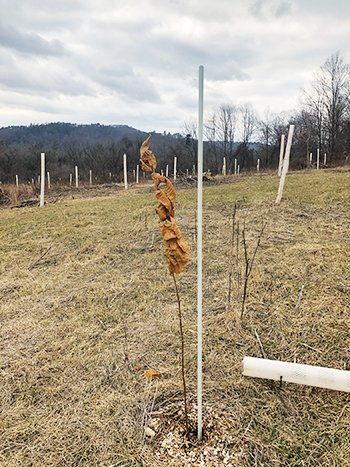 A chestnut sapling gets a momentary breather from its protective tube for a photoshoot in Adamah Farm’s agroforestry project.
For us, it was worth the frustration of applying for CSP, but if you are going to launch that journey for yourself, harvest some chamomile and mint for a little relaxation tea while you go through the process. There may be reason for optimism for future applicants. “The IRA invested over three billion dollars to expand CSP,” Day said. “We hope that this will translate to a smoother application process and larger payments.”
You might also work with your NRCS agent to permanently protect your farmland, wetlands, or grasslands from development through the Agricultural Conservation Easement Program, or to take vulnerable land out of production without loss of income with the Conservation Reserve Program. The Rural Energy for America program (REAP) provides grants and loans to rural small businesses for energy audits, renewable energy infrastructure, or energy efficiency improvements. All three of these programs are also slated for expansion after passage of the IRA.
Risk management
Risk management is a very sterile sounding term that refers to the most terrifying aspects of farming. Crop loss, price fluctuation, injury, infrastructure damage; farming is a nail-biter to be sure. Market farmers have a wide range of strategies for “managing risk” such as investing in soil health, which lends inherent resilience to a farming system; crop diversity so as not to put all the eggs in one basket; developing relationships with customers who have our backs in a pinch.
The USDA’s Risk Management Agency (RMA) designates five categories of risk for farmers: financial, marketing, production, human-resource, and legal risks. There are a number of Farm Bill authorized programs to address these risk categories, including many of the ones mentioned already. The program that comes to mind for most people when thinking risk management, however, is crop insurance.
The vast majority of the billions of dollars spent on federal crop insurance are accessed by farmers growing 200 or more acres worth of commodities — primarily corn, soy, wheat, and cotton. So why even bother bringing crop insurance up in an article about market-farmer-relevant Farm Bill programs? Advocates for farm safety net reform have worked hard to develop options for market growers, with some small successes we should keep an eye on.
Whole-Farm Revenue Protection (WFRP) is a relatively new, crop-neutral revenue insurance policy through which a diversified farm can insure all their crops and livestock under one policy. It was designed to work for small-scale diversified growers, so why don’t I know any market farmers who use it? According to Amalie Lipstreu of the Ohio Ecological Food and Farm Association, WFRP doesn’t serve diverse farmers as well as it should. A farm would need to have a complete disaster of all crops for the WFRP payments to make the premiums worthwhile.
The paperwork is burdensome, and farmer confidence in the program is not high. Again, why do we need to know about this tool if it is so troubled? It does work for some growers in some circumstances, and if the fact that WFRP was cited as a key climate adaptation priority by the USDA last year is any indication, it may be up for an overhaul soon.
Beginning farmers face particular risks including those associated with farmland access, startup costs, and getting established in markets. In many of the programs discussed so far in this article, there are funding pools set aside for beginning farmers. In addition to the environmental and market factors we’ve discussed, discrimination is a major risk factor for farmers of color. According to USDA’s 2019 census, BIPOC farmers operate less than 5 percent of American farms on less than 1 percent of the country’s farmland, despite people of color making up over a quarter of the overall US population.
This is not a fluke, but directly tied to legacies of slavery, land theft, and discrimination, including the reality that many BIPOC farmers have been shut out of the very opportunities discussed in this series.
Seeds of efforts from previous iterations of the Farm Bill and other federal legislation seek to address discrimination, including the creation of funding pools for many of the programs discussed in this article that are set aside for socially disadvantaged farmers (which includes African American, American Indian, Asian American, and Latino farmers and ranchers). The IRA initiated loan relief for farmers who have been subject to USDA discrimination and distressed borrowers, replaces the American Rescue Act (ARA) debt relief program for farmers of color, which was held up indefinitely in court.
Proposals to water the seeds of greater equity via the 2023 Farm Bill and other legislation include: the establishment of an independent board to oversee civil rights within the USDA, establishing a Farm Conservation Corps with a focus on socially disadvantaged groups, and other redress.
Of course, the pandemic was a unique risk factor that affected all of our businesses so I’ll also mention the Coronavirus Food Assistance Programs (CFAP-1 and CFAP-2), even though they were authorized through pandemic response legislation, not the Farm Bill. USDA recently announced automatic CFAP top-up payments for historically underserved farmers including socially disadvantaged, limited resource, beginning, and veteran farmers and ranchers.
Research
Whether you want to trial a new idea on your farm or learn from the experiments of others, the Sustainable Agriculture Research and Education (SARE) program is worth knowing about. SARE funds projects run by research institutions, but it also has a farmer grant program. If you have a new idea you’d like to trial on your farm but don’t want to take on the labor and materials expenses associated with the unknown, consider a SARE farmer grant.
The project goals must be relevant for other farmers and there is a requirement to do some outreach of the results. It takes some time to properly design the project and to collect data, but farmers can get support from outside experts for both. I’ve leaned on many a resource that came out of the SARE program. The slim volume “Managing Cover Crops Profitably” is a favorite nerdy resource of mine, as is “Crop Rotation on Organic Farms,” both funded by SARE.
In addition to publications like these, there is a searchable online database of all SARE projects. Want to learn more about whether commercial soil inoculants measurably increase crop yields? Looking for ideas on the best way to compost food waste on an urban farm? I’ve searched the SARE database for insight into questions like these, as well as just to see what farmers in my area are into. Tons of info in there.
Infrastructure and operating expenses
Farming can require high up-front costs, from putting in a well and irrigation system to buying a tractor. Microloans — referenced in the “land” section of the first article — can also be used for land purchase or lease, and for farm expenses including seeds, animals, or small equipment, up to $50,000. Direct or Guaranteed Farm Operating Loans, also relevant for land purchase, can be used for livestock, farm equipment, feed, seed, fuel, minor improvements to buildings, costs associated with land and water development, and to refinance debts under certain conditions. Beginning and socially disadvantaged farmers and ranchers are given priority in all three loan programs through set asides.
The Value Added Producer Grant (VAPG) and Farm Storage Facility Loans were both mentioned in the “markets” section of the previous article and can be helpful for relevant infrastructure expenses. The Organic Cost Share Program reimburses certified organic growers for a portion of their certifications costs. The EQIP Seasonal High Tunnel Initiative mentioned in the “conservation” section has been utilized by almost every veggie farm I know.
While we’ve focused on programs farmers can use directly in this article, there are many more Farm Bill programs that support the broad infrastructure that supports market farmers. The Beginning Farmer and Rancher Development Grant funds farmer training. The Outreach and Assistance to Socially Disadvantaged and Veteran Farmers and Ranchers offers competitive grants to non-profit and tribal organizations, academic institutions and cooperative extension toward increasing participation among historically underserved producers in USDA programs.
Through the Regional Conservation Partnership Program, NRCS partners with state agencies, and non-governmental organizations to support farmers in conservation activities. The Food Safety Outreach Program supports trainings for farmers run by academic institutions and non-profits. The Organic Agriculture Research and Extension Initiative funds efforts to further our knowledge base around organic farming strategies. From farmworkers to small-scale farm business owners to corporate lobbyists, voices across the country are lining up to weigh in on how the 2023 Farm Bill will shape up.
If you are interested in joining the conversation, Ariana Taylor-Stanley, Grassroots Co-Director of the National Sustainable Agriculture Coalition and farmer/co-owner of Here We Are Farm in Trumansburg, New York, has a few recommendations:
Join the Rally for Resilience: Farmers, farm workers, and farmer allies will be converging on Washington, D.C., March 6 to 8 to urge Congress to make climate change policy a priority in the 2023 Farm Bill. Collaboratively organized by over 20 food and farm organizations, the three-day event will include a rally, concert, and march, as well as an opening ceremony, cultural events, press briefing events, a lobby day, and perhaps even a rotational grazing demonstration with livestock on the National Mall. Travel funding support is available from many partner organizations. Visit bit.ly/farmerclimaterally to learn more and register.
Sign the Farmer Climate Letter: The National Sustainable Agriculture Coalition (NSAC) is collecting signatures for its farmer climate letter to be delivered to legislators at the Rally for Resilience. Add your name at bit.ly/araletter.
Call your legislators: Has one of these Farm Bill programs been impactful for you? Did one simply not work for your context? Whatever the case, it’s all up for review. Especially if your legislators are on the House or Senate Agriculture Committee, but even if they aren’t, it is always worth taking a few minutes to reach out, especially with an action alert in hand from NSAC or other organizations. Find your legislators’ office numbers by calling the United States Capitol switchboard at (202) 224-3121.
Janna Siller is the Farm Director at Adamah, an organic production farm and educational program in Falls Village, CT. She also represents the nonprofit organization, Hazon, as a member of the National Sustainable Agriculture Coalition.
Copyright Growing For Market Magazine.
All rights reserved. No portion of this article may be copied
in any manner for use other than by the subscriber without
permission from the publisher.