











Savanna Institute offers guidance, NRCS EQIP funding
“How do I farm better and do less?” asks a yellow sticky note above my desk; it has been here for a few years now. There are probably a variety of ways to answer this. One solution I’m trying is the incorporation of more perennial species, including trees and shrubs. Incorporating woody perennials into production systems is called agroforestry.
With perennials you pay for and plant them once, and they produce for many years. As the plantings mature, the majority of farm labor is harvesting and selling. Using the concepts of agroforestry, perennials are intentionally incorporated throughout the farm for many benefits including: creating habitat for wildlife, especially birds, which can help with pest control; providing more flowers for pollinators; acting as a wind block and potential drift filter; increasing soil health; storing carbon; as well as producing additional products for sale.
Disclaimer: I am in the early stages of this process, which honestly feels too early to elaborate on it. But when GFM contacted me to write on the subject, I thought about the common saying: When’s the best time to plant a tree? 30 years ago. When’s the next best time? Now. So perhaps this article will come at the right time for you to consider adding trees to your farm plan.
Let me give you a little snapshot of my farm. Delight Flower Farm is a 5-acre plot of flat land in central Illinois near Champaign. Our team consists of a small crew of employees and myself (four to six people depending on the time of year). Together we grow and sell cut flowers on about 2 acres of the land. We sell wholesale to florists, grocery stores, teach on-farm workshops, and sell direct to customers through local farmers markets and a 75ish-member flower CSA.
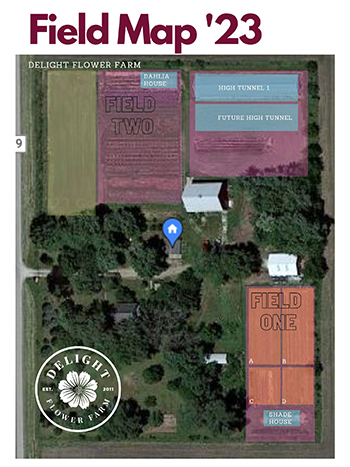 Field map of Delight Flower Farm, including the site of future work under a NRCS EQUIP grant. The farm is on five acres near Champaign, Illinois.
We have two high tunnels, a propagation house, and grow a wide variety of field crops laid out in 4 foot x 100 foot permanent raised beds. I started the farm in my small urban backyard in 2011. In 2015, I leased an acre on another farm on the outskirts of town. In 2017, I leased an additional acre from the same farmer. In 2019, I purchased a 5-acre property. Until having my own property I have been hesitant to invest in perennial crops. But since moving to the farm I have been vigorously planting perennial flowers. However, I have not yet planted many trees.
As my business has grown so has the labor to operate and manage it. Then, 2020 was a particularly demanding year for flowers, which was a great boon for my business. However, that same year several of my longer-term employees took other jobs with more consistent year-round hours. While we were growing more at a rapid rate I was also spending a lot of time training new staff. By mid-summer 2021 I was overworked, underslept, stressed, and had suffered several farm-related injuries.
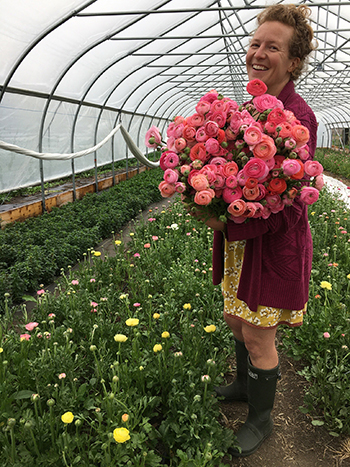 The author in one of her tunnels. All images courtesy of the author.
Something had to change to make this work easier on me. I know enough to know that farming isn’t going to ever be EASY, but something had to give to make the physical labor of this farm less destructive on the humans doing it. In grasping for more ease I sought out the help of the Savanna Institute, a non-profit organization based in the Midwest that helps farmers incorporate more trees and agroforestry practices into their acreage. Mostly they aid in transitioning monocrop acreage out of purely conventional crops to incorporate productive perennial crops. (“Perennial AF,” is their podcast.)
With the help of the Savanna Institute and the NRCS (Natural Resources Conservation Service) through the EQIP (Environmental Quality Incentives Program) I am attempting to make some changes to my farm to help combat a series of issues and increase the overall health of the ecosystem long term:
Alley Cropping: grow perennial crops that I can plant once and harvest for many years to come in between annual crops
Windbreak Renovation: repair an old windbreak on the property to mitigate damage of extreme wind events, which are more common in this era of climate change, and filter potential chemical drift
Wildlife Structures: create more food and shelter for birds which will naturally keep pest pressure in check
Cover Cropping: control persistent weeds and increase soil health on land not currently in use for production by planting cover crops
Additional High Tunnel: increase the amount of high value flowers I grow under the protection of a high tunnel.
Over the years I have applied for and received several NRCS EQIP grants to build high tunnels. This last time around I decided to add some additional programs to my high tunnel application including alley cropping, windbreak renovation, structures for wildlife, and cover cropping. Each of these “programs’’ adds points to my ranking in the application process, making it more likely I’ll receive funding overall.
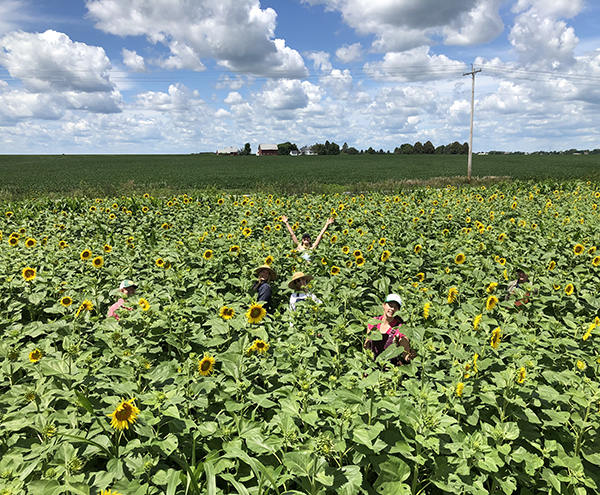 The author chose varieties of cover crops that could be useful to her farm for reasons beyond soil health. Last summer she grew sorghum-Sudangrass and sunflowers. These black oil sunflowers are not a cut flower variety, but still have the effect of making the property look like a flower farm to people driving by, especially since she lets these blooms open in the field. The sorghum seed heads made an excellent addition to fall bouquets. She harvested and sold them to florists and at market, and also harvested some to dry for wreaths and fall decorations. Her customers loved them.
Plot spoiler: I qualified and in the words of NRCS have an “obligated contract.” What this means is that I have three years to complete all of these projects and as each one is completed the NRCS checks that it meets our contract requirements and then pays out partial reimbursement on each program.
Together these practices increase the overall health of the ecosystem on my farm and in the long run, the sustainability of my business. Which hopefully makes farming less strenuous on me and my crew, and easier to manage without compromising financial viability.
Since I’m in the early stages of this contract, let’s discuss the basic steps/strategies for each practice, and how I plan to execute them, so that you might have a starting template for your own farm.
Alley cropping is a practice of planting trees (or woody shrubs) within the cropland layout, sometimes called intercropping. In my case, there will be three beds of annual flowers (dahlias, sunflowers, celosia, etc.) and then one row of woodies, and then three more beds of annuals, repeating this pattern over 27 beds total. Kaitie Adams from the Savanna Institute helped me create a map in a shared Google drive folder.
The file included NRCS’s suggested plant spacing and recommended cultivars. We were looking for plants that I knew would both fulfill the application specifications and had great potential to produce usable stems (with either flowers or berries) that I could sell to customers. Some of these include: winterberry, arrowwood viburnum, holly, highbush cranberry. See above layout. The ASCFG’s book Woody Cut Stems has great info on shrubs that make good cut flowers.
I am in the process of ordering these plants right now to transplant out this spring. I am purchasing from Illinois nurseries that specialize in native varieties more likely to succeed in the long run and are more favored by the NRCS than other more exotic floraculture varieties. My contract specifies that I plant out of two gallon stock, but some contracts allow for bare root plantings. If some of the varieties are only available as bare roots I will pot them up and raise to two-gallon size myself and provide invoices to reflect these additional inputs.
As part of this process I am aiming to control weeds around these plants using a mulching technique I first learned from Floret’s online course. The process is to lay down flattened cardboard boxes one layer thick and then mulch with 4 to 6 inches of wood chips, which I happen to get for free from a local tree trimming company. In the first few years I anticipate a bit higher labor input for all the mulching.
Once established, the shrubs will outcompete future weeds. The NRCS had a line of the contract fund devoted to mulching expenses so that is quite considerate. You could use fabric mulch, but I like using something that is more biodegradable and less plastic. I have had success with this mulching method for ninebark, roses, willow and hydrangea.
Windbreak renovation. Sometime at least 50 years ago someone planted a windbreak on the south and west perimeter lines of this property. Mostly it is made up of two rows of white pines spaced 10 to 15 feet apart. Over time many of these trees have died of age, pesticide exposure or other causes. What remains are 15 living trees, 10 dead trees still standing, and lots of stumps.
The NRCS EQIP plan supports me to repair the existing windbreak by cleaning up the dead wood and replanting trees and shrubs. I will chainsaw down the dead trees, grind the stumps, and remove the debris. I am replanting a mix of new evergreens and deciduous trees in the established two rows and adding a third row on the interior side of the property of some woody shrubs.
Again, the Savanna Institute has been an excellent resource for planning this process. I initially did a roughly drawn survey of the existing tree line. Then, Kaitie made a spreadsheet action plan for the windbreak renovation and together we created the shopping list of tree and shrub species to be planted this spring.
Wildlife structures. Many of the plantings already mentioned will provide both food and shelter for birds, and other small animals. I am also hoping to attract some songbirds for farmer enjoyment and raptors (hawks, owls, etc.) to help keep my vole and mouse population in check. I am installing bird houses specific to the kinds of birds I want to attract. Many of these birds have special nest box requirements which the USDA agent was able to share with me. I also have gotten cheap and thorough nest box building plans from the Cornell Lab NestWatch.org. I built some boxes and others I have purchased.
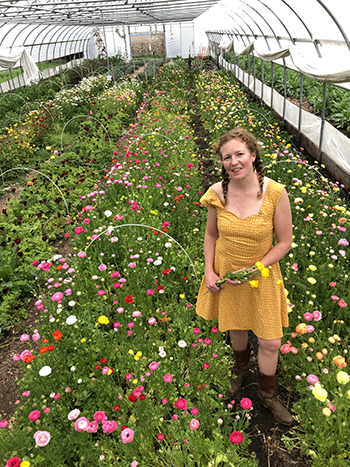 The author in one of her tunnels.
These boxes have only gone up recently and the spring nesting season is upon us, so fingers crossed the birds find them. I received funding for eight boxes total, including some for bluebirds, screech-owls, barred owls, and the one I’m most eager about, a barn owl box. I have been reading about specific bird habitats and while it wasn’t required by my contract, I removed the security light on my farm. Owls and other raptors like their homes free of artificial lights. Part of my five-year farm plan is to make a pond on the property which will create additional wildlife habitat and more diverse food for birds.
Cover crop. This is the practice of growing short-lived crops with the intent of establishing, growing, and terminating them for the purpose of increasing soil health. Increasing soil health through cover crops happens in many ways by capturing and redistributing nutrients, reducing erosion, suppressing weeds, increasing organic matter, helping the soil uptake water, and in my case, reducing compaction. The fields currently in cover crop were formerly horse pasture and the soil has become very compacted. These are areas of the farm that I plan to plant in the future, but are not currently in production.
I chose varieties of cover crops that could be useful to my farm for reasons beyond soil health. Last summer I grew sorghum-Sudangrass and sunflowers both sourced from Green Cover. These black oil sunflowers are not a cut flower variety, but still have the effect of making the property look like a flower farm to people driving by, especially since I let these blooms open in the field. The sorghum seed heads made an excellent addition to our fall bouquets. We harvested and sold them to florists and at market. We also harvested some to dry for wreaths and fall decorations. Our customers loved them. The NRCS contract funds for three years of back-to-back cover crops on these fields so they will be healthy and ready to plant more cut flowers when the contract is over.
High tunnel. This is perhaps the most familiar NRCS program for flower farmers. There are numerous archive articles in GFM on this topic, so I will be brief. I currently have one 30 foot x 48 foot high tunnel and one 30 foot x 144 foot tunnel. This contract will help me afford another 30 foot x 144 foot high tunnel to be installed by my crew and Nifty Hoops the first week in April. NRCS funding maxes out at $11,730 in our county for high tunnels so it will only cover roughly half the cost of the tunnel and installation.
Nifty Hoops tunnels are a little pricier than some other manufacturers, but they are completely built in a day, including skinned with poly. So, I find the extra expense worth it as it allows me to begin growing and selling flowers in it sooner.
This additional tunnel space will allow me to rotate in alternate years which tunnels have ranunculus and lisianthus. Because I have success saving my own ranunculus corms, I currently have to wait for soil temperatures to get warm enough for the ranunculus corms to go dormant before digging them up, which usually means mid-to-late May. This pushes back the timeline for planting lisianthus too late as they like cool temps to establish their roots. With another tunnel the lisianthus can go in the second tunnel while the ranunculus finishes off in the first tunnel.
One note on these contracts is that often when more practices are included the timeline for completing all of the steps is extended. I have three years to complete all of these practices and that extra time has proved helpful. Once the contract is obligated, the NRCS will not increase funding due to inflation or higher materials costs. Initially, I planned to build the high tunnel in 2022, but steel prices were quite high and have only come down recently. Since the rate of pay is fixed, the flexibility in the timeline has allowed me to wait for materials costs to come down.
I hope my experience of planning, implementation, and working with the USDA to add perennial crops to my farm will inspire other farmers to trial some of these practices. They are intended to increase the overall health of our ecosystems and in the long run decrease the annual labor on our farms. Perhaps as my sticky note suggests this could indeed be one avenue to both “farm better and do less” at the same time.
Maggie Taylor founded Delight Flower Farm in Central Illinois (zone 5b). Follow her flower farming and agroforestry adventures on Instagram @DelightFlowerFarm and by joining the farm newsletter through DelightFlowerFarm.com. For more info on agroforestry please check out the SavannaInstitute.org.
Copyright Growing For Market Magazine.
All rights reserved. No portion of this article may be copied
in any manner for use other than by the subscriber without
permission from the publisher.