











One of the tools that has helped me keep my farms going for the past 15 years is a budget coupled with well-maintained books. The budget is a planning tool which helps me make good decisions through the year, and the books are a record keeping tool that help me understand the budget. As a bonus, keeping good books makes getting my accountant the information he needs to do my taxes every year much, much easier.
One of the pieces of advice I got pretty early on from my accountant was to not even think about taxes when setting up the categories in my books, and instead to concentrate on separating things into the categories I want to track when analyzing my business. Unless you’re a corporation or a non-profit needing to make your books public, there aren’t really rules about how you keep your books; the books are just for you. It’s also likely that if your books are well maintained in a way that makes sense to you, they’ll also be easy to get the information you need for tax purposes out of them. For this reason, when I went to set up my bookkeeping initially, I just looked at my budget and the categories I wanted to track and then recreated that within my bookkeeping system.
Budget basics
My budget, like pretty much all budgets, has two main categories: income and expenses. Before every season I make an income projection, estimating how many dollars I think I’ll generate from each of my different revenue sources. At this point there are really only two main categories I use to track income on my farm because we only have two distinct revenue sources: CSA sales, and farm stand sales. For me the CSA sales number is the big one, and it actually comes from a kind of sub-budget that I do when I’m crop planning. Basically, I figure out what vegetables I want to put in the shares, how much of them to grow and if I have space for all of that. Then I estimate the total value of the shares and how many shares I can grow given my limited space. By multiplying the total number of shares by the share price I get my CSA income estimate. Simple, kind of, but I’ll explain more about how it’s a little more complicated in a minute.
 The simple net dollars per hour formula. I like this metric because to me the farm should be generating dollars to pay for the workers and that is directly what this is comparing from year to year – how well we’re utilizing our hours spent working to generate net income for everyone who works on the farm.
The farm stand is really just an outlet for odds and ends and extras that don’t fit into the shares and I base that number roughly on what we’ve sold in the past, adjusting up or down depending on how I’ve changed the crop plan and any other changes I expect to see.
To get back to the CSA income budget and how it’s a little more complicated than deciding how many shares I’ll sell at what price, one thing that’s become very obvious to me over years of looking at these budgets is that hitting my sales target has more impact on whether or not we have a successful season than anything else. Also, like any other number in the budget, it’s just an estimate so I don’t think I’ve ever hit that number exactly. When I create my income budget, I set a goal that is a comfortable number of shares for an average season. As we get closer to the start of CSA season, or even into the season, if demand is there and the crops look good, I’ll sell a few extra shares. Selling a few extra shares makes a huge difference in our bottom line at the end of the year without really adding much expense.
If things aren’t looking good as we’re getting closer to the start of CSA season, for whatever reason, I still need to hit my sales target to cover expenses. Yes, our harvest and packing costs might be incrementally smaller, but we’re probably not going to change how much we’re growing so all of the other expenses aren’t really going to change, and I know that I’ve never been able to make up for missing shares by selling more on the farm stand. Watching those numbers carefully factors heavily in how much time and energy I put into marketing efforts at any particular moment.
Tracking expenses
I break my expenses into two main categories: labor and non-labor.
To come up with the non-labor expense numbers in the budget each year I’m mostly looking at prior years, adding 3% as a rough estimate of inflation if I don’t think anything else is changing, or adjusting the number if I think we’ll be spending more or less for one reason or another in the coming year. If you haven’t made a budget in the past, you might want to start with going back through your receipts from the previous year and totaling up what you spent. If it’s your first year of farming there’s going to be a lot of guessing, and that’s a fine place to start, too. If you pay attention over the years your guesses will get better and better with practice. Again, like the income numbers, I don’t think I ever hit my numbers exactly, and that’s both to be expected, and what tells the story of the specific season that you can learn from for future seasons.
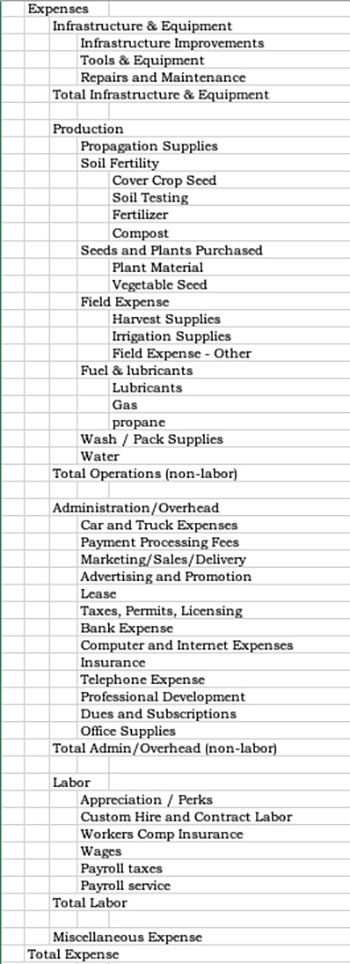 At left is an expanded view of the subcategories I use for expenses. The organization is mostly just what makes sense in my own head and some things are in slightly random places because they were added later. It’s nice if the budget order matches the order that your bookkeeping system generates reports in. If you want to track something that doesn’t fit into one of these categories in your head create a new category. If you want to combine two categories into a single category that’s fine too.
Within the labor category I further split things out into categories like wages, payroll taxes, and workers comp. In the non-labor category I’m also using subcategories like: seeds and plants, greenhouse supplies, fertility, harvest supplies, etc. Splitting into smaller categories makes it easier for me to estimate changes to the budget from year to year that might be tied to changes in production methods or other factors internal to the farm.
For labor expenses I have a separate sub-budget where I am estimating the number of labor hours I’ll actually need through the year. This is also based on the prior year, and is detailed out for every day of the year (with simple spreadsheet tricks this isn’t as crazy to put together as it sounds). By totaling up the hours and the average wage I can get a good idea of my labor expense for the year.
The reason I’m specifically looking at labor expenses separately from non-labor expenses is because my primary metric for tracking how my farm does from year to year subtracts non-labor expenses from the gross income and then divides that by the total number of hours worked (by everybody whether on payroll or not) to get the dollars per labor hour generated by the farm. I put these numbers up on my website for public consumption at the end of every year.
Using the budget during the season
During the year I try to set aside at least one day a month to completely get my books up to date. Ideally there is also a second day mid-month to do some of the data entry and make my job easier at the end of the month. Once a month I update my annual budget with the income and expenses from the previous month and I check the totals for my actual income and expenses against the budgeted income and expenses. They never match, but they always give me good insight into how the farm is doing: Are we starting to spend a little too much on labor, or is the reason we’re feeling behind because we haven’t been spending enough on labor? Are we selling enough CSA shares, or do we need to step up our marketing efforts? Do we still have money in the budget for a nice new tool or would it be better to wait until more income comes in?
When I create my budget it’s for the full year. When I’m looking at the totals at the end of each month, it’s for the year to date – not typically the full year – but even so, with a little understanding of when I would expect each type of income and expense to come in over the course of the year it’s not hard to tell how the farm is doing. Labor is the one expense I budget month by month and track month by month, not just for the full year.
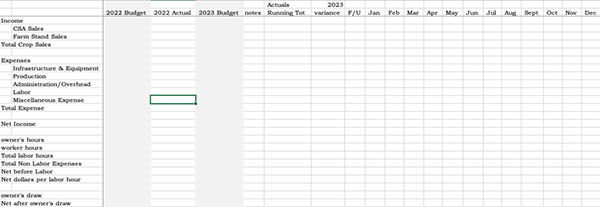 A simplified version of the categories in my farm budget. For the current year I enter month by month expense totals in the columns on the right and a formula adds those up to keep the running total. The variance column shows the difference between the running total and the budget for the year. The F/U column displays an F if the variance is favorable, and a U if it is unfavorable which is easier than remembering if the variance should be positive or negative for each category in order to be favorable.
One other important note is that there is a bit of a lag in the numbers. For example, it’s usually late June by the time I have complete numbers in my books for May. With labor hours I run payroll at the end of each month so those numbers only lag by a few days each month. Again, it’s less important that things are 100% up to date here, it’s more important that they’re a good representation and are helpful in making decisions.
The bottom line
When I make my budget for the following year the only number I’m really concerned with is the bottom line: the income minus the expenses. As the owner of the business this number needs to be large enough to pay me reasonably at the end of the year. Any of the other numbers can be big or small, but as long as they all balance out in the end it doesn’t really make a difference to me what the gross income was, or the labor expenses when I look at them individually.
My experience with the actual bottom line has been that some years I do pretty well, others I just scrape by, even though my budget, optimistically, has me right in the middle of those two poles every year. Even though the actual numbers never end up matching the budget, having the budget and tracking it through the year is hugely helpful in making decisions during the season about where to focus our attention, what to spend money on, and where we can cut expenses when needed. I think the biggest benefit to me of using a budget and learning from it has been understanding that sometimes I can actually make more money in the end if I spend a little more in the beginning – but also that there are real limits to that approach. It’s far too easy for me to overspend, or even underspend without the guidance of a budget. The other big benefit to me has been peace of mind – often reassuring me that even though it seems like I’ve been spending a lot of money on labor and other expenses, that it’s not really more than the budget can absorb.
Josh Volk farms in Portland, Oregon, and does consulting and education under the name Slow Hand Farm. He is the author of the books Compact Farms: 15 Proven Plans for Market Farms on 5 Acres or Less, and Build Your Own Farm Tools, Equipment & Systems for the Small-Scale Farm & Market Garden, both available from Growing for Market. He can be found at SlowHandFarm.com.
Copyright Growing For Market Magazine.
All rights reserved. No portion of this article may be copied
in any manner for use other than by the subscriber without
permission from the publisher.