











Look at the big picture to reduce weeds in the long run
Spring has sprung, hopefully newly emerging crops are sprouting forth with youthful vigor, spurned on by your abundant soils’ sweet succor. I had the opportunity in a recent issue of this illustrious ag-mag to share with you some tips on weeding tools (Tools and strategies to reduce time spent weeding from the October 2022 GFM). While knives, hillers, finger weeders, and other ways to physically control weeds are neat-o, they are but bits of metal.
Weeding tools are parts of the bigger picture of your cropping system. Your cropping system can be designed to manage weeds – your crop rotation sequence can control weeds; the timing and type of your tillage can be chosen to control weeds; and the cover crop varieties, their densities, and their culture can be adjusted in order to influence the weeds that grow in your fields. These are the bigger systems that will really aid your weed management and make your weeding tools more effective.
One term for this type of planning in your cropping system is – cultural weed management. For me, cultural weed management requires higher powers of farming knowledge and observation of plants and soil. More than mere tools of steel and diesel, these higher powers call for nuance, humility, and a nimble mind – rather than a wrench and measuring tape. In this article, join me in thinking about the principles behind cultural weed management, with real examples of how you can implement them on your farm to manage your weed population.
See the diagram for my very own, Oschwald Tilton’s Grand Unified Theory of Weed Management (see the diagram on page 4). What I hope to communicate with this graphic is that wonderfully clean fields filled with healthy and mature crops is the final goal that is best achieved with a plan that considers a progression of techniques, with many decisions starting before that crop’s seeds are even purchased. You can also see reflected in the graphic, that while weeding tools are a crucial part of managing weeds on your farm, they are only a part, and a less important part than cultural weed management, i.e. making decisions that will reduce weed populations in future seasons, instead of just knocking back the weeds that are in front of you.
Managing weeds through cultural techniques
Let me pose some questions to you, ones that help me think about this bigger picture of cultural weed management, and help determine which weed species your growing practices are selecting for.
Knowledge about your crop
• Crop spacing – Will you choose a crop spacing (in-row and between-row) that quickly closes in canopy to shade-out weeds?
• Crop growing time – When in the season and how often does tillage/tarping occur for preparing the soil for this crop?
• Crop time of planting – When in the season is this crop planted, and what members of your weed community emerge in that same window?
• Crop time of maturity – When is the crop terminated, and will the weed species that tend to grow with that crop have set seed by that time, or will the crop’s termination prevent the weed species from setting seed? You can choose the timing of your tillage/tarping to target and coincide with the weak point in your problem weed’s life cycle.
• Method of Crop termination – Will you choose to terminate the crops with methods that leave weed seeds near the top 2’’ of the soil (tarping, shallow rototilling, disking), or choose methods that bury surface weed seeds so that they won’t germinate next season (plow, chisel plow, deeper tillage)?
Knowledge about your weed community
• What species is it? The first step in understanding the lifestyles of weeds is observing and identifying them, so that you can understand the environment a weed species likes, and then work to reduce or manage that environment within your crop rotation.
• What is its life cycle: annual, biennial, or perennial? Having a weed set seed, also called ‘seed-rain’, should be avoided at great cost. You’ll want to know which of your common weed species set seed in a single season, and which take two or more years to set seed. This can help you prioritize what needs weeding most urgently in the height of the season. Also, perennial weeds often spread through their roots – and trying to weaken the roots of plants is a different game than killing seedlings.
• When does it emerge? When are the times in the season that the main members of your weed community emerge? You want to avoid planting a susceptible crop at a time of year when its problem weed tends to naturally germinate to avoid that competition. Instead, for example, could you wait another two weeks and fit in an extra stale-seed bedding, or plant earlier?
• When does it set seed? What time of year, or how long after germination, do your problem weed species release seed?
I hope that your powers of observation are far better than mine, but if you’re anything like me, then using other resources, like the internet and books, will help you learn the personalities of your weed community more thoroughly than by observation alone. One fun challenge to help understand your weeds’ personalities is: each season, commit part of your mental weed management budget to identifying and learning about two new weeds on your farm – their species, life cycle, and other helpful information, like from what depth their seeds can emerge. You can also observe their population in the landscape and how it changes from year to year. Can you observe the conditions or locations each weed favors?
As I gathered my thoughts about managing weeds through cultural practices (cultural weed management) I found myself returning to the writings of others that have taught me so much. I often felt that these farmer-writers were saying it just right – and so below I’ve included some longer quotes. I also hope they will introduce you to these insightful authors.
You can watch your weed community change based on the management actions you take. A godfather of weed management, Chuck Mohler, would generalize and say that two main weed personalities are based on how they set their seed – ones that produce their seed all at once towards the end of a season in a ‘big-bang’ (like common lambsquarters and redroot pigweed), and those that set seed early after only a few weeks and then ‘fizzle’ a little seed out over a long period of time (like galinsoga, purslane, and chickweed).
Chuck Mohler was a weed scientist at Cornell University for many years, who developed a clear understanding of weed personalities and the effects of management techniques to control them. He also wrote a fantastic book, along with Antonio DiTommaso and John R. Teasdale, called Manage Weeds On Your Farm, which is available for free online. Quotes are taken from that book. In the weed entries in this book, you can learn all necessary personality information for your problem weeds – and then use that knowledge against them!
In their book, Chuck and the gang describe how the big-bang bang annuals find their niche in full-season crops, and as they size-up later in the season they make it harder to cultivate fields of things like cabbage, corn, and squash. But the fizzling annuals, in contrast “are better adapted to the frequent cultivation that often occurs on vegetable farms and in salad crops. They produce seeds before they are noticed, and often their seed dormancy is such that a new generation can immediately sprout.” The fizzlers are the most disturbance-adapted weeds. You can see how the two lifestyles of weeds – big-bang and fizzling – each thrive in different cycles and seasons of soil disturbance.
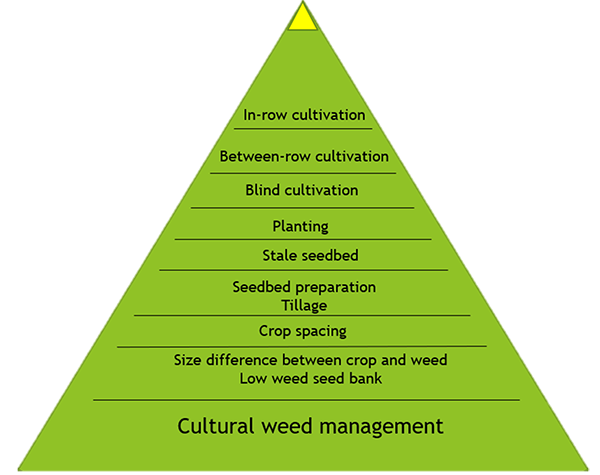 Above: Oschwald Tilton’s Grand Unified Theory of Weed Management.
The lifestyle and general preferences, or personality, of each weed, explains how the overall weed population on a farm changes over the seasons. “Because different types of weeds are adapted to different disturbance regimens, vegetable fields frequently undergo a succession of weed communities. Often perennials and big-bang annuals predominate on new vegetable farms as holdovers from previous uses of the land. Frequent cultivation . . . may eventually bring these species under control . . . Meanwhile, the ‘fizzling’ annuals slowly increase due to their ability to rapidly produce seeds. . . the shift is just a natural but slow response to the change from one disturbance regiment to another.”
I am hoping that this big-picture view of how weed populations respond to your cropping system is getting your brain juices flowing. You can see how the timing of a weed’s seed rain is an important part of its lifestyle to understand. Similarly, the timing of a weed’s germination affects when it thrives.
Mark Schonbeck, whose musings on weeds have inspired several factsheets, has a good way of understanding how crop rotation and the timing of weed germination influence your weed communities. Two of Mark’s publications that I appreciate are: Twelve Steps Toward Ecological Weed Management in Organic Vegetables (available for free online), and An Ecological Understanding of Weeds, which is the source for the quotes here. He says, “weeds exist that can exploit virtually every possible pattern, or niche, associated with production of [most crops]. However, no one weed species has evolved to exploit all or even most of these niches.
Weed problems are most likely to develop when weeds are exposed to a reasonably predictable pattern of disturbance that allows their population to increase over time. For example, suppose a field is clean-tilled and planted in mid-May, cultivated once or twice during early crop establishment, and is not tilled again until after crop harvest at the end of summer. Those weed species whose seeds germinate in late spring or early summer in response to tillage and cultivation, and complete their life cycles within 60 days or so, can successfully set seed under these conditions. If tillage, cultivation, planting, and harvest schedules remain approximately the same year after year, these weeds will likely multiply over time and eventually compete severely with the crop.”
“For example, a four-year vegetable rotation might consist of sweet corn [to] snap beans [to] squash family [to] tomato family, with winter cover crops planted after each vegetable. While this is . . . diverse, it can still result in heavy pressure from pigweeds, lambsquarters, foxtails, galinsoga, and other summer annuals. Why? In that rotation tillage and cultivation patterns remain fairly consistent year after year, especially on those farms that rely on the rototiller to incorporate cover crops, prepare seedbeds, and till down vegetable residues in the fall.
These small-seeded weeds emerge in response to the soil pulverizing action of the rototiller that occurs reliably each year in the late spring. Adding some early and late season vegetables and summer cover crops to this rotation shifts the dates of tillage year to year, and can make it harder for this population of weeds to multiply. When summer vegetables are planted, the late spring niche for weed emergence weeds can be reduced by managing the cover crop with mowing or rolling [or tarping] rather than tillage. If the weed seed bank is really heavy, it may be necessary to use a cultivated fallow (repeated shallow tillage to trick the weeds into coming up, only to be killed by the next cultivation) to draw it down to manageable levels.
Galinsoga deserves special mention as a nightmare weed for vegetable growers. It can form mature seed in as little as 30–40 days after emergence, and the next generation pops up after the next cultivation. One way to take this weed by surprise is moldboard plowing or other inversion tillage—its seeds can neither emerge nor survive longer than a year when buried in the soil . . . Try to see the bigger picture of your entire weed community, as they WILL change over time, and as the weed community changes, you can adjust your cropping plan to disrupt the new community.”
Choosing the crops in your rotation and their timing to target your weed population is cultural weed management – doing more by planning than by actions in the field. You can also consider how you manage your cover crops – so that they remove the environmental niches preferred by your problem weeds. Anne and Eric Nordell in Pennsylvania have developed several elegant cropping systems. They are intentional in using cover crops to reduce weeds and the labor needed to manage them. The Nordells are truly wonderful organic farmers who share their experience freely. I suggest their publication Weed the Soil Not the Crop, and the article about them, Rotating Out of Weeds by Jean English, from which the title of this article is taken as well as quotations.
Like many farmers, the Nordells seed a cover crop either with (inter-seeded) or after long-season vegetables (tomatoes, squash, late cabbage). The Nordells often plant winter rye. In the spring the rye is mowed several times to encourage it to tiller and regrow. The repeated mowing weakens perennial weeds by cutting their tops and prevents annual weed seedlings from setting seed below the rye canopy. Mowing also creates a nice mulch to smother newly emerging weed seedlings and helps with termination of the cover crop, since six foot tall rye stalks are harder to manage than those previously mowed.
The Nordells also manage soil-building biennial yellow sweet clover (Melilotus officinalis) to make the most of its two seasons in the ground. For early crops that are removed by the end of July or early August, sweet clover is inter-seeded with a drill while crops are growing or directly after harvest in the summer, so that it becomes well established before winter. “The following year, the sweet clover is mowed several times to prevent it from growing 4 or 5 feet tall, which would be too much growth to incorporate into the soil easily. Mowing also promotes increased root growth in the sweet clover and helps with weed control.”
The Nordells will mow once more around the fourth of July. After those repeated mowings, the clover is plowed down and a bare fallow period begins, with the soil being worked every two or three weeks. The bare fallow as practiced by the Nordells acts like several sequential stale-seedbeds the year before the crops are planted. “You’re depleting the weed seed bank and putting weeds out of a job by using cover crops to build soil structure.”
Rules of thumb
In summary of our discussion above, may I offer three Rules of Thumb for designing weed management into your crop plan:
1. Keep the big picture of your farm in mind when it comes to your weeds.
Weeds are only a problem when they interfere with crop growth or harvest. The goal is not perfectly clean fields (because those don’t make you money, unless you are an Instagram star), rather the goal is a population of weeds that don’t take too much time to manage and that don’t interfere with your crop. To do this, you want your weed population to be getting smaller each year, not growing. This means that when weeds produce seed, they really set you back. Realize that a single plant of lamb’s-quarters or kochia or bindweed or galinsoga going to seed can be a much bigger problem next year than 10 or even 100 non-reproducing plants are now – so marshal your precious weeding resources with consideration.
2. Grow crops that have a wide variety of times to maturity.
Each weed personality adapts itself to specific niches in time and space. There is a wide spectrum of times in the season when weed-killing full-field tillage/tarping can take place – play with the timing to keep your problem weeds in check.
3. Use clean fallow periods every 2-3 years.
Think of them as several stale seedbeddings, but with the tillage in the fallow period tailored to the weed – if your issue is annual weeds that spread seeds, then a shallow (2-4’’) tillage depth will kill them. But if perennial weeds are or are becoming a problem, tillage for your bare fallow period needs to be deeper depending on how deeply your perennial species root (6-10’’). The book Manage Weeds On Your Farm has a profile of exactly what you’ll want to know about every weed species, just look in the index.
As a rule of thumb, seeds on or near the soil surface (from the surface down to 2” deep) either germinate or die, whereas seeds buried more deeply remain viable and can germinate when exposed to shallower depths, and depending on the species, seeds buried deeply may die there after 1-3 years. In my book, a rule of thumb is something that is not always right but mostly is, and is often good enough, especially when considering all the things that the craft of farming requires a knowledge of.
4. Be intentional about responding to actual field conditions when choosing the following crop and type of termination (in both your crop planning and in-season pivoting).
Have weeds gone to seed? Which species? Follow weed-prone crops with crops in which weeds can easily be prevented from going to seed. Let’s say your squash and corn got weedy at the end of the season, and those lambsquarters and pigweed set a lot of seed – this is where you can be intentional about being realistic and accounting for the way things actually happen on your farm. Maybe you’ll make a special effort to rogue out late weeds in longer-season crops, but you can also accept and expect seed rain in late-season crops when you plan your rotation. Ask yourself, in crops where you’re expecting a late-season weed seed rain, what move comes next (in this game of cropping chess)?
Planning for a thick, late-season seed rain could lead you to forgo tillage in the fall so that the seeds will stay on the soil surface and be more likely to die from the weather extremes and be eaten by animals and insects. Then in the spring you could plant a more weed-competitive crop like corn or potatoes. Or perhaps you would choose to do the opposite, and plow the field in the spring, burying the weed seeds below the depth from which they can germinate. If you are able to leave those seeds undisturbed at that depth for a few years many of them will die. Or perhaps in addition to where you place those weed seeds with tillage, you consider a dense fast-growing, cool-weather cover crop like brassicas or oats and peas to smother germinating weed seedlings.
This is why Hans Bishop at PrairiErth Farm told me, “All these weeding tools are great, but I am realizing that I am only as good as my planning . . . I am starting to see that more important than the timing of using a weeding tool is the much bigger-picture planning: I need to use my rotations, cover-crops, summer-fallows, and stale-seedbeds to target specific weeds and fields and tailor-make the place where I plant each crop. So that when it comes to planting fall carrots, I don’t want to be deciding where they will go in April, but right now I want to be thinking where the carrots will go in two seasons from now.”
I couldn’t have summed it up any better, Hans. And with that I thank you for spending some time on the page with me, and bid you safe and fertile activities in your fields.
Sam Oschwald Tilton is the Fresh Market Produce Specialist for UW-Madison Extension. He lives on lake Michigan’s shore in Sheboygan, Wisconsin. He has a background in vegetable farming and horticultural education, and earned a master’s degree in horticulture from Michigan State University. He coordinates the Midwest Mechanical Weed Control Field Day (September 27th this year in Wooster, OH), and he enjoys jokes and popcorn. You can reach him at glacialdrift@protonmail.com.
Copyright Growing For Market Magazine.
All rights reserved. No portion of this article may be copied
in any manner for use other than by the subscriber without
permission from the publisher.