


I’ve spent 26 seasons turning non-agricultural land into top quality soil, and my love affair with cardboard is stronger than ever. We are located in the North Quabbin region of Massachusetts, in the hills above a once fertile valley that was flooded in the 1930s to create the water supply for Boston. Many said we could never grow food on the land that is now Seeds of Solidarity Farm.
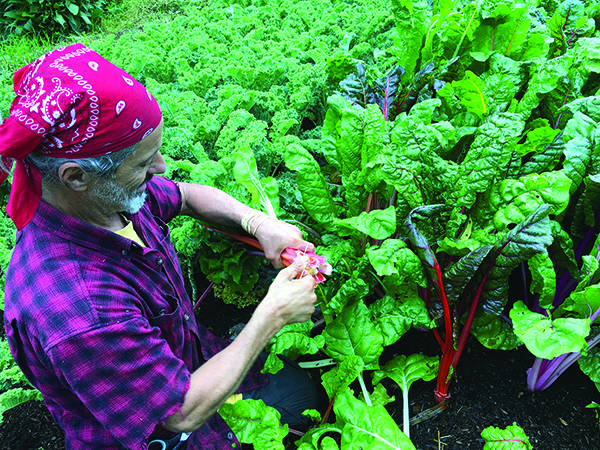 Harvesting greens planted through cardboard. All photos courtesy of the author.
Looking for land in 1996, this patchwork of rock-strewn fields and acidic forest without a house or any farm buildings was all we could afford. So, we got to work building home, family, and soil. Years later, a Cornell University comprehensive assessment of soil health carried out by the American Farmland Trust indicates our farm’s soil overall rating of 96 out of 100, one of the highest of all farms tested in our Western Massachusetts greater region.
This detailed assessment of soil health measures indicators such as soil respiration, active carbon, and available water capacity as well as organic matter and pH, and minor elements. I hope readers will be inspired to know that even marginal land can be radically improved through no-till techniques to create a successful, abundant, climate resilient farm.
I have three tools in my no-till toolbox: cardboard, tarping and cover crops. Cardboard was my entry to no-till, in part because I had no choice — an almost non-existent layer of topsoil meant I had to build soil from the ground up. Previously, I co-owned a farm in New York and cultivated 20 acres of organic vegetables using tractors, but the human unsustainability of it all burned me out. If I were to continue farming, I had to do it differently.
In this article I focus primarily on my passion for cardboard and the multiple ways in which I have experimented. No-till methods have enabled me to farm in a personally sustainable way, and largely on my own. My wife, Deb, helps with seedling production. We hire friends for the garlic harvest and packing. Otherwise, I comfortably handle the planting, managing and harvesting of four, 100-foot hoophouses and one and a half acres of field crops. For those not interested in using machinery and looking to transition to no-till, or simply wanting to add a new method to their farming toolbox, or have been using cardboard and want to expand on ideas and techniques, I hope you find this article beneficial.
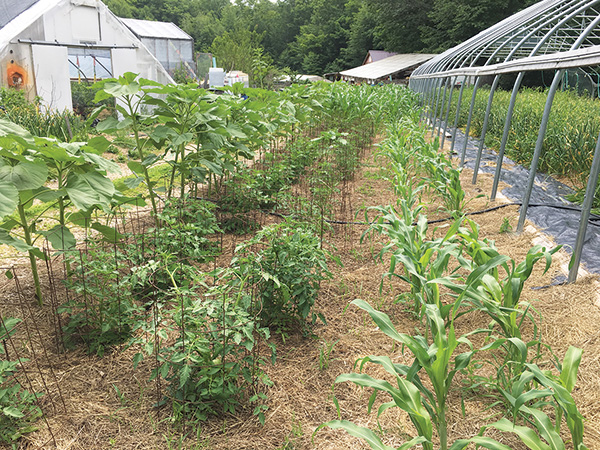 No-till beds with a diversity of crops. The straw on top of the bed helps keep the cardboard from blowing away when it is first applied.
We are very active in our community, run a large festival, and Deb runs our non-profit organization with many educational and public programs (fiscally separate from the farm). For the first decade of Seeds of Solidarity, we had apprentices for six-month periods and enjoy lasting relationships with many of them. But given the multiple and public facing pieces of our lives, I reached a point where I just wanted to do the daily work of farming alone and not deal with managing others and the costs of labor.
In talking to other farmers — along with most business owners — labor is often the weak link of the operation. No-till methods can keep debt and stress low and support a vision of small farms throughout urban, rural, and suburban communities that are run by a single person or couple, producing nutritious produce sold locally at prices that ensure quality food is affordable and accessible to all.
The ways I use cardboard have expanded significantly over the years through experimentation. A critique of cardboard I’ve heard repeatedly is that people perceive it taking too much upfront labor to apply. I get a kick out of this as the time upfront laying it down saves me an incredible amount of time weeding and irrigating throughout the season. Plus it has become one of my main (and free) fertilizers as all of that carbon feeds the microbial and worm life and decomposes to become gorgeous soil.
What other farm tasks have such multiple benefits? I have detailed the benefits we’ve seen regarding soil fertility, worms and abundant worm castings in previous pieces including in Growing for Market, The No-till Farming Revolution, and our book, Making Love While Farming: Field Guide to a Life of Passion and Purpose (Levellers Press, 2019).
As many know, there is a wonderful relationship between cardboard and mycorrhizal fungi. I’ve observed that cardboard allows a contiguous surface upon which it spreads and thrives in a moist and dark environment. I’d love to see more research on this aspect of cardboard in no-till systems to support our efforts as farmers and soil scientists to increase the web of mycorrhizal fungi in our fields.
One of the largest single crops we grow is garlic, all of it sold as value-added seed planting packets at our North Quabbin Garlic and Arts Festival. While I’d used cardboard with almost every other crop except the cut and come again salad greens we grow in our hoophouses, until recently, I did not use it on my garlic beds, relying on mulch hay instead.
In fall of 2022, I planted 13, 100-foot long, 4-foot wide beds, each with five rows of garlic. I planted all of it through cardboard that I had laid a couple of weeks prior to planting, using a dibbler to make holes 5-inches apart. This will be our second year of this garlic planting method, after the success of the prior, in which there was zero weeding (thus no labor) and minimal additional irrigation needed during an extremely dry year. As I await the emergence of the garlic this spring, the knowledge that I will not have days and days of weeding, along with gratitude that the soil will be growing even richer thanks to the cardboard feeding soil life brings a sense of ease.
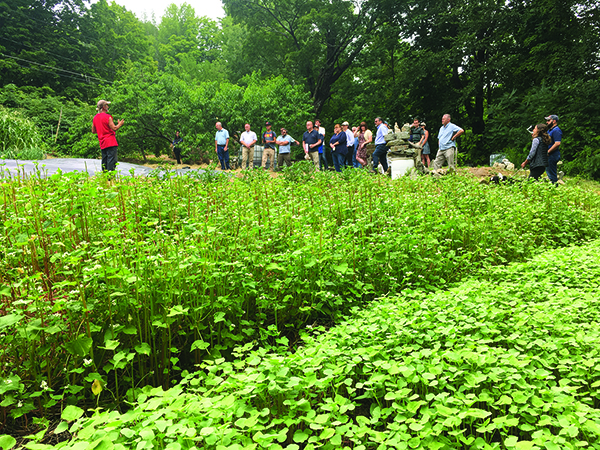 Sharing our climate resilient methods for Congressman McGovern’s farm tour.
Because I have been using cardboard as a primary part of our no-till farm for over two decades, I’m seeing many benefits from its long-term use. Soil health-wise, in addition to the results from the aforementioned soil testing, results from a SARE research project we did a number of years ago showed a reduction in soil acidity without the addition of even one bag of lime anywhere, with no evidence of any negative residue. In addition to so many benefits related to fertility, soil health, moisture retention, and carbon sequestration, the use of cardboard has allowed me to cut way back on labor, as well as to reduce the quantity of high quality compost that I purchase (we use chicken).
We have taught thousands of gardeners and farmers how to incorporate no-till cardboard methods. There are some commonly asked questions, such as sources and what cardboard to use or not. One of the many things I love about cardboard is that it is free, a waste product that can be transformed, and accessible in all communities.
We’ve found the best sources of plain corrugated cardboard are furniture and appliance stores, as the boxes are so large, unwaxed and minimally printed. One full pick-up truck load of such boxes will cover an area 30-by-100 feet. Sadly, some of these small businesses have closed, but once I put out the word in our community, new relationships such as with a general store and food co-op where I deliver produce, a food pantry (with one of their volunteers delivering) and others emerged to mutual benefit.
Another question people often ask is when to apply (or re-apply) cardboard. The answer is most anytime of the year depending on the way you are using it, and with a goal to keep soil covered. Because our fields are now brimming with soil life, cardboard breaks down within a season. Each autumn, I try to get as much cardboard down as I can, once crops are harvested and before the snow falls. I especially try to cover the outer edges of our fields well — given we are surrounded by forest, — to keep brambles, bindweed, and other invasive species from encroaching. At edges of fields, I lay it on thickly, double layers of cardboard or more to keep weeds in check. I know many growers are dealing with the bane of bindweed and cardboard is a great deterrent.
Cardboard must be covered with some organic material in order to stay moist, break down, and so it doesn’t blow away. I’ve used mulch hay or less expensive manure such as horse manure on top. Leaves, leaf mold, and wood chips are also great cardboard covers so long as they stay on top and don’t mix with the soil where they rob nitrogen. Initially, I purchased a great deal of mulch hay for this purpose but have found that a local source of horse manure is both cheaper and heavier so the cardboard doesn’t blow with the increasingly intense winds we are seeing.
Come spring I resume laying down cardboard, covering it with organic materials, and preparing to plant. When teaching, I often use the phrase “no-till, self-sustaining cardboard method.” This describes the continual cycle of cardboard digested by worms leaving rich castings that then become the primary fertilizer, along with the added benefits of undisturbed mycorrhizal fungi throughout.
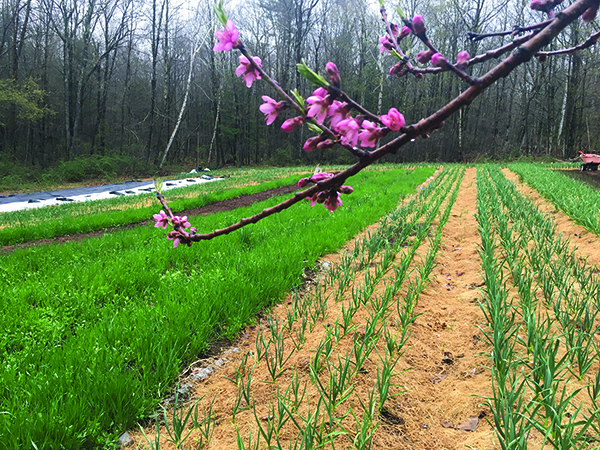 Weed-free, cardboard planted garlic, cover crops and tarping.
In regard to moisture, it is no secret that the extremes of drought and storms have increased radically with climate change. Adaptation (along with devastation) is a common conversation among farmers. Plants are like humans, preferring moderation to extremes. One summer during a drought period, a group of college students circled around me as I parted the cardboard mulch surrounding some corn. The soil underneath was moist, a vast contrast to the exposed farm fields elsewhere — organic and conventional both were sunbaked and parched.
Four of our hoophouses are used for another of our major crops, successive sowings of cut and come again salad greens grown from March to December. An unshaded house is used for warm weather crops plus some root crops. An additional 40-foot hoophouse plus a small shade house are used for seedling production of bunching greens, brassicas, flowers and assorted other crops.
When ready, these seedlings are planted through cardboard in permanent raised beds in the fields. I use a dibble to make holes along a rope pulled taught to make straight rows. I’ve tried many dibbles, the best of which have a metal point and a handle that enables leverage rather than a straight or T-shaped. In addition to crops like brassicas and warm weather crops commonly started as seedlings, we also start flint corn in advance, rather than direct sow. This allows us to dibble it through the cardboard, evenly spaced, with no loss from crows or need to thin. It provides a head start to the season.
Because our soil has become so rich from years of cardboard as well as cover crops, when I plant out seedlings I only need a minimal topdressing of additional, quality compost around each. Cardboard really shines with crops that don’t have shading foliage that keep weeds down, such as onions, leeks, and garlic where weeds are notorious for taking over crops. Instead of commonly used plastic, cardboard does the trick while feeding the soil and moderating moisture.
Cover crops and tarping
While I’ve focused on cardboard, cover crops and tarping are also key tools on the no-till farm, serving different and complementary purposes. Some of my favorite cover crops are a rye/vetch mix, buckwheat, Sudan grass, oats, and various cover crop cocktails. However, a standard practice with cover crops is to till them in, defeating many of the benefits as the soil structure is disrupted. Instead, I use large tarps to terminate the cover crops in the fields. These do an amazing job of returning that biomass to the soil and producing a clean seedbed.
I also use narrower, 5-foot wide tarps in the hoophouses once a cut and come again salad crop is spent. Within two weeks the plant remains are a vegetative mat and I simply cover these beds with some more compost and sow greens again. In the past, I hoed and raked this out but realized they could serve as a green manure of sorts and tarping them instead eliminated much labor.
I’ve also been experimenting with covering fall planted cover crops with cardboard in the spring, then planting through both the cardboard and cover crop biomass below. It’s common to see in one’s compost pile gorgeous plants growing out of decomposing organic materials. Along these lines, the method of planting through cardboard with a freshly decomposing cover-crop below the cardboard above the soil creates a life-filled environment in which a seedling can flourish.
This technique is somewhat akin to crimping cover crops, then planting right into the cover crop. What can happen with crimping, however, is that the cover crop can break down too quickly and doesn’t provide weed protection through the whole season. Whereas cardboard on top of the cover crop provides the green manure benefits along with the season-long weed control.
Knowing that I have ways to use tarping and cardboard to incorporate cover crops reduces stress of the potential for a wet spring that can really impact farmers relying on planting or incorporating cover crops with tractors. Granted, I have reduced my overall acreage to a scale that is humanly manageable for me, but it works, provides a livelihood, and I enjoy farming more than ever, more than 35 years since I began. No-till methods on smaller acreage are also a critical model for urban, BIPOC, and the rising generation of young farmers given that purchase of large tracts of agricultural land and extensive infrastructure are now out of reach for most.
These times demand us to be creative, to keep experimenting, and to see what comes from our experimenting and sharing of ideas with each other.
Ricky Baruch and Deb Habib run Seeds of Solidarity Farm and Education Center in Orange, Massachusetts (www.seedsofsolidarity.org), and are the authors of Making Love While Farming: Field Guide to a Life of Passion and Purpose (Levellers Press, 2019).
Copyright Growing For Market Magazine.
All rights reserved. No portion of this article may be copied
in any manner for use other than by the subscriber without
permission from the publisher.