









NC farm helps others integrate forest crops
Thatchmore Farm in Leicester, North Carolina, hosts forest farm tours for the Organic Growers School in Asheville and regularly teaches other farmers and would-be farmers how to integrate woodland crops. The hilly farm embedded in the forest grows unusual fruits, ornamentals, mushrooms, and perennial crops in addition to typical field and greenhouse crops.
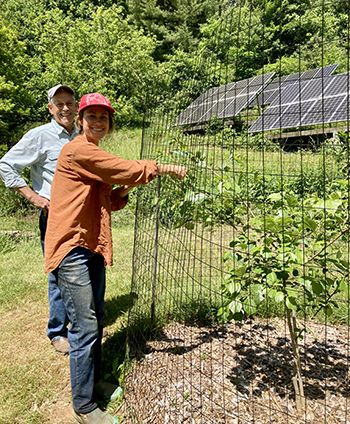 Tom and Liz Elmore with the Che fruit tree (also known as melonberry) planted in 2020. Mature trees can produce 100 pounds of fruit. Photo by Jane Tanner.
The woodland crops came about by necessity. When Tom Elmore and Karen Thatcher settled in western North Carolina in 1987 to farm, their 10-acre property had two tillable acres — the rest rolling hills and steep inclines. At first they grew vegetables on the flat areas.
The uneven terrain seemed suitable for fruit trees, shrubs and other woodland crops. They started with 70 apple trees, but producing flawless apples would have required a weekly organic spray regimen from spring into winter. “Looking back at it I only would have planted a few for the table,” Tom said. Now, they harvest some flawless apples to sell, but otherwise make home brew beer and wine for themselves.
They were certified organic from the get-go, among the first farms in North Carolina. In fact, Tom helped create the Organic Growers School and served as president and other leadership positions for many years. As the farm evolved, they both continued off-farm jobs — Karen, a real estate attorney, and Tom, a natural resources planner.
After the apple trees, they planted blueberries. Meanwhile, Tom investigated more unusual fruits at conferences. Among his go-to resources: Lee Reich’s Uncommon Fruit for Every Garden and the North American Fruit Explorers (nafex.org), a network of U.S. and Canadian farmers and gardeners devoted to high quality varieties of fruits and nuts. The group has a cult-like following for unusual fruit, Tom said.
Over the years, Thatchmore Farm added hardy kiwi, goumi berries, six varieties of persimmon, Asian and European pears, paw paw, pomegranate, cherry trees, juneberries, mulberries, serviceberries, figs and hazelnuts. When I visited in June, Tom and his daughter, Liz, the farm manager, showed me Che fruit trees planted in 2020.
Ornamentals — Christmas trees and yaupon hollies — are also important crops. They plant Turkish firs and white pines among recently planted hazelnut trees. Eventually, the hazelnuts take over, but in the meantime the Christmas trees provide cash flow, Tom said. In an area on the edge of the woods, rows of mushroom inoculated logs line a hillside. They planted white oak trees to produce logs for shiitake mushrooms.
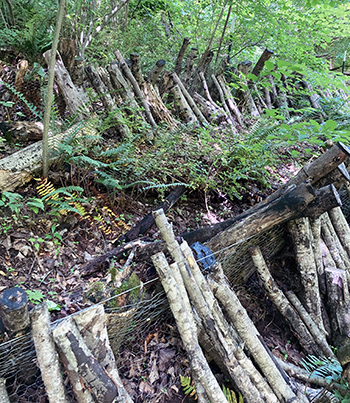 Right: Mushroom logs on the forest edge of Thatchmore Farm. Photo by Jane Tanner.
Meanwhile, row crops continue to be an important part of the mix, including lettuce, kale, stir fry mixes, spinach, arugula, dandelion, miner’s lettuce, sorrel, endives, squash, potatoes, herbs and more. Thatchmore Farm’s field crop area is literally carved out of the forest; the trees along the sides of the beds create a micro climate that’s great for greens in the middle of the summer, Tom said.
In three wood pellet-heated greenhouses, they grow tomatoes, peppers and cucumbers. Wood pellets are more environmentally friendly, and half to a fourth of the cost of propane, Tom said. They use soil blocks for seeding plants in a small propagation house.
On a per-square-foot basis a 12-foot by 50-foot area of cultivated sorrel is the most profitable and productive. The leaves of perennial Rumex acetosa from Johnny’s Selected Seeds are large. Liz feeds it with fish emulsions. The sorrel sells for $16 a pound at markets. Like the other row crops, they planted it into landscape fabric. “It’s great on hillsides you don’t want to bother with,” she said. The fabric cuts down on weeds, keeps moisture more even, cools the soil in the summer and warms it in the winter, and results in cleaner crops.
They use 50-foot fabrics that hold up for 30 years of season-to-season use, some date back to the first years of the farm. Tom created a tool (pipe fitters, rebar and vice grips) to burn uniform holes in the fabric. The pipe fitters heat in a fire until they are glowing red (farmers can use whatever size they need). Then, the hot metal is pressed against the fabric repeatedly to burn out circular holes. A red-hot pipe fitter can burn 50 holes before re-heating, he said. You can find Tom and Karen’s article about the tool and use of landscape fabric in the March 2002 GFM, “Couple calls landscape fabric ‘the marriage saver.’”
In addition to sorrel, they grow native perennial Sochan (Rudbeckia laciniata, cutleaf coneflower), a picking green (young leaves are edible along with shoots and stems). Historically, the wild plant has been a staple of the Cherokee community. “There’s no problem in terms of it taking care of itself,” Tom said.
Liz was raised on the farm. After leaving to study biology, she worked with AmeriCorps anti-hunger programs and as a plant researcher with the National Ecological Observatory Network. In 2018, she returned to manage the farm as its first full-time employee. She embraces the farm’s crop diversity and has added new ones, including ginger and turmeric.
“We are a niche farm, trying to find crops that other folks don’t have,” Liz said. “We cannot compete on a large scale, the fruits are part of our niche.” At the end of May, a couple days before I visited she had taken goumi berries (Elaeagnus multiflora) to market in addition to greenhouse tomatoes and green peppers.
The goumi berries attract attention. Initially, most market customers don’t recognize the tart berries, so they provide samples. Liz tells customers they can eat the berries as a snack. I ate several off the shrub, and as Tom suggested, the extra ripe ones are sweet without astringency. Customers can let them ripen on for about a week after purchase. The goumi shrub is a relative of Russian olive and autum olive. Since the fruit is size of grapes, picking a pint takes only a few minutes.
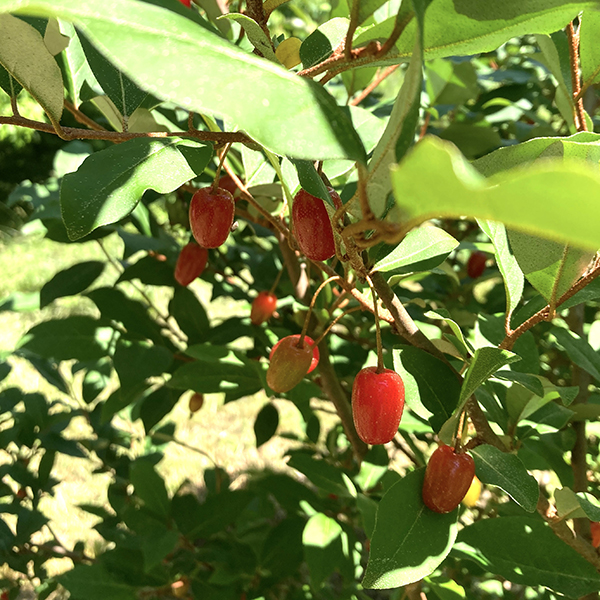 Goumi berries are one of the unusual fruits grown at Thatchmore Farm. Photo by Jane Tanner.
Another popular fruit at markets is hardy kiwi (Actinidia arguta). Initially, the vines didn’t produce well until they started trellising them. They are very productive after the last frost, as much as 100 pounds per plant. Among cultivars they grow are ‘Ken’s Red,’ ‘Anna,’ and ‘Meader Hardy Male,’ the latter a cold-temperature tolerant pollinator for the female ‘Anna.’
The grape-sized berries taste like kiwis. “People love them, any fruit we bring to market will disappear,” Liz said. Hardy kiwi seconds are made into wine for family and staff.
The Che trees (Maclura tricuspidata syn. Cudrania tricuspidata), also known as melonberry, are related to mulberries and figs and grow to the size of dogwoods. They produce big raspberry-sized fruit that tastes akin to raspberries or watermelon. Mature Che trees can produce 400 pounds of fruit each. They planted a male tree 50 feet away from three self-fertile females to produce seedless fruit.
They caged the young Che trees to keep deer away. Similarly, they caged European pear, persimmons and cherry trees to protect them from deer. Tom said caging to deer-proof doubled plant establishment costs. He said deer love cherry tree leaves. Now in the third year, they are producing fruit. “I’m still optimistic,” he said.
They also battle to keep squirrels away from nut trees. They harvest hazelnuts (European and two types of American trees) slightly immature in the fall before squirrels get them and then let them mature off the tree. Last year, they started using a mechanical sheller from the Asheville Nuttery (ashevillenuttery.com), which processes black walnuts, hickories, acorns, and hazelnuts (and sometime pecans brought in from lower elevations).
The processing operation is an off-shoot of the Nutty Buddy Collective (nuttybuddycollective.com) — a business created by perennial crop enthusiasts, who among other projects are converting underutilized land in Asheville to native nut-centered orchards and supporting farmers engaged in perennial agriculture. Generally, the Nuttery staff process nuts brought in or buy them outright. When Tom and Liz took in their hazelnuts, they got to help. “[They] took a ‘miller’s share’ of about 14 percent of the product as I recall, which seemed very reasonable to us,” Tom said. “It’s a great concept for a piece of equipment that is only needed a few hours each year.”
Woodland and field crop conflicts
Blueberries are an example of the friction that can occur among field and greenhouse crops versus perennial and woodland crops. In the heated greenhouses tomatoes and peppers come on strong in May and June — the same time as blueberries. Harvesting blueberries is time consuming and puts the farm behind on sowing and transplanting other crops. “Blueberries sell themselves,” Liz said, “but you are stressing your workforce.”
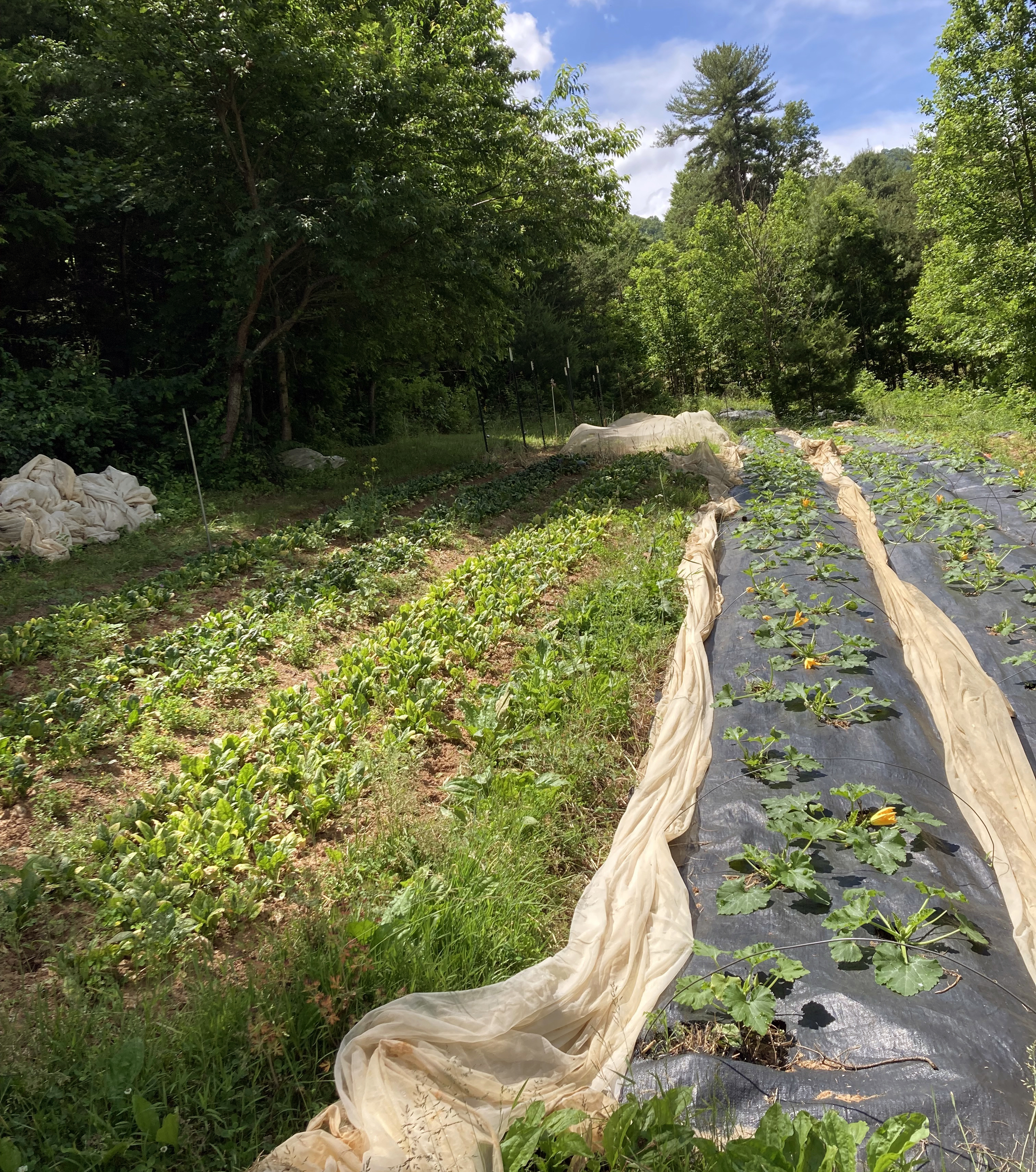 Field crops are tucked into a forest clearing at Thatchmore Farm, so woodland crops were a natural fit. Photo by Jane Tanner.
The harvest time payoff is lower. The fully ripe goumi and hardy kiwi berries at the size of grapes take only a few minutes to harvest a pint, while smaller blueberries take longer, yet they both sell for the same $10 a pint price.
So, when Liz took over managing the farm, she focused on pruning. Pruned blueberry bushes produce larger berries which cuts down on harvest time. Pruning the mulberry bushes keeps them lower to the ground and wider. This year, they’re pruning the hazelnut trees.
Balancing woodland crops with the other crops takes extra planning. “The greenhouse and field crops feel more urgent,” Liz says. “Walking out the front door, do I harvest this lettuce or do I go prune the apple trees? But lettuce won’t be there next week. I have to personally put it on calendar to prune.”
“The vegetable and greenhouse crops are the most labor intensive,” she said, “but the ornamentals have the potential to be more lucrative.” So, they are building the stock of ornamentals. Liz is working toward a breakdown of a third ornamentals, a third fruit production and a third vegetables. Today, vegetables are grown on an acre or so, the ornamentals and Christmas trees on one acre, with two in fruit, nut and mushroom production.
Right now, the fields and greenhouses account for 90 percent of the cash flow. “A pack of lettuce seeds is harvested in six weeks,” Liz said. “Trees take a long time.” Overall, they value the diversity of crops. The diversity creates more interest at markets. And, it helps protect against climate-related losses.
“More diversity the better in self-insuring with weather,” Liz said. While a hailstorm might wipe out the lettuce, the shiitakes survive fine. This spring a localized thunderstorm caused flooding in neighboring areas. They’ve faced erratic weather such as warmer weather in February that triggers trees to begin budding, followed by late frosts that cause damage. That happened two winters ago — early warm temperatures and a late cold snap, resulting in no hardy kiwi and no apples.
The shiitake mushrooms fit well into the labor scheme. “Log production in winter is good for the crew,” Tom said. “We try to keep them year-round and the harvest is pretty quick.” The Christmas trees also entail off-season work and extend the cash flow well into December. The Serbian spruce, Turkish fir, and white pine trees are adapted to their elevation. They allow customers to choose and cut from the stand of trees. Wreaths also provide December work for their crew. Pruned branches from the Hazelnut trees can be made into garden ornaments.
Additional winter work is cultivating the Yaupon holly. The Ilex vomitoria ‘Hoskins Shadow’ cultivar grows well in Zone 6a. They take cuttings in the fall and move them into 1-gallon containers in the spring. After two years, they are bumped up to 3-gallon containers, which they sell for $30. After three years, yaupons in a 7-gallon container sell for $60. “People seek us out,” Tom said. The hollies are so popular they limit one per customer.
They also sell green leaves from the bushes with roasting instructions so customers can make teas. It has strong caffeine, and the taste is nearly indistinguishable from yerba mate tea, Tom said. (Despite “vomitoria” in the name, it doesn’t induce vomiting.)
The next generation
This year, they’ve hired three crew members (plus one who just comes to harvest in exchange for produce). The crew work two days a week from mid-January through mid-December. Thatchmore Farm provides hourly compensation along with educational lectures and produce. They take the educational part very seriously. When I sat chatting with Tom and Liz on Tom’s front porch, I saw the handout he had used that week during a lunch lecture about on-farm electrical work. He went into great detail on the various electrical systems used on the farm.
Training the next generation of organic growers is an important part of their mission and their crews are eager to learn from their model. They also are members of Western North Carolina Collaborative Regional Alliance for Farmer Training, aka WNC CRAFT Farmer Network, that links established farmers with apprentices and would-be farmers for sustainable agriculture training and networking, including winter round-table discussions and a LISTSERV to exchange information.
CRAFT (craftfarmer.org ) initially started in New York in 1994, and a few years later groups of farmers in pockets around the United States and Canada began forming alliances. Vanessa Campbell of Full Sun Farm heard about it, and while Tom was on the board of Asheville’s Organic Growers School, he helped rallied support to start one there in 2008. OGS staffs it and local farmers direct it.
Jane Tanner grew cut flowers and specialty crops at Windcrest Farm and Commonwealth Farms in North Carolina, and helped manage the biodynamic gardens at Spikenard Farm in Virginia.
Copyright Growing For Market Magazine.
All rights reserved. No portion of this article may be copied
in any manner for use other than by the subscriber without
permission from the publisher.