











It is the heat of late summer, and we are all in the throes of a hectic harvesting and marketing season. But in the midst of it all, I bet you are thinking about next year already. More of this, less of that, none of that ever again. It is in our nature to plan ahead, looking forward, trying new things, improving our farms and ourselves.
What is your long-term plan? Nut trees are a long-term crop, though not as long as you might think. They can be planted in a traditional orchard set up, but also put into any odd corner that can be maintained for harvest. Every market farmer would like a storable, marketable, profitable, unique product for their offerings. Nut trees can be fit into any market farming scenario. Just two trees can add to the bottom line.
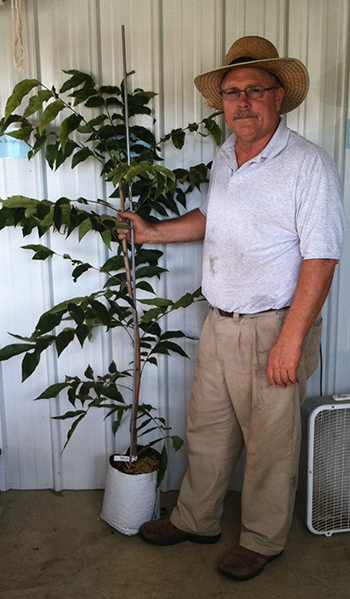 The author with a pecan seedling.
I often talk to growers who are looking for something they can care for as they get older. A retirement crop so to speak. It is a good plan if you start before it is time to retire. Nut trees are often alley cropped when they are young. So, a current grower with a plan for slowing down one day, can continue to grow his crops and have his future crop growing and maturing as the years pass by. My do the years go quickly.
So, what to plant? Pecans are native as far north as parts of Iowa. Black walnuts, Zone 5 and south. English walnuts and heartnuts in Zones 5 and 6. Hickories, Zone 5 and south. Chestnuts, Zone 5 and south. Hazelnuts, Zones 4 to 8. Almonds Zone 5 and south. We are not talking about random wild trees. A group called the Northern Nut Growers (nutgrowing.org) has been selecting superior trees for over 100 years. They have been selecting for cold hardiness, flavor, productivity, and easy shelling qualities.
If you are familiar with wild black walnuts and wild hickory nuts, you may be scratching your head and asking why anyone would promote those as a crop? Well, imagine walnuts and hickory nuts with thin shells that crack out in whole halves, and then you have something that is special in the marketplace.
Local sources for commodity items like pecans and almonds give you pricing power. If you have never eaten a fresh pecan, you have never eaten a good pecan. We have lost our chestnut food culture since the demise of the American chestnut, but European and Asian immigrants still have a strong chestnut food culture. Heartnuts are the coolest thing you’ve never heard of. It is a variant of a Japanese walnut that cracks out whole and is shaped like a long heart. It is a pastry chef’s dream.
Time will pass whether you plant trees or not, so waiting is the enemy. Planting is best done in late fall or early spring. Planting at this time of year is simple. Plant, water, protect from deer and rabbits and watch them grow. Water if it is a dry season for the first few years. Pruning tasks are best done during late winter or early spring.
So, nut trees are a viable option in Zones 4 and south. Like other fruit trees, each species has its preferences in growing locations. Pecans like plenty of water and heat. They will do best on a south slope or in a bottomland situation. None of these like wet feet. English walnuts, heartnuts and almonds are susceptible to late freezes so they should be planted on high ground away from frost pockets.
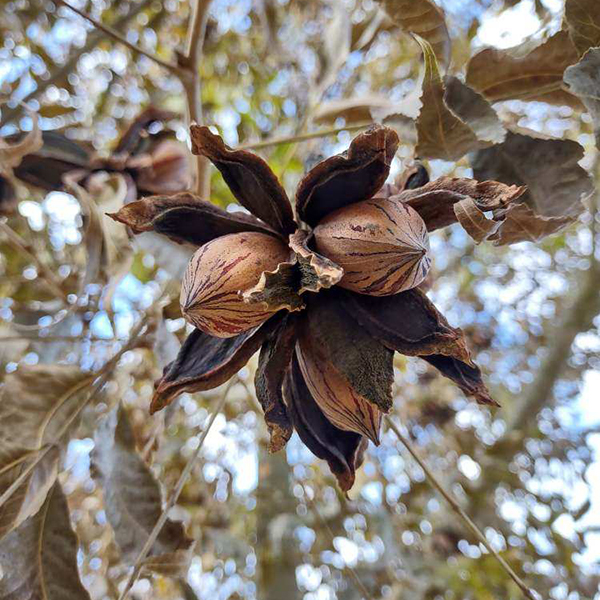 A pecan cluster on the tree. Photo by Robert Jones.
Hickories will grow just about anywhere, but they are usually grafted on pecan rootstocks so a moist soil will help them grow faster. Chestnuts need a dry site. They will suffer greatly in a wet location. Hazelnuts bloom during winter, and a nice well-drained site with good airflow and plenty of sun is good for them. They can also be planted between other nut trees as a filler as the young trees grow.
There is a simple formula for fruit and nut production: Sunlight = Flowers = Fruit or in this case nuts. Sunlight provides the energy to make flowers and ripen the nuts.
Why would you add such a crop to your farm? Outside the primary growing areas for these crops there is no local supply. Even in the pecan growing areas there is demand for fresh local nuts both in season and out of season. Remember, this is a storable crop. Almonds, hazelnuts and English walnuts are all West Coast products. There is only one black walnut sheller in the United States.
Any commercial heartnut growers are tiny, and there is only one commercial hickory nut grower I have found, and all his sales are local. There are some chestnut grower cooperatives in the Midwest, but the United States still imports millions of pounds of chestnuts each year. [See GFM February 2021 “Small orchards and agroforestry in the field” on chestnut growers and other tree crops.]
Let’s use pecans as an example. There are 27 pecan trees per acre. Each mature tree will produce an average of 100 pounds per tree, some years more and some years less. Maturity begins at 20 years. That is 2,700 pounds per acre. In shell on-farm prices begin at around $6 per pound which comes to $16,200 per acre. Of course, there are expenses such as fertilizer and sprays if you choose to use them and harvest, storage and marketing expenses.
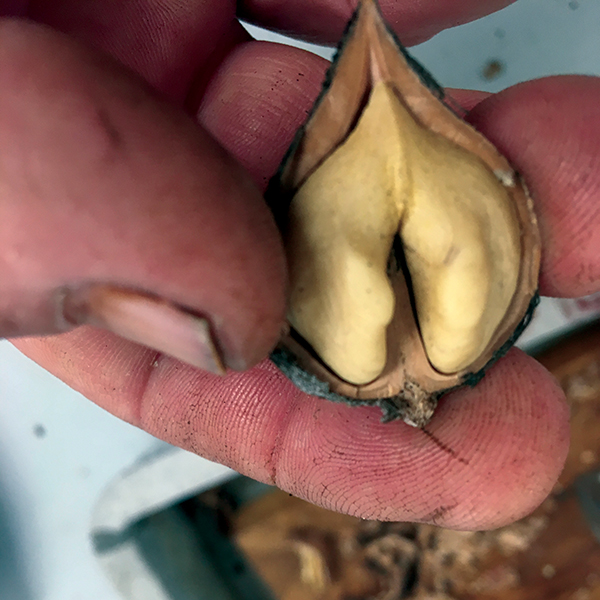 A heartnut is a variant of a Japanese walnut that cracks out whole and is shaped like a long heart. Photo by the author.
Five acres produces an estimated gross of $81,000 per year. I have been in the market garden business a long time, and I know the realities can be far different from grower to grower and location to location. Yet, I have heard from enough growers with actual success stories to know that this is possible if you are willing to direct market to the consumer. I am not even going to suggest a wholesale market plan. We are talking about small operations and local markets here.
So, how do you put this into practice? What will be required? Variety selection is probably the most important decision in establishing an orchard. Choosing a tree that will ripen a crop in your location is key. Getting that tree on a rootstock that is hardy in your location is just as important.
Nurseries in the deep south use a pecan rootstock that is adapted to their climate. Much north of Birmingham, Alabama, that rootstock will freeze and die during an average cold winter. I prefer trees grown in root pruning containers. Bare root nut trees have always struggled for several years for me. Hazelnuts are on their own roots usually. Almonds are on a hardy peach rootstock. Walnuts are usually on a black walnut rootstock.
I am a big fan of appropriate technology when it comes to the small farm. To plant, all you need is a shovel. I dig a hole big enough for the rootball and that’s all. Fertilize on the surface around the tree. Let the fertilizer percolate down to the roots. There is no need to amend the soil. Trees get very large and their roots reach very far. You do not need to geo-engineer your farm to grow a tree.
If you want to irrigate, plan to put it in sooner rather than later. Mature trees need a lot of water to make a full crop. Of all the tree species listed only the almonds are self-pollinating. All the others will benefit from having more than one variety. There are charts available for some of these that show pollen compatibility. A good diverse legume grass mix underneath your trees will help with fertility, but a fertilizer program will give better and more reliable results.
Trees do not compete well with grass. Mulching trees especially when they are young will help them grow faster. We let our grass grow between the rows this year and mowed it like a hay crop and raked the windrows into the tree rows as a mulch. We are mowing about every two weeks now so the grass will be under control when harvest time comes. We mow pretty low right before harvest so it will be easier to pick up the nuts.
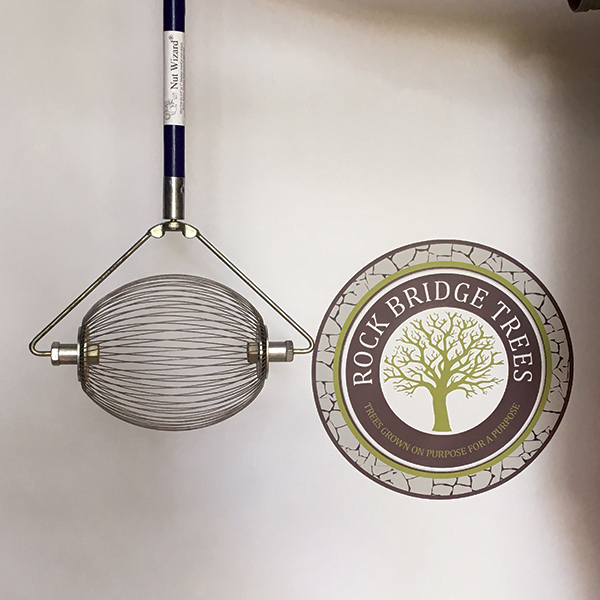 A “nut wizard” can be rolled along the ground to pick up nuts.
There are several pests and fungal diseases that can affect your trees. Choosing pecans that have scab resistance will go a long way to reducing disease issues and increasing crop yields. A strong Integrated Pest Management program would be good. There are plenty of pesticides and fungicides registered for nut trees should you need them. Your individual tolerance for crop loss will dictate your need for any intervention. For example, squirrels and crows are major consumers of nuts. Trees can be protected from squirrels by banding the trees with sheet metal. Crows should be scared away.
Harvest can be done by hand, but there are several aids out there to pick them up that are cost effective. The Nut Wizard wire basket is the simplest and cheapest way to get started. Bag-A-Nut from Florida has some nifty nut pickers when you get to the next level. There are of course large commercial scale equipment companies if you want to get that big.
Nut trees are usually shaken to get the nuts out. I have built a cable shaker to shake my young trees. By the time they get too big for that, I should have made enough money to buy a mechanical tree shaker. Walnuts and almonds will need the husks removed immediately to keep quality up. I prefer pecans and hazelnuts that fall free from the shucks. Hickory nuts also fall free from the shucks.
All nuts need to be gathered as soon as they fall or market quality will decrease rapidly. There are mostly homemade walnut hullers, and a pressure washer works well for cleaning the nuts after hulling. Walnuts hulled as soon as they fall and cleaned right away have lighter colored nut meats and the flavor is better. The hulls will flavor the meats if left on to deteriorate naturally.
Post-harvest handling is very important to the marketability of your crop. Nuts are storable but still perishable. Contrary to what you see at the grocery store, nuts are not storable at room temperature. Short-term storage in shell can be in a bag in a cooler. Long-term storage is best in a freezer both for in shell and shelled nuts. Warm temperatures cause the oils in the nuts to go rancid. And some nuts meats will darken quickly at warm temperatures. Nuts do need to dry or cure after harvest but this has to be done in the shade. The nuts will need to be put in the cooler as soon as curing is done.
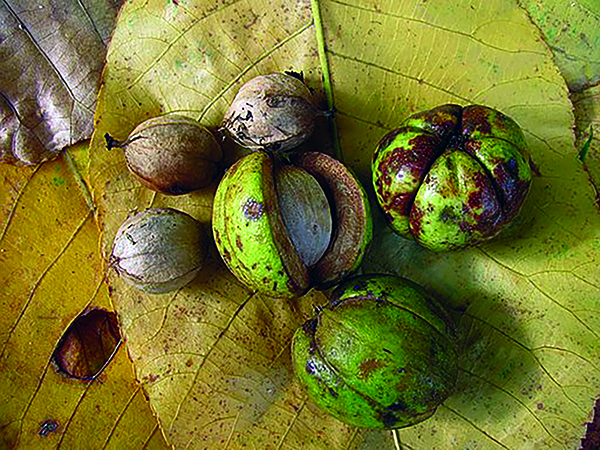 Hickory nuts in and out of the husk.
Should you choose to shell your crop, you will need to consult with your state’s regulations. Some states may consider any shelling as processing. Some states allow for cracking but not cleaning. Of course, proper labeling with allergy warnings will be necessary.
When presenting your crop to the consumer, in shell nuts can be sold loose and bagged by the customer at your stand. They are often sold in mesh bags with your farm label in 5- 10- 25- and 50-pound increments. Cracked or shelled nuts are usually packaged in clear bags or clamshells and sold by the pound. Cracked nuts may be subject to different handling requirements. Consult with your states rules before starting.
If you do value added products, well, the ideas are endless there. Baked goods and candies, oh, the list goes on. Fresh pralines outside the deep south, Oh My!
This is a very brief overview of a pretty broad topic, but I hope it plants a seed or two. In my own case, I knew about these wonderful, improved nut varieties for 40 years before I planted any. I, like most of you, had never seen first-hand these jewels, treasures saved by a few interested people. I happened upon a gentleman with some mature trees and got to sample some nuts firsthand. They were everything I had heard and more. My first young trees on my farm are beginning to bear and I am planting more every year. What are you planting for your future this year?
David Hughes, AKA Farmer Dave, has grown and sold produce to restaurants in Nashville, Tennessee, for more than 20 years. He owns Rock Bridge Trees (rockbridgetrees.com) that specializes in northern pecans, improved hickories, hazelnuts, almonds, persimmons, pawpaws, and other edibles as well as flowering trees for beekeepers.
Copyright Growing For Market Magazine.
All rights reserved. No portion of this article may be copied
in any manner for use other than by the subscriber without
permission from the publisher.