





Many diversified vegetable farmers come to this profession focused on producing food for their communities, exercising their entrepreneurial spirits, stewarding the land, or some combination of the above. Few would likely say they got into farming because they wanted to be employers. And yet this industry has become heavily reliant upon hired employees — those individuals who share the labor burden, make it more possible for owners to expand their operations, and ultimately help turn the farm’s vision into reality.
Drawing connections
“When it comes to the sustainability of our farm, we are completely and totally reliant on our employees.” Over several years of formal interviews and casual conversations as part of my dissertation research and through my work with FairShare CSA Coalition, countless vegetable farmers from across the country have echoed this sentiment shared by David Bachhuber of Wisconsin-based Lovefood Farm.
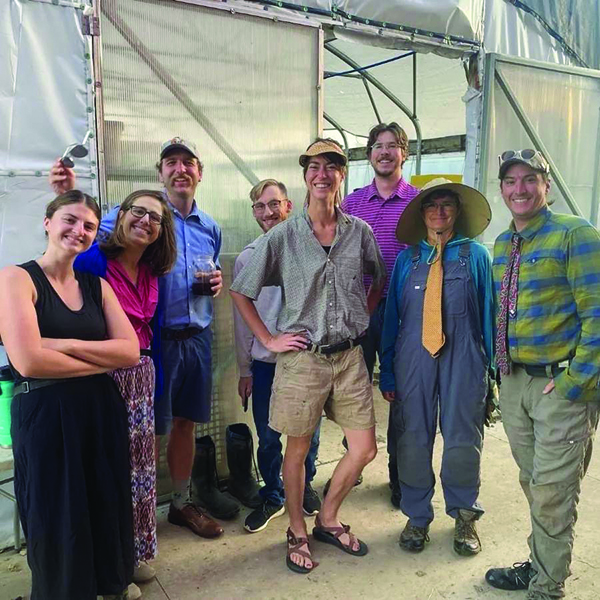 The 2023 Lovefood Farm crew on business casual Monday.
As a non-profit serving diversified vegetable growers across the Midwest, FairShare develops programming and facilitates peer-to-peer connections based on farmers’ needs. A long-time need has centered around how to support and stabilize this industry’s workforce. Even as many farm owners readily draw these connections between their employees and the sustainability of their farms, they may be just as likely to feel unprepared or uncomfortable in the role of employer.
After all, being a boss and leading a team requires a set of skills somewhat different from those applied on the production side. From very straightforward tasks like organizing and communicating a plan for the day, to working through your own discomfort in order to address unhealthy conflict compassionately and directly — these skills are wide-ranging and it’s not hard to see why this work might feel overwhelming, if not intimidating.
Adding to those feelings the urgency of daily tasks, unpredictable weather, volatile markets, and countless other stressors, it can be easy to keep this work low on the priority list, focusing on production and hoping that everything else falls into place. But humans are at the heart of farming, and creating a supportive and rewarding labor experience can make a difference in big ways — from improved efficiency and product quality to higher employee satisfaction, labor retention, and overall quality of life.
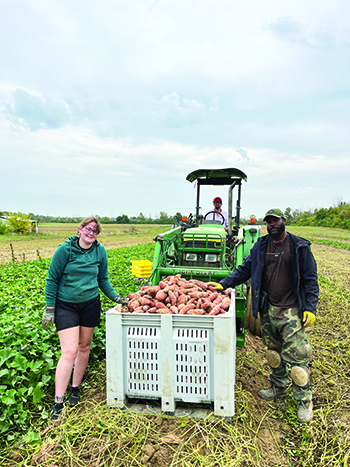 The crew at Mile Creek Farm brings in the sweet potato crop.
Oh, and all of this? It’s good for business. In the words of Katrina Becker of Cattail Organics: “Our farm sees employees as critical assets, not as a high-cost liability. By investing in these individuals who are giving so much to the farm, we are creating an environment that recognizes their value, makes space for them to share their ideas and feedback, and rewards their efforts. And we continue to learn as we go, but we’ve also seen this turn into people staying longer, greater capacity for creativity and innovation, and just better work-life balance for everyone on the farm.”
At this point you might be thinking, “Sure, this sounds good but what does this look like in practice?” The good news is that a growing number of programs and resources are supporting farm owners and managers as they strengthen their leadership and employee relations skills. Read on for a closer look at five such examples.
Becoming the Employer of Choice for Vegetable Farmers (BTEC)
- Host: FairShare CSA Coalition and University of Wisconsin-Extension
- Audience: Vegetable farm employers and experienced farm managers
- Format: Online annual delivery; occasional in-person deliveries; resource library
- More info: https://www.csacoalition.org/btec
- The next BTEC training delivery runs from November 9 through December 11, 2023
The BTEC labor management training program is the result of a group of farm owners and educators working together to address the challenge — and opportunity — at the heart of this article. Adapting an earlier version of BTEC created by UW-Extension to serve dairy farmers, we adjusted each session to reflect the realities and address the needs of diversified vegetable producers.
Today, BTEC consists of eight two-hour sessions, each highly discussion-based and delivered by a two-person training team, one of whom is a farmer, which helps to keep peer-to-peer connection and learning at the center of this program. Sessions explore concrete topics like hiring, training, and conducting reviews, as well as more abstract considerations like your farm’s culture and building intercultural competence.
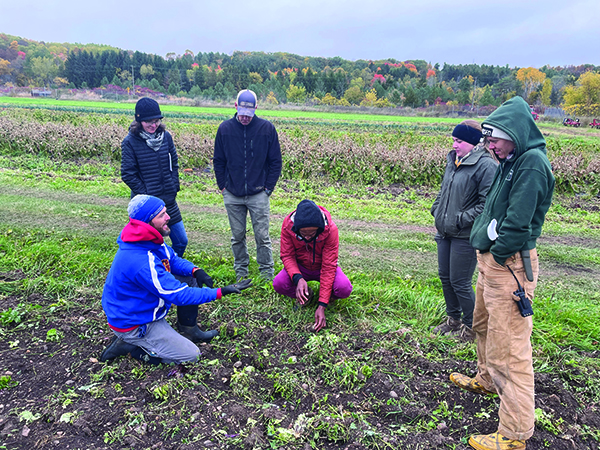
Beginning farmers participating in FairShare’s Organic Vegetable Farm Manager Apprenticeship program apply what they learn through TEAMs on their host farms across Wisconsin.
For Ohio-based farm owners Emily and Ben Jackle at Mile Creek Farm, BTEC’s grounding in both research and concrete examples felt like a winning combination. “Managing employees had taken a back seat to everything else required to run a farm. BTEC shared practical skills and strategies to help us prioritize being better managers.”
Each session includes a set of supplemental resources intended to help farmers take those next steps as they leave the discussion. For instance, Hiring the Right People includes example position descriptions, a library of interview and reference check questions, and a sample script for unsuccessful applicants.
Farm owner and BTEC attendee Danielle Boerson spoke of BTEC’s impact on her operation. “The BTEC course truly did impact how I managed our crew this season. We had several new people this year, so going in with an improved manual, clearer communication strategies and anecdotal advice to fill in the gaps all contributed to a more successful season. This training is helping us put these pieces together, and I am looking forward to seeing the rewards pay off over time.”
The Farm Labor Dashboard
- Host: University of Vermont-Extension
- Audience: Vegetable and livestock farm employers and managers
- Format: Online and in-person delivery, resource library
- More info: https://www.uvm.edu/aglabor/dashboard/welcome
The Farm Labor Dashboard seeks to help farm owners make informed, data-driven labor decisions. A collaboration between farmer educators located in Vermont, New Hampshire, Wisconsin, Minnesota, and Nebraska, the Dashboard project has produced a set of concrete online resources, including an “Are You Ready To Hire?” self-assessment that helps direct users to targeted resources; an Employee Cost Estimator to help farmers understand the full cost of hired labor; a Job Description Generator; and a Personnel Policy Generator.
The Dashboard project’s many workshops invite farm owners to share “concrete, real-life examples” while also making space for farm employees to share their experiences. Visiting the website, you’ll find a robust library of articles, videos, and reports gathered from across the industry and related to supporting positive and healthy farm labor management experiences.
Earlier this year, Dashboard partner Renewing the Countryside — in collaboration with other project partners — began hosting online learning circles for women-identifying farmers to come together and share the challenges, strategies, and opportunities they face as farm employers. Additional learning circles will be offered in 2024. In the meantime, check out the Dashboard’s slate of virtual winter offerings, including “Growing Successful Work Teams” on December 6 and 13, 2023.
Farm Commons
- Host: Farm Commons
- Audience: Farm employers, farm service providers, legal professionals
- Format: Online delivery, resource library
- More info: https://farmcommons.org/
Being an agricultural employer means navigating an increasingly complex legal landscape, one that often varies from state to state. Farm Commons provides dynamic education to help farmers increase their knowledge and build the legal resilience they need based on the specifics of their farm business.
And as Maya Rose, a Food and Farm Business Coach and Trainer with Employer Business Impact Northwest, points out, their information is highly accessible. “Farm Commons takes really daunting topics and puts them into practical steps. I love using and sharing their resources because I know they won’t be a slog to get through. They’re clear, approachable, and give the answers people need on state-specific employment law issues.”
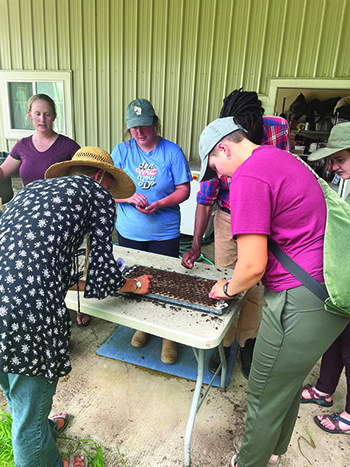
Beginning farmers participating in FairShare’s Organic Vegetable Farm Manager Apprenticeship program apply what they learn through TEAMs on their host farms across Wisconsin.
Annual membership opens up access to in-depth workshops like Discovering Resilience and Farm Employment Law, a deep and growing library of topical resources, and the peer-to-peer Commons Community. Workshops are free to members, and non-members can also register for a fee. While Farm Commons began as a service to farm employers, it has since expanded to include targeted support for farm service providers as well as attorneys and legal professionals operating in the agricultural realm.
Get a taste of what the Farm Commons team is all about by checking out their podcast, where staff explore a wide range of topics from “Legal Considerations for Working Interviews” to “Innovative Farm Labor Models” and so much more. Watch for upcoming programming, including a deep dive into becoming an H-2A employer, scheduled for December 5 and 7, 2023.
The Employment Resilerator
- Host: California FarmLink
- Audience: Vegetable farm employers, ranchers, and fishers
- Format: Online delivery
- More info: https://www.californiafarmlink.org/courses/the-employment-resilerator
This fall, California FarmLink launched The Employment Resilerator, a new nine-week course developed in response to growing demand from farmers, ranchers, and fishers for targeted support in the area of advanced employment relations. As one participant shared, “Managing employees is something that I never really thought I wanted to do, but it became necessary for our farm to grow to a profitable scale. And while there are many aspects of employee management that I do enjoy, there are still many aspects that I’m unsure about, and I always want to do better. I’ve never had any professional training in management so this seems like a great opportunity for me.”
With the goal of going above and beyond what is legally required, The Employment Resilerator explores concrete ways to create an environment that gives employees a growing number of reasons to stay. Discussion topics include creating a safe and respectful workplace, conflict resolution skill-building, and onboarding and recruitment, among others. Combined, instructors Judith Redmond and Andrea Levy bring nearly five decades of experience in the agricultural space as farmers or in service of farmers.
Currently, The Employment Resilerator is available to producers residing in California who have also completed The Resilerator — a 10-week FarmLink business resiliency course. However, in the future, this offering may become available to any interested California-based producer.
Training and Education for Aspiring Managers (TEAMs)
- Host: FairShare CSA Coalition
- Audience: Current and aspiring vegetable farm managers
- Format: Online annual delivery; resource library
- More info: https://www.csacoalition.org/teams
The TEAMs program grew out of conversations I was having with farm employees from across the country. While many expressed a desire to move into management roles as a way to advance their farming careers, limited access to formal industry-specific training often meant they were hesitant to take on those extra responsibilities. Thus, the work to create TEAMs began, with experienced farm managers providing a year’s worth of guidance and feedback to help shape the program’s four sessions.
Each spring, we dig into topics like leadership and emotional intelligence, communication, delivering and receiving feedback, and recognizing and addressing conflict. Peer-to-peer connection and learning is a critical part of this program.
As Alabama-based farm manager Jessica Hill points out, that’s important given how expansive this job can be. “The role of ‘farm manager’ carries so much responsibility, and it’s important to know how to safely lead and support a team. I would recommend TEAMs to any farm manager, and I would encourage management teams to take the training together. This program gave me confidence in the leadership skills I already had, taught me new tools for handling conflicts, and gave me common language to use with our Assistant Farm Manager.”
For farm owners, incorporating hired managers can have a resounding impact on everything from daily operations to overall work-life balance, and the TEAMs program is one resource that can help prepare individuals to succeed in those crucial roles. While farm employees and managers can sign up for TEAMs directly, each year a growing number of farm employers connect current and aspiring managers on their farms to this training as a form of professional development. Look for the next TEAMs delivery in March 2024.
Bringing it full circle
The energy, skill, and intuition that people bring to farming can unlock so many possibilities. Yet, proactively supporting that human element often means investing in additional skills beyond those used for crop-planning, preparing for inspections, or managing pests and disease. And farm owners aren’t alone in recognizing the importance of this work and its possible impact.
What I have learned from conversations with farm employees from across the country is that they want to work on farms that have strong labor management practices in place. They want to see well-established systems and policies, regular and clear communication, and a healthy and respectful workplace culture. Farm employers play a central role in building and nurturing this environment. While the above list is far from exhaustive, these programs and resources can serve as a starting point or a way to deepen your ongoing work in this area.
Stay tuned for a follow-up discussion in the January issue, where we’ll get more specific about what farm employees working on diversified vegetable farms look for and value in a workplace — including factors that may support their retention over time.
Sarah Janes Ugoretz works with FairShare CSA Coalition where she supports the Organic Vegetable Farm Manager Apprenticeship. She is a co-creator and trainer on the BTEC and TEAMs programs. Her PhD focused on supporting long-term career pathways in diversified vegetable production. Sarah works closely with farmers – both owners and employees – in all aspects of her work, and also draws from her own experience as a former farm employee and manager. Feel free to reach out to her at sarah@csacoalition.org.
Copyright Growing For Market Magazine.
All rights reserved. No portion of this article may be copied
in any manner for use other than by the subscriber without
permission from the publisher.