











Farmworkers play a critical role in the day-to-day operation and overall sustainability of diversified vegetable farms. But what are these individuals looking for in a work experience? Do they simply want a season spent outdoors and a few good stories, or are they hoping to pursue a long-term professional career in this field? More and more often, it’s the latter — and that’s great news for farm employers who hope to stabilize their workforce, streamline their operations, and improve quality of life for everyone on the farm.
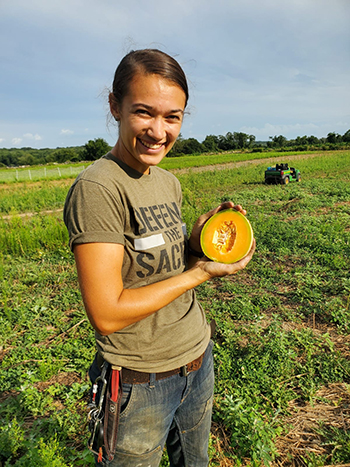 Keely, a farmworker based in Massachusetts, reflected on the financial insecurity that often accompanies farmworking and that in turn fuels labor turnover.
Earlier this year, Anita Adalja (with Not Our Farm and Ashokra Farm), Rue Policastro (with Owl’s Nest Farm), and I published a toolkit called Farming Into the Future by Centering Farmworkers: A Deep Dive Into What Diversified Vegetable Farm Employees Value in a Workplace. This toolkit — all 70 pages — is based on a few years worth of conversations with farmworkers from across the country. Given that employee turnover tends to be a top challenge for farm owners, our goal was to bring more information to the table: spotlight the employee perspective, explore what they’re looking for in a work environment, and identify the factors that might keep them working and growing on a farm over time.
Drawing from focus groups discussions, one-on-one interviews, and responses to a national electronic survey, we found ourselves with a mountain of insights to dig through. While there are clearly several factors that matter to farm employees, we focused our attention on four key topics: strong communication, a professional and safe work environment, opportunities for growth and advancement, and livable wages. Throughout the toolkit, we discuss these at length, exploring farm owner and farmworker perspectives and highlighting ways in which farm owners from across the country are engaging in this work. We conclude each section with a few questions where we invite the reader to engage in some reflection and active planning.
This article provides a high-level summary of what we explore in the toolkit. You can access the full resource here (tinyurl.com/fitftoolkit), we hope you do. In addition to practical tips, practices, and examples, you’ll find an assortment of supplemental resources towards the end.
First, an important note
A very specific segment of the agricultural workforce informed this toolkit. These individuals were often college-educated, spoke English as their first language, had U.S. citizenship status, and worked on smaller-scale diversified vegetable farms in both for-profit and not-for-profit settings. Their interests and passions primarily brought them to this work, and on the whole, they likely experience different privileges and protections compared to the majority of our country’s agricultural workers.
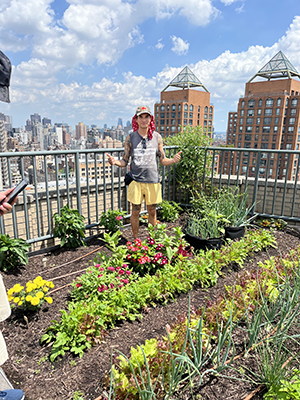 Anthony, a farmworker based in New York City, highlighted how a culture that prioritizes production over worker safety ultimately harms the individuals working on the farm as well as the farm itself.
We identify these differences not to diminish the challenges the workers we surveyed face, but rather to acknowledge that they exist. The farm employees who informed this resource often use different strategies that allow them to continue doing this work. Many have second jobs to supplement their farm incomes. They face seasonal instability and often qualify for public health benefits like food stamps. And they labor with their bodies to build something they believe in but often do not own. Despite all of this, many of these individuals are eager to build a long-term, professional career in farm work.
At the same time, farm owners face no shortage of entrenched challenges. Farm labor on the whole is undervalued, the agricultural marketplace is volatile, federal subsidies tend to favor conventional commodity producers, and consolidation across the food system means that producers are more often price takers than price makers. Farm owners must balance increasing input costs, narrow profit margins, debt payments, and the urgency of the work itself — all while juggling the very real responsibilities that come with being not only a producer, but an employer as well.
Talking about employees’ and farm owners’ needs can be a sensitive subject that brings up a lot of strong feelings and emotions. Yet for all of the ways in which their experiences, wants, and needs differ, both groups share a deep passion for the work they are doing. And more often than not, they need one another.
Farm owners need employees’ labor, skill, and creativity to help their businesses thrive. Farmworkers need owners to share the knowledge, expertise, and professional infrastructure that will help them build their careers in this field. This is the spirit underpinning Farming Into the Future, and our hope is that this discussion will help farm employers identify what they’re already doing well and what they might want to explore moving forward — all in service of creating a rewarding work environment that supports long-term labor retention and farmer quality of life.
Now let’s take a closer look at our key topics.
Strong communication
In a profession as fast-paced and unpredictable as farming, communication is among the most important tools farmers have at their disposal and one that farmworkers value greatly. On the farm, communication can take many different forms, and employees highlighted a variety of approaches they see as contributing to a strong communication infrastructure. Included in the mix are:
- Practices like regular check-ins, formal employee reviews, and crew meetings;
- Tools like walkie-talkies, white boards, field maps, standard operating procedures, shared community agreements, and codes of conduct;
- Systems like project management and communication apps (e.g., Trello, Todoist, and Slack); and
- Skills like emotional intelligence, active listening, and delivering, receiving, and implementing feedback.
Prioritizing this work may feel secondary to the farm’s production goals, but as a farm owner, creating space for effective and clear communication can help people become better at their jobs. As one Wisconsin-based worker emphasized, how communication is set up on the farm often shapes how the work gets done. “Having those various communication pieces in place makes it easier for us to do those production tasks, and do them efficiently and with confidence. As an employee, it also helps me adapt and make better decisions on how to proceed with a task that isn’t going as planned without always needing to stop and ask for help.”
Central to this equation is the role of feedback — sharing it as well as inviting it. That can happen in the moment and is also a great practice to approach more formally through check-ins and reviews. Of the nearly 150 farmworkers we surveyed, 52 percent said they participated in regular check-ins and 30 percent sat down with their employers for formal reviews. As a farm owner, the idea of incorporating this on your farm might feel overwhelming, especially as the season ramps up.
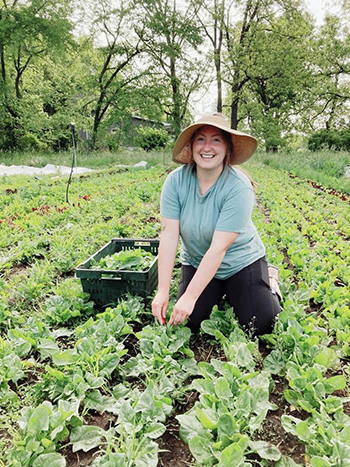
Hannah, a farmworker based in Wisconsin, spoke about the impact that strong communication has on her ability to do her work with confidence.
Yet, one owner emphasized the value this practice can unlock for the farm and everyone on it. “No matter what size your crew is, whether it’s two people or ten, I think our problem is we don’t want to take the time to do it. To check in and have those regular conversations. But what if the result is that you’re going to be more productive and you’re going to have better morale because you’re taking some time to communicate better with your crew?”
Having a more clear understanding of what the work is, what the standards are, and what expectations exist can lead to real and tangible gains for the farm business. See pages 18 through 20 of the toolkit for a few tips and examples that farmers provided on this topic.
A professional and safe work environment
In certain ways, farm work can seem informal. We might assume that people doing this work don’t want to be encumbered by the systems and structures that are so common in other industries. While employees value many of those informal aspects — like working outside and sharing meals together — many also see the work they are doing as professional and skilled. They want that to be reflected in how the farm business is managed and how they fit into that business.
Farmworkers pictured a number of things when envisioning a professional and safe work environment, including farms that have or provide:
- Employee orientations and employee handbooks or manuals;
- Systems for inviting and offering feedback;
- Regular breaks and clearly defined and respected work-life boundaries;
- Clean break areas and bathrooms;
- Ergonomic support and stretch breaks;
- The ability to decline tasks that feel unsafe;
- An inclusive farm culture; and
- A plan for promptly addressing microaggressions.
Some of this work may seem fairly straightforward, like creating and using an employee manual. Prioritizing accessibility and ergonomic practices, on the other hand, will almost certainly take more intentionality and investment. Yet as one Minnesota-based worker points out, the degree to which these considerations are taken into account can have very real impacts not only on the physical work environment but on workers’ overall wellbeing.
“It seems like a lot of the systems were designed without workers in mind. They were designed to create a certain product, not for ease of work flow. And a lot of the time, it kind of feels like we’re just set up to fail. So building and space design is a huge thing. Even row design, making rows that fit our bodies and that are easy to access and move through.”
In addition to applying this type of lens, owners also can ask workers to help identify ways to make the work more safe and less physically daunting. For instance, one Wisconsin-based farm owner asks employees, “What tools do we need to make your job better?” and “What was the worst thing about your job?” This feedback informs the farm’s practices and purchases in a way that prioritizes physical safety and accessibility. See pages 33 through 36 of the toolkit to explore additional tips and examples.
Opportunities for advancement
Nearly two out of three employees we surveyed said they plan to be farming five years from now. One of the main things that will get them there is working with a farm owner who connects them with new responsibilities so they can grow in their positions. This support can take many different forms on the farm, from weekly field walks and topical deep dives to creating crew lead positions or providing professional development stipends. Perhaps the best place to start, however, is with motivation.
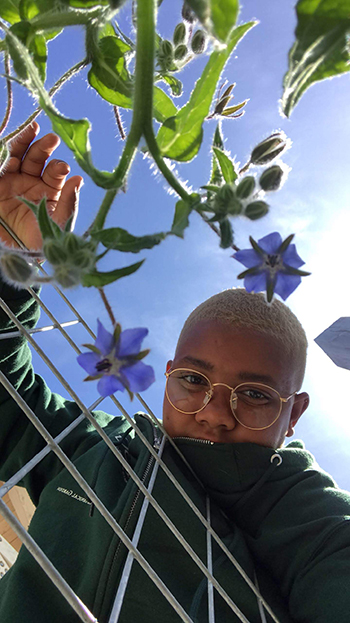 Sajo, a farmworker based in Rhode Island, invited us to be both honest and creative when it comes to what is and isn’t working within our current agricultural system
What creates that spark for an employee? Is it all-things-irrigation, wash-pack systems, or pack shed Tetris? Understanding where workers really want to dig deep and then matching those interests with the farm’s needs can make this a win-win situation. And remember that you can start small. Maybe invite an employee to draft an SOP (Standard Operating Procedure) for a farm task they’re familiar with or have them lead a portion of the weekly field walk.
We can’t talk about skill building and delegation without acknowledging that this also means letting go of some control and accepting that mistakes may happen along the way. Providing some structure and parameters can help ensure that if there is a learning curve, “employees are making hundred dollar mistakes, not thousand dollar mistakes” as one Wisconsin-based farm owner likes to say. And then finding ways to treat those mistakes not as failures but instead as learning opportunities will keep this work moving forward. Over time, the trust you build will feed into greater competency, ownership, and accountability.
Many of the conversations I’ve had with farm owners over the years also make it clear that investing in employees isn’t just an investment in the farm business. It also has the potential to impact the farm owner’s overall capacity and wellbeing. While you’ll see evidence of this throughout the entire toolkit, we highlight here a few thoughts shared by a farm owner based in Michigan.
“I talk to a lot of growers who see labor as a liability. If you shift your mindset to instead see labor as an asset and focus on how to leverage that, it changes everything. I firmly believe that the steady process of adding worker-centered support over the years is what allowed us to grow to where we are right now. Making investments in your crew builds loyalty, allows us all to specialize based on our strengths, and makes this business possible.”
Livable wages
And now, we’ve arrived at what is often the most sensitive of subjects — wages. Within the small-scale diversified vegetable world, we can say with great confidence that farmers — both owners and workers — are not paid enough for their labor. In this toolkit, we spotlight farmworkers’ experiences. Pages 47 and 48 provide a breakdown of what non-management and management-level employees were making by region in 2022, along with what they would consider a fair wage for their work.
The difference is stark and is perhaps best paired with some additional data. Among our survey respondents, 52 percent of employees had a second job, 1 in 4 were receiving public benefits like food stamps, and 53 percent depended on external financial support in order to work on farms — like a partner’s income or access to a parent’s health insurance plan.
People cannot work at a job they love for very long if their wages don’t support the basic necessities of their lives and allow them to make progress on their financial goals. As one Illinois-based employee shared, “There’s no saving going on. There is no planning for retirement with this kind of job and this kind of wage. We can’t really thrive.” This quote represents the financial outlook that many farmworkers are grappling with.
It is dire, and there is no easy answer to help farm owners move closer to being able to provide a livable wage for employees and for themselves, one that will make it more possible for individuals to continue down this career path. Perhaps the most important thing we can offer here is that, as a farm owner, addressing this doesn’t need to be an all-or-nothing approach.
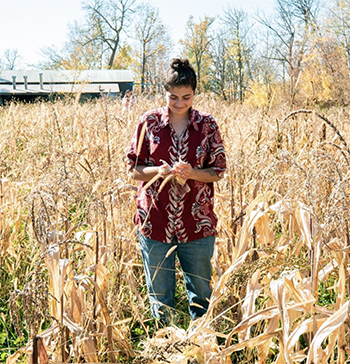 Maya, a farmworker based in New Mexico, drew connections between our industrial food system and its impact on how food and human labor are valued within our society.
Wages are one piece of the puzzle. On page 49 of the toolkit, we outline a few additional factors that contribute to employees’ financial wellbeing, including paid time off, regular raises, bonuses, stipends for professional development and farm gear, farm food, and access to land or equipment. Even essentials that employees may need to do their work safely can make a difference like tick spray, sunscreen, or CamelBaks for hydration.
As one Minnesota-based farm manager emphasized, “Sometimes even a small amount goes a long way. A small raise or bonus or benefit shows employees you value them, even if you can’t afford something big every year. For instance, one of our owners gives gas cards to employees commuting from farther away.” At the same time, showing employees that there is a progression to what they can make over time matters.
Being able to see what that financial picture might look like one, three, and five years from now can help workers assess how that fits in with their broader needs and goals. Simply put, when farm employees have access to higher or progressive wages — wages that support their needs and that they perceive to be more reflective of the value of their labor — they’re more likely to continue doing this work over the long term.
Concluding thoughts
Supporting the humans that make small-scale vegetable and flower farming possible is absolutely essential. In Farming Into the Future, we have attempted to turn what farmworkers have shared with us into multiple points of action for farm owners to consider based on their own circumstances and priorities. While our target audience is farm owners, we took care not to “bubble wrap” our discussion in a way that would minimize the very real challenges many workers are experiencing.
Instead, we sought to engage the pain points and discomfort head-on in an effort to move this work forward in real and authentic ways. This toolkit is a living document, and we invite you to explore it in its entirety and share your stories, examples, and questions with us so we can support its evolution over time.
I’ll close with a few words that a California-based farmworker shared with us during one of our focus group discussions. “Along with environmental and economic sustainability, we need to consider the principles of worker sustainability. If farmers ask how they can continue to make progress on meeting some of these needs, we may find that more and more workers are able to make it through multiple growing seasons. And more of us may even be able to do this as a career, staying and growing with the farm over the years. Many of us do not feel like that is possible right now, but we want it to be. I think it starts with shifting to a more worker-centered approach and recognizing that the prioritization of quality working conditions is an integral part of the farm’s success. By doing this we can improve the well-being of farmworkers, increase retention rates on the farm, and strengthen business longevity for farm owners.”
Funding from various grants supported the creation of this toolkit in one way or another. Thank you to NCR SARE, USDA-DATCP, and the Center for Integrated Agricultural Systems at UW-Madison.
Sarah Janes Ugoretz works with FairShare CSA Coalition where she supports the Organic Vegetable Farm Manager Apprenticeship. She is also a co-creator and trainer on BTEC and TEAMs – two peer-to-peer labor management training programs for farmers. Farming Into the Future is part of her doctoral dissertation through the University of Wisconsin-Madison. Feel free to reach out to her at sarah@csacoalition.org.
Copyright Growing For Market Magazine.
All rights reserved. No portion of this article may be copied
in any manner for use other than by the subscriber without
permission from the publisher.