











#toolsforgrowingformarket
Last summer I took a two-week summer vacation in June with my partner to Germany. It was right in the gap between peak planting and peak harvest time on my farm, but CSA harvests and distributions were still in full swing. I hadn’t done that in a while, but it’s also something that I’ve very intentionally set my farm up to be able to accommodate – for any member of the crew – and it’s a great tool for avoiding burnout for all of the folks on the farm.
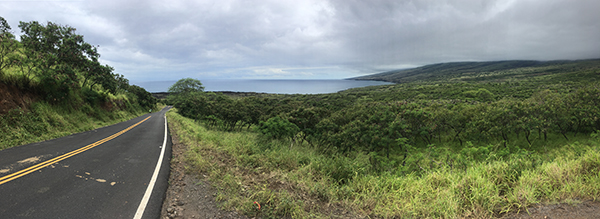 Summer vacations don’t have to be long to be a good get away. This is a photo from a quick four-day ride around Maui my partner and I did in 2018 at the end of April. Even though it was just four days away it felt like we’d traveled for weeks and came back completely refreshed.
Not everyone is going to want to take a summer vacation from the farm, I get that. Though if you are someone who would like to farm and take a summer vacation, but you think it’s just not possible, think again. I was pretty lucky to apprentice on a farm with a farmer, Andy Scott, who was not only a great farmer, but also understood that farming wasn’t the only thing. The year I worked for him he took his family camping in the California Sierra for a week in the summer – totally off grid – and left all of the farm work to his two apprentices. It was a great experience for us, to work independently for a week, and I’m sure it was a good break for him, allowing him to come back to the farm with new energy for the second half of the harvest season.
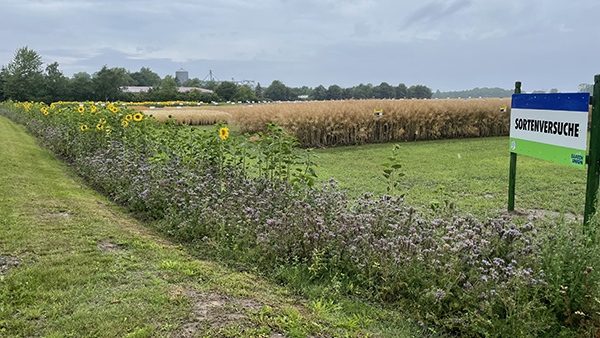 If it were up to me I’d fill my vacations with farm tours, but my partner has other ideas. Still, I stop to take photos of farms even when we’re on vacation. Above are trial plots we rode past on the island of Rügen, Germany, this summer. Even though we weren’t visiting farms, the areas we rode through were very agricultural and it was a fun way to get to see the landscapes.
Looking back, he was able to do that for a number of reasons. One reason is that he had trained us well and we were already used to working from his harvest and priorities lists, even when he was around. He involved us in nearly all the aspects of the farm, so we knew how to run the funky irrigation system, how to water and ventilate the greenhouse, how to harvest, wash and pack the CSA shares, and even how to do some tractor work. The farm was also part of a larger ranch, so if anything major did go wrong there were folks we could get help from.
When I set my own farm up many years later, I wasn’t consciously thinking of that example Andy had set, but I did know that I wanted travel to still be possible for me so I thought about how to create systems that would accommodate that.
There are 4 things I’ve done to make summer vacations a regular part of the farm:
1. I am not the only one who knows how to do everything that has to be done every week. I work with 2-4 employees each season and we have a lot of regular systems on the farm. I try to have my employees to not only see all of those systems, but to get comfortable using them. This is an investment in the beginning as it makes a lot of things take longer in the short term.
2. I do a lot of planning in advance. Crop planning, greenhouse seeding schedules, bed prep schedules, detailed planting plans, outlined harvest plans are all in place to make day to day decision making easier, and to answer the questions that someone new to the tasks will inevitably need answered – how much to plant, where to plant it, how far apart… This summer when I left the farm for two weeks I was able to adjust these plans in advance to reduce the work load for the crew while I was gone, and to leave them with lists that were detailed enough to answer all of the questions they would have about task specifics while I was gone. This required minimal extra work on my part as most of it was just shifting things around from our usual plan and then making allowances for the particular weather forecasts when we got closer to the dates.
3. I’ve invited other farmers to locate their operations on the same ground I’m working. This has meant shrinking my already tiny farm, but it has benefits. One benefit is additional backup if anything goes wrong at any point, and it’s especially great to have that backup while I’m away. Another benefit, not necessarily related to vacations, is getting to watch someone do it a little differently (or very differently) and to learn from their successes and failures too.
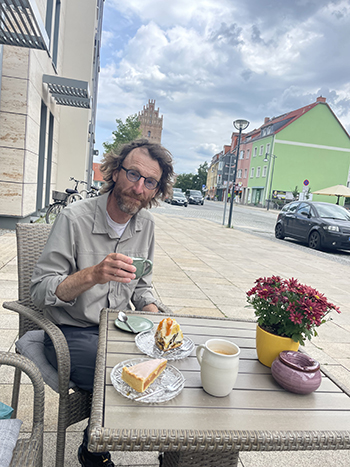 An afternoon Kuchen stop while waiting for a train in Germany. One thing that made a two-week trip to Germany in the middle of the summer easier was modern technology. With my phone I was able to stay in touch with the farm in case of emergencies and even continue making the short weekly social media posts to let our CSA members know what was in the shares. This wasn’t essential, but it was a nice option and happily no emergencies came up.
4. I let the crew take summer vacations, too. The core of my crew works year round, more hours in the summer, but some regular hours even through the winter. I’m not the only one who wants a break sometimes. With the size crew I have and the people I’ve hired I haven’t found it necessary to create strict rules around this, and that has pluses and minuses. Everyone is hourly and time off is not paid so there’s an incentive to not take too much time off with that. I let people know that if they need to take time off for any reason they can do it, but I ask them to be conscious of trying to not take time off when someone else is, and to schedule time off as far in advance as possible to help avoid conflicts. This approach hasn’t always been ideal for the farm in the short term when someone is away at the last minute (in reality it doesn’t happen very often), but we’ve always been able to get done what we have to, and in the long term the morale boost of having the option more than makes up for it. In 6 years of doing this I can’t remember ever saying no to a time off request.
I think that not saying no has made it easier for people to feel comfortable asking for time when they need it, but I can see one of the less than ideal aspects of not having clear rules is that ultimately I hold the power to deny someone time off or to make it more difficult for them so it’s also my responsibility to encourage them to take the option when they need it, and to be completely ok with them doing that.
All of this is also connected to a shift that I’ve made over the years in how I think about the farm work. In the past, growing the produce the farm sold was the main goal, and that goal has shifted over time to center the wellbeing of the people who are connected to the farm. The difference is very subtle, as outwardly the produce is still what we are producing for sale. By focusing on the people first I’m more willing to compromise what is best for the produce in the short term, but it turns out that ultimately the system feels better for both the people and the produce in the long term.
Josh Volk farms in Portland, Oregon, and does consulting and education under the name Slow Hand Farm. He is the author of the books Compact Farms: 15 Proven Plans for Market Farms on 5 Acres or Less, and Build Your Own Farm Tools, Equipment & Systems for the Small-Scale Farm & Market Garden, both available from Growing for Market. He can be found at SlowHandFarm.com.
Copyright Growing For Market Magazine.
All rights reserved. No portion of this article may be copied
in any manner for use other than by the subscriber without
permission from the publisher.