








In 2017, my wife, Rachel, and I moved our rural vegetable farm into the city, primarily to be closer to schools, extended family, and activities for our two young kids. The move also allowed the farm, then 11 years old, a fresh start.
We micro-sized, from 1 acre to 1/3 of an acre in production. Instead of seven buildings, we built one — a barn-house. Instead of four greenhouses, we put up two. We now sell almost all of our food within 1½ miles of the farm.
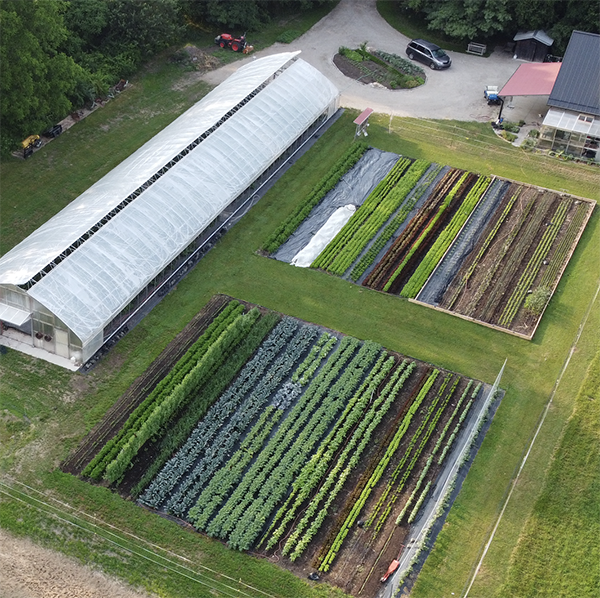 When kids came along, we decided to downsize and focus better. We went from 1 acre to 1/3, and from working 60 hours a week to 35, without a pay cut. We built this new farm in 2018.
We switched to a no-till deep mulch system, utilizing four inches of compost on the soil surface. Instead of feeding our plants minerals that were mined and shipped from far away, we now rely only on our own compost, made from local leaves, for fertility. We use just seven field tools to complete most work. We still grow a wide range of crops, but chose five focus crops; all of our crops are grown within 60 steps of our barn-house.
While our farm is smaller, and we work less, we earn as much as before. Not every day is perfect. We made plenty of mistakes along the way. But this pivot, to a tiny-scale urban farm has allowed us a new beginning.
Earl Butz, President Nixon’s Secretary of Agriculture in the 1970s, famously told farmers to “get big or get out.” Farmer and author Gene Logsdon countered with better advice: “get small and stay in.” Here are four “get small” principles that we used to build a smaller, but better farm.
1. Leverage constraints
When we finally made the decision to move (when our kids were two and four years old), Rachel pulled out a giant sheet of paper and taped it to a wall in our house. We drew circles on the paper, and inside the circles we wrote titles representing core tasks on the farm — selling at farmers markets, CSA distribution, bookkeeping, etc. For each circle, we asked ourselves simple questions: How much is enough? Enough income? Enough work? Enough time spent on the task? Enough investment? The reality is, in order to parent well and stay on top of our farming, we needed to set boundaries.
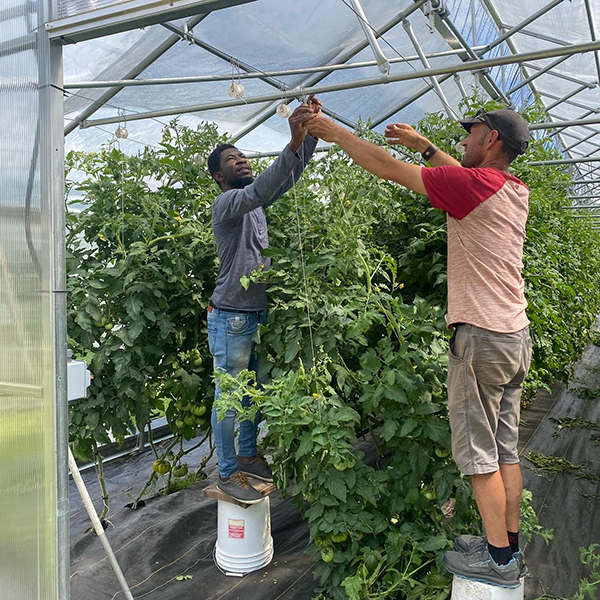 Instead of growing 60 or more crops, we chose five focus crops: tomatoes, mostly Margold heritage tomatoes, baby greens, spinach, cilantro, and full size kale.
These weren’t easy conversations. I’m typically the one wanting to do more — scale up, try new crops or sell to some new restaurant. Rachel is the one asking, how does this serve us? What do we gain and what do we lose? In the end, I’m glad Rachel’s point of view held sway. Here are three boundaries that we set for ourselves:
Sell everything inside Goshen, Indiana, our hometown. This would reduce driving time, save vehicle costs, be better for the planet, and increase our time on the farm and with kids.
Work 35 hours per week or fewer. This rule, for me, meant setting dedicated hours to field work, and sticking with them, to allow time to be with the family. For Rachel, 10 hours per week, spent on bookkeeping and other tasks, would allow her primary focus to be on the kids and household work.
Shrink the production space to 1/3 acre. If we were going to cut back our hours, then we’d need less land to manage.
To be honest, I didn’t think the plan would work. I was skeptical that we could still earn our living with these changes. I didn’t think 1/3 acre was enough land to grow on, and I didn’t think we could get all of the work done in so few hours. I wasn’t at all sure we’d find enough customers that close to the farm.
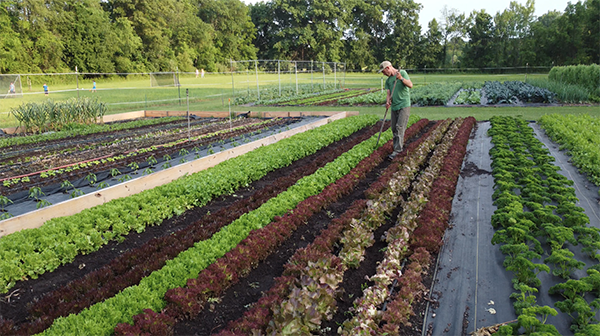 Bed space- We decided to add 12 inches to our bed width, from 30 inches to 42 inches, increasing productive growing space, and to lengthen them to 75 feet. One bed now accommodates two 6-inch paper pot chains (with four rows per bed) with no waste. We use this system to grow lettuce, cilantro, hakurei turnips, and basil, among other crops.
But I was wrong. The constraints we placed on ourselves motivated us to make strategic changes, to do less but better, to focus, to root out waste. We doubled down, listening more closely to local customers, asking them how — precisely — could we add more value for them. As of this writing, we primarily serve just two clients — a co-op and a brewing company — that contribute most of our income.
We also sell through a 20-member CSA and to a few other smaller-volume wholesale clients. The key is open and frequent communication, delivering what these core customers want, when they want it, and in the right amounts. We collect this information every winter using Value Sheets based on a face-to-face conversation.
In the field, we compressed and got more efficient by switching to two-step bed flipping (see my article in the Nov/Dec 2023 GFM) and by getting rid of most of our tools (more below), among many other changes.
To cut our hours, we made a strategic hire, for an assistant farm manager. We use a lean management approach that involves “pushing responsibility down the ladder” — giving real responsibilities to workers early on and allowing for as much flex-time work as practical. For example, we ask Nicole, whom we hired, to recruit our CSA customers, collect their payments, communicate with them, and even deliver food to their porches.
This frees us up to simply grow the food (and to hang out with our kids). Nicole also contacts chefs, receiving their orders and taking care of any other communication needs. She does much of her work for us from home when it is convenient to her. In addition to the assistant farm manager, we hire a part-time field worker from April through October.
The constraints, in the end, weren’t limits; they were opportunities to do better. A turning point for me — when this truth really soaked in — was when we got rid of our walk-in cooler, which we were able to do because of our proximity to customers. Without this costly beast, we save thousands every year. We now use a three-door fridge to hold a few items short-term if needed. Yet, almost all our food now goes from field to customer within a few hours’ time without spending time in a walk-in. (Our processing room has a mini-split air conditioner, and we use a Toyota Sienna with AC for deliveries.)
The point here is to set clear boundaries around your work based on your values and the life you want to live. Then, leverage the constraints to motivate better, less costly, more productive work.
2. Essentialize
To shrink the footprint of our farm without sacrificing profits, we chose the most essential crops and customers to focus on and got rid of the rest. We leaned heavily on the Pareto principle — the idea that, in many businesses, 20 percent of your time and effort is most likely giving you 80 percent of the results (while 80 percent of your time and effort is probably giving you the remaining 20 percent).
With customers, we asked ourselves, who’s in the 20 percent. As I said, we now sell primarily to just two wholesale clients and a small CSA. Before moving, we’d sold to as many as 15 wholesale accounts. We winnowed our wholesale customers by asking: who pays consistently, orders in large volumes, and is located closest to the farm? We narrowed our CSA customers to those who live in or near Nicole’s neighborhood since she does the CSA deliveries. Instead of a wide net, we cast a targeted net that best fit the needs of our farm.
We also winnowed our crops. We asked ourselves which ones can we produce in high volume on a tiny patch of land, at low cost of production, and that sell for high (fair-market) prices. Instead of growing 60 or more varieties, we decided that on this new tiny farm we would focus on just five: tomatoes, baby greens (lettuce, Asian greens, etc.), spinach, cilantro (for us, it’s a surprisingly big seller with a high margin), and full-size kale.
You’ll note that these are all cut-and-come-again crops — plant once, harvest multiple times. This maximizes dollar-value-per-square-foot. We do grow a few other items for our small CSA, but only in small volume and only during the 16-week CSA window. With fewer crop types to manage, we’ve been able to hone our systems on the “vital” five.
All that said, I think it’s also important to incorporate your values and your own growing passions into your farm. We still keep a home garden full of edamame, sunflowers, shishito peppers, and other things that don’t make the Pareto cut. And we give food away to folks in our community who couldn’t normally afford it.
3. Simplify
The great hermit from Massachusetts, Henry David Thoreau, wrote, “Our life is frittered away by detail. Simplify, simplify, simplify!” Though I’ve written books on lean farming, part of me still can’t resist adding new tools and techniques and systems that usually just add detail, as it were, and that fritter away time. This new farm has been a chance for me to be more disciplined. Here are a few changes we made to help us cut back on hours while increasing productivity.
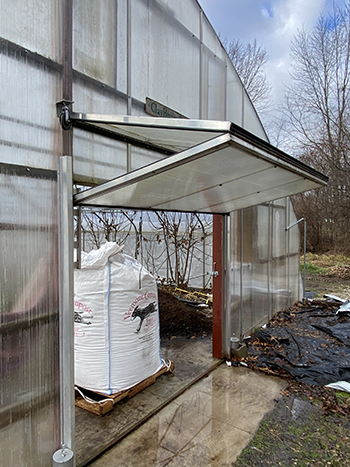 This bi-fold door, which you can buy from Silvercraft in Middlebury, Indiana, creates an awning for loading the van, and seals tightly. All images courtesy of the author.
Use just seven field tools. We decided, as I said above, to pare back our tools. Humans have farmed for centuries with a tiny number of tools, why couldn’t we? A few good hoes (I like the half-moon hoe and Eliot Coleman’s narrow collinear hoe), a bed preparation rake, an adjustable width tine rake (for raking debris from pathways), an aluminum scoop shovel (for moving compost), a wheel hoe (with Hoss tools fixed sweeps), and a Clarington Forge garden fork. With few exceptions, this is all we use in the field and it’s all we really need.
Rely solely on compost for fertility. We stopped spending money on expensive minerals from far away to fix our soil problems. Instead, we make our own compost from leaves and spent grains from the brewing company that we sell food to, using Richard Wisbaum’s low-input composting methods (see www.cvcompost.com/low-input-composting). In short, we collect a giant pile of leaves, delivered by the City of Goshen, add a few spent grains, and move the entire heap (with a skid loader that we share with neighbors) two or three times in the summer. The key is to rely on a large central core (where the composting action takes place) and on a few number of well-timed turns, rather than over-mixing and over-pulverizing the pile.
As stated, we started our farm with four inches of compost laid directly on the surface (this is the “deep mulch method” that I describe in my book). Once each year or two we add a skim coat of another inch of compost.
Lay out the farm to fit paper pot chains. Our beds are 42-inches wide by 75-feet long. This size perfectly accommodates two 6-inch paper pot chains with no waste. We grow cilantro, basil, multi-cut head lettuce and many other crops with this spacing. Using paper pots, with a simplified system, has shaved many hours from our workload.
We also decreased our greenhouse growing space from 9,000 square feet to about 6,800 square feet, but managed to increase productivity in them through better design (see photos).
4. Practice Swadeshi (localize)
This move into town, close to customers, also gave us a chance to better integrate farm and community. Swadeshi is a term first used by Gandhi that he defined as “the spirit in us that restricts us to the use and service of our immediate surroundings to the exclusion of the more remote.” Swadeshi — local economic self-reliance — was a key strategy in the Indian struggle against colonial rule. But for Gandhi it was also a spiritual discipline, part of simple living, and a way to strengthen villages. Our downsizing was an opportunity to practice Swadeshi, to really localize.
I think it’s important to note that Gandhi saw localizing as an opportunity to increase efficiency, not as a burden or a weight on productivity. Gandhi was a serial entrepreneur, always looking for ways to do things more simply and efficiently with local supplies. He invented snake catching tools and sandals made from used tires. My favorite Gandhi invention: a charka (spinning wheel) that he created with two wheels instead of one, to spin yarn twice as fast.
On our farm, we think of Swadeshi, or localizing, in two ways. First, it means replacing more and more of our farm’s inputs with locally-sourced alternatives, like using local leaves for fertility. We’re not purists, we still have an Amazon account, but now we think twice before defaulting to the easy, shipped-in option.
Here are a few examples: when building our greenhouses, we used salvaged electrical panels and boxes, and chunks of old concrete to build sidewalks. To build a deer fence, we used salvaged posts and, as I write this, we are in the process of taking down an old fence from another neighbor for use in the project.
This work — replacing shipped in stuff with local, found alternatives — seems more doable now that we are farming on a smaller scale. Could we replace our harvest knives with knives from a local blacksmith? Could we replace row covers with local reed or hemp fiber mats? This is my future work.
Second, localizing means opening the farm to folks from the community, really integrating into the community, rather than farming in isolation (the more common model in American agriculture). We host school groups, offer tours to visitors and customers, and show chefs what we have to offer. We’ve been able to provide work for new immigrants in the community and to folks recently released from prison. We are a host site for an internship program run by the local high school. These connections knit the village and farm together.
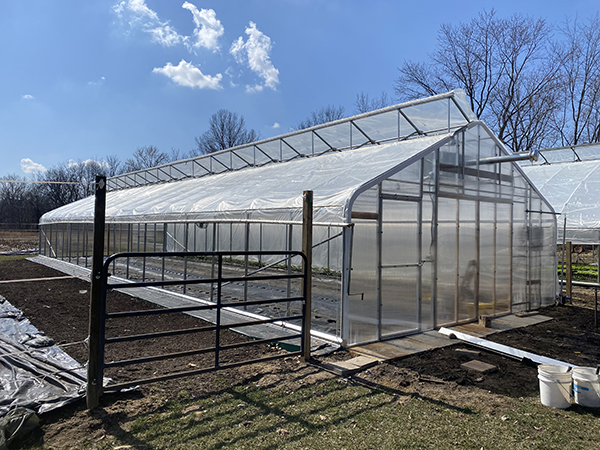 GH peak vent- we put peak vents on our two greenhouses, allowing us to keep the sides closed for most of the winter and early spring. The peak vent keeps temperatures much more stable, and plants grow faster. You can buy them from CT Greenhouses. We use Orisha Automation controls.
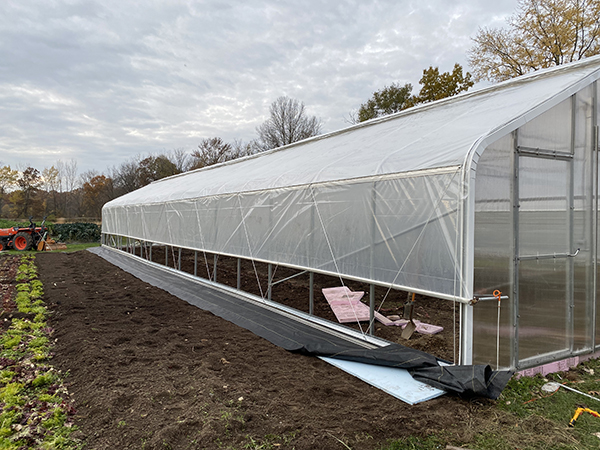
We also install Swedish skirts around the perimeters, laying down 1 inch of rigid insulation around the base of the greenhouses, covered with landscape fabric. This sheds water, prevents weeds, and keeps the outer growing beds much warmer in winter.
I wanted to tell our downsizing story in my new book, The Lean Micro Farm, because I think that farming is an incredibly rewarding career. I wanted to show that you don’t need a giant piece of land and huge upfront investments to make a farm profitable. You can do a lot with a little, with the right approach. I hope the book will inspire new growers to give farming a try — starting small, perhaps in a backyard, and perhaps just part-time.
I encourage you to consider trying the “get small” principles. My experience is that with less stuff and simpler systems, it’s possible to find a comfortable rhythm in your work, to really enjoy it and to be present. Think of how our world would be different if instead of constantly doing more, we all did a little less, but better.
Ben Hartman, along with his wife Rachel Hershberger, operate Clay Bottom Farm in Goshen, Indiana. His most recent book, The Lean Micro Farm, was published in 2023 is available in the GFM bookstore. Portions of this article were adapted from that book.
Copyright Growing For Market Magazine.
All rights reserved. No portion of this article may be copied
in any manner for use other than by the subscriber without
permission from the publisher.