




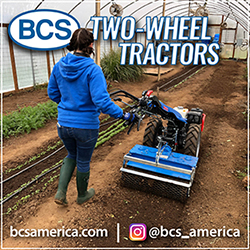






While the paper pot transplanter originated in Japan, innovative small farmers in the US for decades have invented similar models. None became widespread in use, however, because the number of small farms in the US dramatically declined in the 20th century, shrinking the market for such tools.
Many similar tools have been patented through the US Patent and Trademark Office. Below are two examples of US-designed small farm transplanters, from patents filed in 1916 and 1937, respectively. They provide proof that human-scale tools—machines designed for real people to use—have existed in this country for decades, though in the shadows of gigantic-scale agriculture. Following these two is an example of a more recent Japanese invention of a transplanting machine.
Werstler transplanting machine (1916)
Like the modern paper pot transplanter, the Werstler transplanter featured a furrower to create a shallow trench, a long body, and press wheels to pack soil around transplants. The opening sentence of Werstler’s patent proudly proclaims, “Be it known that I, Roy N. Werstler, residing in Hartville, in the county of Stark, in the state of Ohio, have invented a new and useful transplanting machine.”
Werstler described the machine as such: “My invention relates to improvements in transplanting machines in which two tapes or plant holding strips are employed and the plants held between the tapes or strips until they are brought to the point designed to be deposited intermittently.” The strips holding the plants would be reusable. They would not be left in the ground, as with the modern paper pot system.
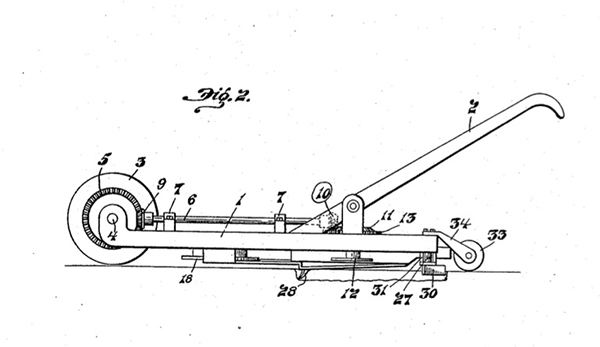
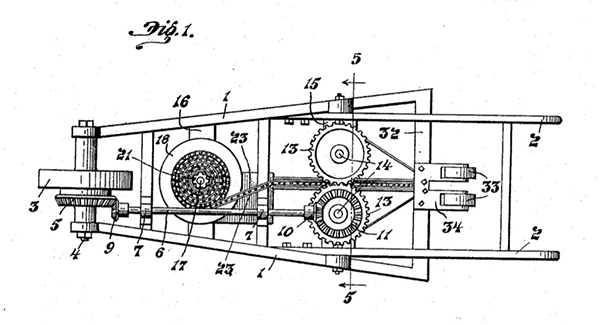 Photograph from Roy N. Werstler, Transplanting Machine, U.S. Patent US1192140A, filed January 13, 1916, and issued July 25, 1916, 1, patents.google.com/patent/US1192140A/.
The tool was designed to be compact and portable. Its frame fits a human body. His objective was “to simplify the construction of transplanting machines.” The drawings in the patent are orderly and show careful thought in every detail.
McCartney transplanting machine (1937)
Edward W. McCartney, from Houston, Texas, inventor of the McCartney transplanter, went a step further. He invented a transplanter on which two people could sit and that was to be pulled by a draft animal. The transplanter featured a water tank at the rear for drizzling water next to transplants as they went into the ground. Plants would move through the machine on a conveyer before tiny pinchers carefully released them into soil.
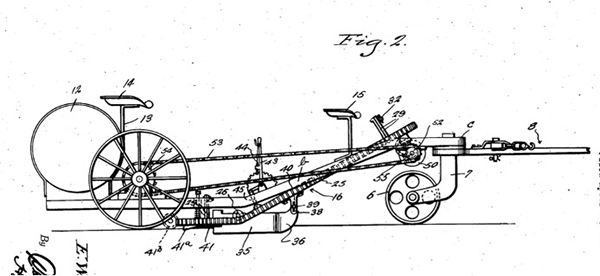
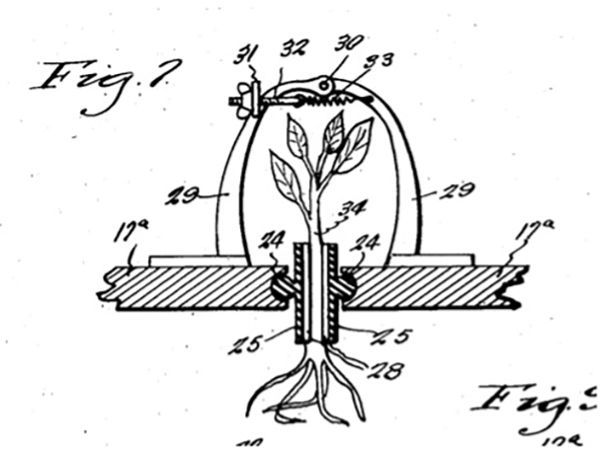 Photograph from Edward W McCartney, Transplanting Machine, U.S. Patent US2145771A, filed April 28, 1937, and issued January 31, 1939, 2, patents.google.com/patent/US2145771A/en.
He wrote in his patent letter, “The principal object of the present invention is to provide a transplanting machine capable of planting much more rapidly than the present-day type of machines now in general use.” He also had people in mind when he invented the tool: “Another important object of the invention is to provide a transplanting machine wherein the plant handler sits in advance of the packer, to the end that the plants are fed from a forward corner of the machine, consequently reducing the likelihood of jamming of the machine and confusion on the part of the handler.” This tool required careful attention by the user to optimize its use.
Many tools from this era, in fact, assume engaged users. The goal was to increase efficiency through a meld of human involvement with better engineering. By contrast, the trend in much modern engineering is to erase the end user through robotics and “self-driving” technology.
Masuda/Nambu transplanting system (1977)
The design closest in concept to the modern paper pot transplanter is Akijoshi Masuda and Tetsuo Nambu’s machine from 1977. The inventors, from Obihiro, Japan, filed a patent request for hexagonal paper cells, linked into a chain in which seedling would grow. The cells were designed to break apart individually as they were dropped into the ground, allowing for a variety of plant spacings. The paper was intended to dissolve in the ground. As with the other transplanters, a front furrower would create a trench and rear press wheels would fill soil around the plants after they went into the ground.
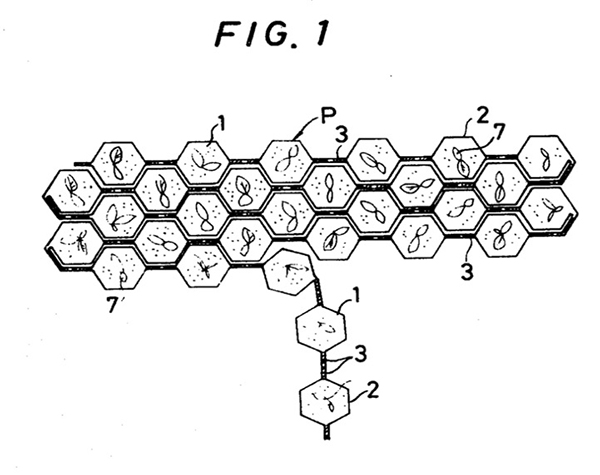
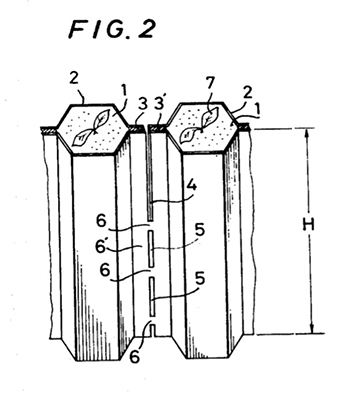
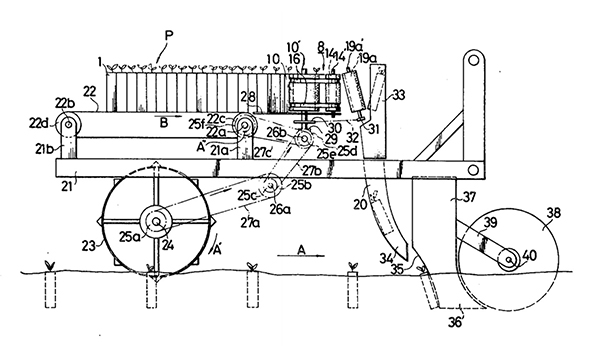 Here are images from an early patent request for a tool similar to the paper pot transplanter that we use on our farm. The assignee on the patent is Nippon Tensai Seito Kabushiki Kaisha, Tokyo, Japan, and the tool was invented by Akijoshi Masuda and Tetsuo Nambu from Obihiro, Japan. In countries like Japan and Korea, where farm size is relatively small, engineering minds are put to use designing tools like this for small-scale farmers. In the U.S., most research investment is geared toward large-scale operators.
The attention to detail in the patent file is staggering. For example, Masuda and Nambu conducted experiments to determine the precise tensile strength required of the paper chain in order for it convey through the machine but pull apart between plants with “a small force” at just the right time. To adjust tensile strength, they tried poking small holes in the paper between plants with a sewing machine needle, and they finally settled on creating slits, as seen in the images below. Charts in the patent delineate the results of these tests.
As German designer Dieter Rams put it, “good design is design down to the last detail,” clearly a principle that these inventors understood well.
Ben Hartman and Rachel Hershberger own Clay Bottom Farm in Goshen, Indiana. Ben is the author of The Lean Farm, The Lean Farm Guide to Growing Vegetables, and The Lean Micro Farm, all are available from Growing for Market. Subscribers always get 20% off all books at growingformarket.com/.
Copyright Growing For Market Magazine.
All rights reserved. No portion of this article may be copied
in any manner for use other than by the subscriber without
permission from the publisher.