










#toolsforgrowingformarket
An email from a reader got me thinking about seed drills, those tools we dump seed into, and then push or pull down a bed to set the seed into the ground at just the right spacing and just the right depth, all in a straight line. A lot of folks probably just call drills “seeders” these days and I’ve had the opportunity to use quite a few different ones over the years so I thought a little overview of some of the basic features might be helpful for folks starting out or thinking about buying a new seeder.
Typical to seeders is some sort of opener that creates a furrow, followed by a metering mechanism that controls the amount of seed dropped into the furrow, and then by a closer that closes the furrow and covers the seed. The other common parts are depth control wheels, drive wheels to power the metering mechanism, and press wheels to give good seed to soil contact. Depending on the seeder, the depth control wheel or wheels might also function as the drive wheel and/or the press wheel. Sometimes there is no drive wheel but the metering mechanism is driven by a separate motor. If the seeder is pulled by a tractor that motor might be the tractor’s motor either via the PTO shaft or hydraulics.
Here are few examples of seeders described so as to explain the typical parts and to give some benefits and drawbacks of different designs.
Many growers are familiar with the Earthway “Precision Garden Seeder,” which isn’t all that precise, but is relatively affordable, and versatile in the range of seed sizes it will handle. It’s also relatively easy to understand mechanically. There is a front drive wheel that uses a rubber belt to drive the metering mechanism for picking up an dropping the seeds. The belt drives a hub on the hopper. To the hub you can mount different plastic plates which sit inside the seed hopper. These plates have little scoops with holes and as they rotate, they pick up seeds from the bottom of the seed hopper and then lift them to a chute where they drop out of the hole in the plate.
The seed travels down the chute and falls into a furrow that is created by the wedge-shaped opener. A chain that is dragged behind the opener pulls soil back into the furrow and then the press wheel in the back firms that soil over the seed. The depth of the furrow is set by moving the opener up and down vertically, while the two wheels keep the whole thing level. By varying the size, shape and spacing of the scoops and holes in the plates the seeder can vary how many seeds it picks up and how often it drops the seeds down the hole.
A far more precise seeder, but one that has the same basic parts, just in much more refined versions is the Seed Ace Vacuum Seeder. The drive wheel on this seeder drives the metering mechanism with a chain instead of a belt, and the cog sizes can be changed in order to change the spacing between seed drops. Seeds are picked up by vacuum nozzles which are much better at singulating the seeds. The furrow is opened with double disks which cut a much cleaner furrow and don’t clog with debris as easily as a wedge. Instead of a chain to close, there is a spring-loaded plate that fills the furrow more evenly.
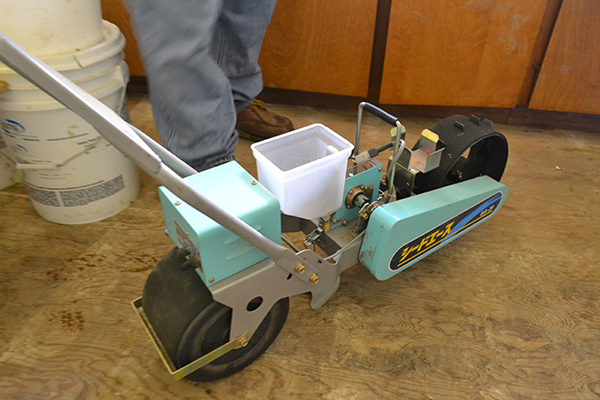
The Seed Ace Vacuum Seeder uses a battery powered vacuum to pick up seeds one at a time and drop them very evenly in the row.
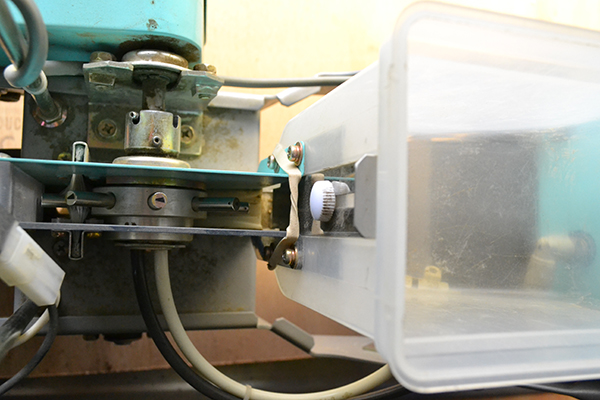
The Seed Ace hopper has a hole at the bottom where a gate regulates the flow of seed going past rotating vacuum nozzles. The nozzle size can be changed for different sized seeds, and the rotation speed is determined by cogs used in the chain drive.
The difference in cost between these two tools is more than an order of magnitude – less than $200 for the Earthway versus about $4000 for the Seed Ace. There is also a significant difference in weight and ease of set-up between seed types. To switch between seed types on the Earthway you just change the seed plate, which is relatively quick and easy and requires no tools, and you may also need to change the depth setting which is also tool-less with just a wing nut.
The whole thing is relatively light weight so to empty the hopper you can just turn it over and pour the seed out. That light weight makes it relatively easy to carry around, but it means that in heavy soil it doesn’t really want to dig a furrow or go straight. Different seed plates let you seed everything from small brassica seeds up to very large lima beans, but all with limited precision.
The Seed Ace seeds a narrower range of seed sizes, with beet and chard being on the large end. It also takes longer to adjust between seed types and requires tools for some of the adjustments, but that adjustability is part of the reason it can be truly precise. The heavier weight and disk openers are much better at opening a furrow through heavy soil and at holding a straight line.
A middle ground between the Earthway and Seed Ace is the popular Jang seeder, and there are two similar versions for small to medium seeds, the AP1 and the JP1. I wrote about these seeders back in 2020 so you can look back at the specific differences between those two in that article. The Jang seeders again have a similar form to the the Earthway and Seed Ace but the metering mechanism is different. Like the Seed Ace there is a chain drive with sprockets which helps to vary the rate of seed drop. It also is available with a double disk opener, or comes standard with a wedge type opener.
The metering mechanism for the seed is a plastic roller with divots in it. By varying the number, size and shape of the divots the seeder can be used to plant very small seeds up through corn and pea seed, although it’s really best with seeds no larger than beet seeds and there is a larger TD1 model that is specifically designed for large seeded crops. There are far more rollers available for the Jang than there are plates for the Earthway and that, combined with the ability to change cog sizes on the chain drive means there’s more adjustment possible. Again, this one is heavier than the Earthway making it harder to lift, but easier to use in heavier soil.
The Jang seeders also have a longer wheelbase than the Earthway. The distance between the front and back wheels matters, with a longer wheelbase being a bit less maneuverable in tight spaces, but improving straight line tracking. Because the wheels are also used as part of the depth control, having a longer wheelbase means that any bumps or dips in the bed have less of an impact on the depth of the opener.
In addition to the longer wheel base they also have a removable seed hopper, which makes emptying leftover seed a little easier. This is a common feature on heavier seeders as there’s not really a good way to turn the thing upside down, but it adds complexity and cost and creates more parts to potentially break at some point.
Back in the days when the Earthway was really the only readily available push seeder for market gardeners in the US, a lot of growers would buy multiple seeders and gang them together to seed more than one row at a time. This worked decently well for two rows, but if you get up to three rows the problem becomes bridging if your bed isn’t dead flat – and many seed beds in the field aren’t, despite appearances. If one part of the bed was higher than the others, two of the seeders would lift the third seeder (or the rest of the seeders if you had more than three in a gang) off the ground. The problem here is that if the drive wheel is off the ground no seed is getting dropped, or if the furrower comes off the ground the seed just sits on the surface.
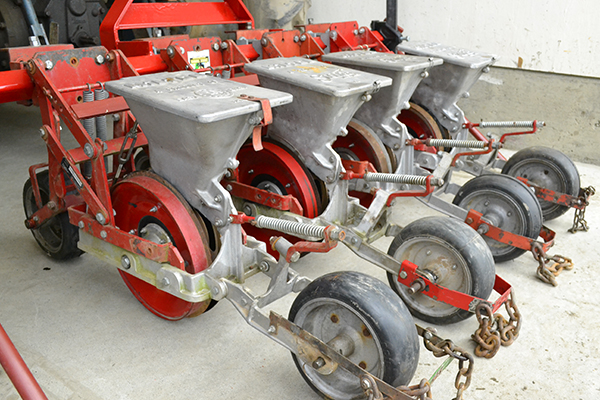
In the example above there is a four bar mechanism (parallelogram) which allows the seeder to float up and down. You’ll also note that the rear press wheel is spring loaded to maintain consistent ground pressure.
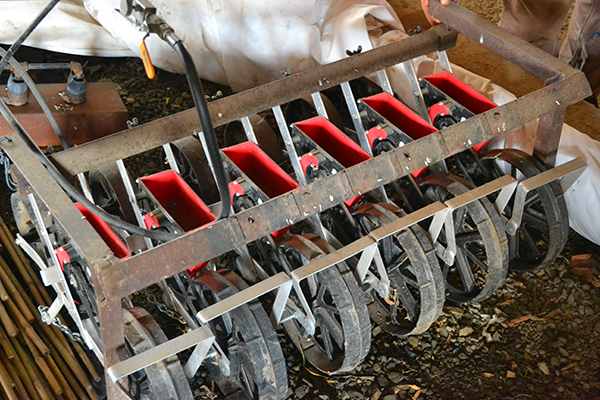
Six Earthway seeders that have been slightly modified and fitted to a frame that will fit under the belly of an Allis Chalmers G tractor. There are better solutions these days for seeding multiple rows but this can work. There is some float built into the frame which allows the seeders to sit flat on the ground (as long as the ground is flat). One method for emptying fixed hoppers like this is to use a cordless handheld vacuum cleaner – just make sure it’s completely empty first!
With tractor mounted seeders there are a few common methods of avoiding this problem that don’t involve going to extra measures to make every bed billiard table flat. One of those measures is allowing each seeder to float independently. In the example above there is a four-bar mechanism (parallelogram) which allows the seeder to float up and down. You’ll also note that the rear press wheel is spring loaded to maintain consistent ground pressure. The seeder pictured (I forget the brand) has a unique opener which is essentially a large double disk opener with the metering mechanism built in. Chains dragging behind the press wheels loosen the surface after the seed is pressed in place, which helps prevent surface crusting over the seeder track, a problem in some soils causing poor seed emergence.
When seeding a crop like salad mix, rows tend to be very close together and it’s desirable for beds to be dead flat to aid harvest tools so instead of having the seeders float independently it’s typical to have one large wheel, or roller in the front, flattening the bed, and to do the same for the press wheel, keeping the surface of the bed as flat as possible.
The Johnny’s six row seeder again works very similarly to the Earthway, Seed Ace and Jang, and is most similar to the Jang in that its metering mechanism is essentially a roller with different sized divots for different sized seeds, and the drive rate for seed drop spacing can be varied by changing the cog (or in this case, pully) size. The diameter of the rollers on this seeder are significantly smaller than the wheels on the other seeders, but because they are so wide they still float on the surface. They don’t do well with larger clods, but they are designed to be used on finely prepared seed beds with small seeds so it’s not typically an issue.
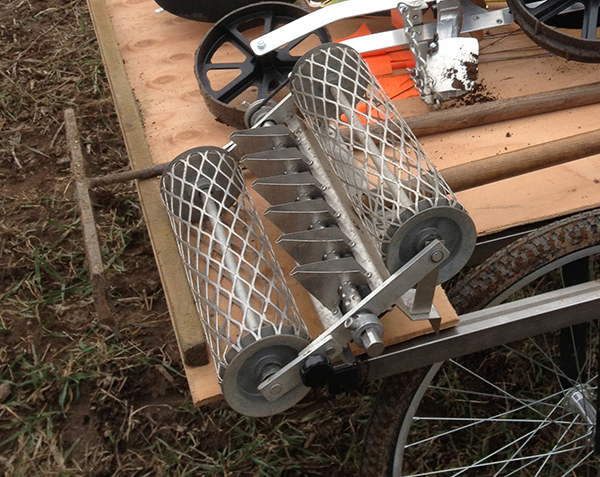
You can see the underside of a Johnny’s six row seeder above, and even larger seeders would look similar from below.
Before the six row seeder came out Johnny’s 4 row seeder was popular with small salad growers. This again uses a roller mechanism for metering, but one that is directly directly driven by small wheels on the sides of the seeder, with no press wheel at all. By moving the drive wheels to the side and eliminating the press wheel cost was saved, but so was weight and length, making it one of the easiest seeders to use in tight spaces. Because there is no drive wheel in front and press wheel behind depth control is by tilt angle; and many growers would roll over the beds with a separate tool after putting the seed in the ground to press it into place more firmly.
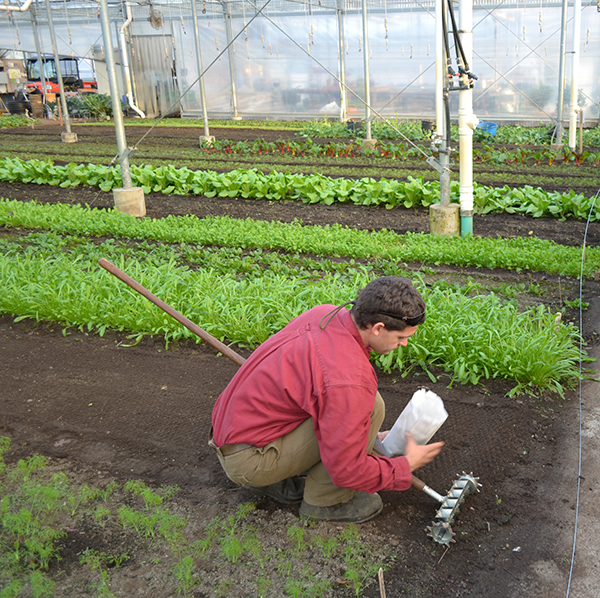
The Johnny’s 4 row seeder is one of the simplest and smallest seeders making it good in tight spaces. Unlike most other hand scale seeders it is designed to be pulled rather than pushed. All images courtesy of the author.
There are many other seeders out there in the world, but these are the most common types I see on farms here in the US. They provide a good demonstration of the typical parts on most seeders, as well as illustrating the considerations when selecting a seeder for a farm. The types of seed it will handle, the precision needed, the soil conditions it will work in, the ease of adjustment and use are all important factors, not to mention the price relative to its ability to generate income for the farm. A $4000 seeder would have to save you at least 100 hours of labor in thinning work, or increase yields proportionally to justify its purchase if you’re already doing ok with the $200 seeder. I own a Jang and its my primary seeder, but I’m not sure it’s actually saved me any money over using an Earthway on my little farm. I do relatively little direct seeding and spend a lot of time swapping rollers and adjusting cogs whenever I do go out to seed so there is no time savings there. On the other hand, the heavier seeder with double disk openers never clogs with field debris for me, and I get more even stands so there’s a bit of time savings and improved yield which may make up for the higher cost of the tool.
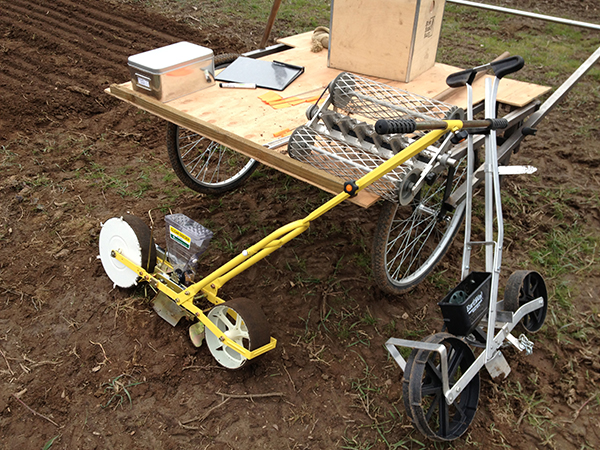
A Johnny’s six row seeder, Earthway, and Jang all sitting on a farm cart in the field. The six row seeder is upside down showing the six openers which create the furrows for small seeded crops.
Making the decision of what seeder to invest in should take into consideration the cost of the tool, and also the costs of operating the tool, as well as any benefits or drawbacks for the crop you’re seeding. One of the less obvious costs to consider may be changes to the way you need to prepare your seedbeds to accommodate the features of a particular seeder.
Josh Volk farms in Portland, Oregon, and does consulting and education under the name Slow Hand Farm. He is the author of the books Compact Farms: 15 Proven Plans for Market Farms on 5 Acres or Less, and Build Your Own Farm Tools, Equipment & Systems for the Small-Scale Farm & Market Garden, both available from Growing for Market. He can be found at SlowHandFarm.com.
Copyright Growing For Market Magazine.
All rights reserved. No portion of this article may be copied
in any manner for use other than by the subscriber without
permission from the publisher.