











Tips and techniques for working with the next generation
Youth team members aged 12-17 are a valuable and ready supply of labor on our farm. We developed this labor model over the course of eight years as we went from part-time to full-time farmers in 2019.
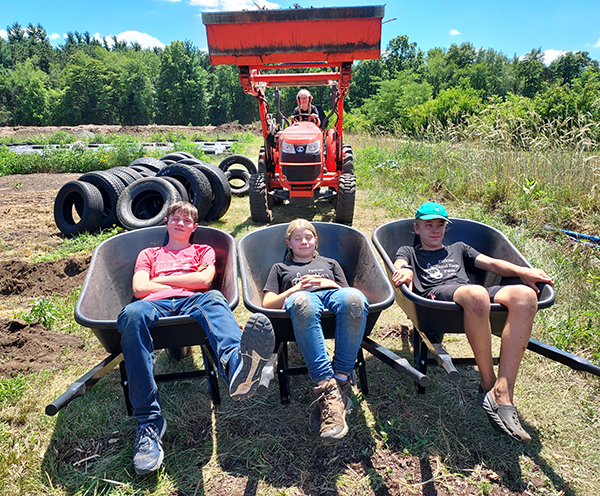
We have fun working together and doing tasks with efficiency and gusto. All images courtesy of the authors.
Going into 2024, my wife Julie and I are entering our 14th year of farming in rural northwest Indiana, our fifth year of full-time farming. Our gross sales in 2023 from farm produce (1.25 acres of permanent no-till deep compost beds) and value-added kitchen items is over 185K. We sell our produce via:
A four-season CSA, with winter shares at 75 members, spring 150 members, and summer and fall at 175 members. This traditional CSA made up 49% of our revenue in 2022, which is farmers market-style pickup only with no boxing of shares.
On-farm stand- 29% of revenue in 2022- which includes other local farmers’ produce and farm-made items.
Small batch commercial kitchen- 18% of revenue in 2022. It includes grab and go soups, salads, and gluten-free baked goods.
Wholesale accounts- 4% of revenue in 2022- which includes a food hub that sells to area restaurants, cafes, and local schools in the region.
We have four team members that are year-round, and up to 8-10 team members during the main growing season. Although not homeschoolers ourselves (we have 4 kids, ages 15 to 8), a majority of our production labor has come from our local homeschooling community, which is very strong in this area.
Early in our farm development we had a vision of cultivating a farm that would feed our neighbors, raise a family, and provide a middle-class income. In my naivete and inexperience, I thought Julie and I and one or two other part time workers could get the job done- surely grossing 100K would be enough to raise a family.
Boy was I wrong. We were finding farming, family life and working full-time off-farm jobs a difficult balance. Money to capitalize farm infrastructure was present, but time to do all the work, plus continuing to build farm infrastructure was non-existent. We had reached that critical point where we needed to produce enough to begin fully replacing off-farm income and support the lifestyle we wanted. As we expanded our wholesale, summer sales, and Fall CSA we needed people to do the daily work of summer and fall harvests.
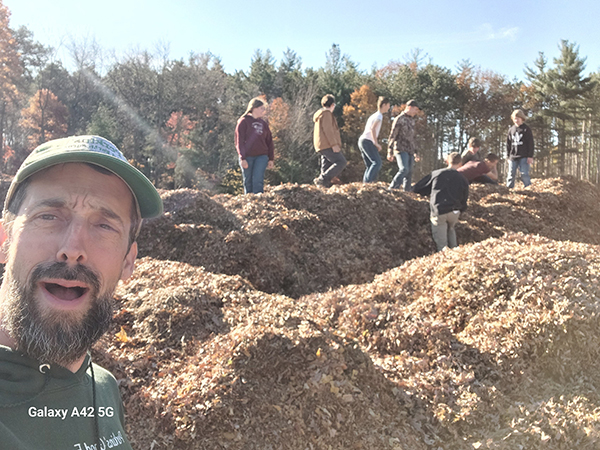
Team building by playing king of the leaf pile.
To meet this need we first hired a local homeschool high schooler who had an interest in agriculture. We also hired a college student for 40 hours a week (10 hours for research and 30 hours to work on the farm) via a Purdue University project. After that first season of hiring help, we realized we could never grow the farm and keep our sanity without help. We also realized that the local homeschool group was a valuable and ready supply of year-round labor. Here is the current system for how we grow a quality workforce of young people.
Abide by agricultural wage and labor laws
State laws can vary a lot, so do your research. In Indiana, as an employer of youth (age 12-17) we have to register with the State Labor Department, which is free in Indiana. We learned that Indiana ag labor law allowed youth 12 and older (younger than 12 can work with parental consent) to do farm work. Typically this must be outside school hours. Homeschoolers set their own school hours so this is easy to abide by. If more than $600 of wages will be earned in a year, they must fill out a W4, and you must take appropriate FICA, state, and local taxes out of the paychecks.
Recruit via a working interview
Find a task that requires lots of labor during the year as your initial recruitment tool. For example, during hardneck garlic harvest, popping, and planting we need lots of extra labor for a couple days at a time. This is our first interview for many potential workers. I can typically tell within 30 minutes if I am going to ask someone to come back for the next day of work. I also check in with my current team members as to their opinions. I then decide if I am going to have a further conversation about working more hours throughout the year.
I am generally looking for enthusiasm and teachability. If they run and move fast between tasks they are ready to work. I also find out if they are able to listen to instructions from myself and other team members. I specifically set this up by not being present all the time and checking back in with my current team members. A two-week trial is the norm for us. In that way no hard feelings emerge, and we can see how a person fits in or doesn’t fit into our work culture over time.
Communicate closely with parents and youth
Discuss hours, days, and flexibility during each time of year that works for their school and home life schedules. We communicate clearly to parents that the shoulder seasons – April/May and Sept/Oct – will be very busy work weeks, but the hours taper off so they often can slowly phase in school, knowing they can catch up later. They thank us for allowing their child to work and learn valuable skills.
We have had the joy of being able to employ youth for their entire junior high and high school years, as well as multiple siblings. They typically start age 12 and are with us till they graduate high school or even stay another year or two as they figure out life. If you can, tap into a couple families that could be your next 10+ years of labor. This is especially valuable because you can take the time to train them more thoroughly since they will be back year after year. Most parents view this as a learning job and give some sort of homeschooling credit for it.
Different work for different ages
Ages 12 to 14 work best in 3-4 hour shifts of work three days a week depending on time of year, school load and maturity level. This keeps it fun, but also long enough to make it worthwhile. In summer heat, the younger team members work 8am to 1pm to avoid the heat. Spring and fall hours are from 10am to 2pm to avoid the cold. We tend to shift hours week to week depending on weather and various life events as well.
Ages 15 + can typically handle 20 hours a week during the school year and 40+ hours during the summer season. They generally want to have fun, not work alone for too long, and have a variety of jobs. We cross train across different jobs in the field and even into our kitchen and farmstand. We make sure no one keeps doing the same job week after week.
All team members get a job review every six months. At each review we ask what they love doing, what they don’t, what more they want to learn, and we set some basic goals. We keep a file with their answers over time and really try to honor these responses as we assign jobs each day. Once they reach driving age, I allow them to operate the tractor after training.
Hire by the season
Define what your labor seasons are, and total hours needed each week with those seasons. We have four seasons of labor – spring, summer, fall, and winter; each of these seasons has weekly labor hours based on actual labor hours worked from our past three years of payroll.
We schedule out one month in advance so that we can allow for vacations and other time off, while still getting all the work done. During the main season we range from 136 to 200 hours a week of labor hours. I distinctly remember the season I didn’t have to harvest one cherry tomato! I could focus on working on the business rather than just in the business.
Categorize each team member
This helps crew members know their role and level of responsibility. A full-time farm hand (must be available to work all 4 seasons) works March to Thanksgiving 25-40 hours a week, and December to February 5-8 hours a week. They typically have worked a summer season or two and are 15 years or older. I consider this our core group and we have four positions for them.
A part-time farm hand (must be able to work 3 seasons) has the same weekly hours as above but are typically under-15 youth and those with more demanding school/life schedules. They typically move on to full-time farm hands as they get older. They are good sub-ins for sick and vacation days of full-time farm hands. I have two to three spots for this role.
A summer farm hand (6 weeks of summer) has done garlic work a season or two and can vary in age. This labor pool is large in our area, so we use our garlic work and other big tasks to select our summer team members carefully. This group can sometimes be called upon during the school year or Saturdays if needed.
Hire more farm hands than you need. I always have one part-time farm hand extra and a summer farm hand extra at the start of each season. Since we now have a waiting list of youth who want to work for us, we can sometimes call on them to fill in for emergencies or unseen events. We hire extra for several reasons.
For one, youth are not doing this work for a living. Family vacations, 4H fair weeks, random trips with grandparents, “Oops, I cannot come in tomorrow because I forgot . . .”, unplanned events, sickness, and forgotten alarms always come up no matter how much we try to plan. We also hire extra to reduce stress and increase flexibility. It is far less stressful and of great value to youth and their families to have flexibility built in so that time can be taken off and the workload each week still gets done. It is sometimes a balancing act for summer vacations and county fair week. This also allows our full-time farm hands to take several weeks off for special trips that sometimes occur, such as mission trips and extended family vacations.
Give them titles, responsibility, and reasons to be joyful (a walkie talkie and music). Our full-time farm hands are given “manager” titles and responsibilities (guided by a job description and SOPs within each area). Team members switch manager roles each month/season to increase learning and job satisfaction. Cross training has lots of benefits. It is amazing how much better a team member harvests once they have been a wash-shed manager. This also gives the older team members some authority and leadership structure, so I am not getting all the questions and they listen to each other.
A walkie talkie for each team member avoids lots of extra walking (muda) and mistakes and allows open communication. Give each team member a walkie talkie with clear rules of use. I allow bluetooth speakers for music. Earbuds are only allowed when working alone and only one ear. If having earbuds disrupts work or communication (i.e. not responding to walkie talkies) then they are not allowed for a time. Our managers are:
Washshed Manager – Starts up and tears down wash shed each day we wash (3x a week). A wash list and cooler inventory board guide the workflow of this manager.
Greenhouse Manager – Weekly seeding, watering of starts, irrigation in tunnels, soaking of weekly transplanting trays, etc. I use spreadsheets from Farmer Spreadsheet Academy by Dan Brisebois. They make trays on Thursday and seed all trays on Friday.
Field Manager – Weekly weed scouting and harvest leader. A dry erase board with crop, day to harvest, priority, location, and harvest amount is used to keep everyone on the same page. General farm hands assist as needed in each area.
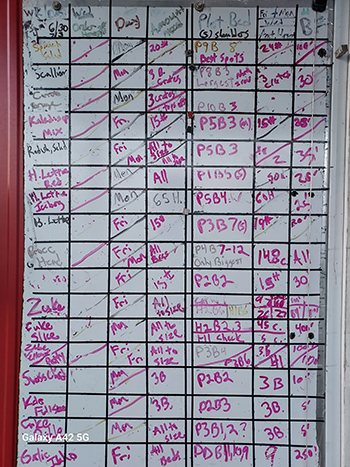
Dry erase boards for field work, harvest order and record keeping ensure everyone is working together.
We deliberately teach our farm hands to work on our farm using the following steps:
Winter class study – An eight-week class and potluck each year. Every other Thursday from January through March we gather to discuss a chapter of several different books we have in rotation and new books as to what best fits that year’s crew’s needs. Some of the books we have done include – Daniel Mays’ “The No-Till Organic Vegetable Farm,” and Ben Hartman’s “The Lean Farm Guide to Growing Vegetables.” Each team member leads a chapter with a simple outline guide, and then we discuss ways it applies to the farm. These book studies have increased community, teamwork, and joy of working in all aspects of our farm. Plus, it really is about growing the people, not the veggies!
Weekly farm walks – We do this with our full-time team members. We take about 20 minutes to walk the farm and make observations and key tasks that need to be addressed. I do this by myself beforehand to list and prioritize tasks for the week, so I can home in on what is important that week. A lot of minor problems are fixed before they become major ones, because we get lots of observations and questions that I would miss alone. I try to pick one focal point to spend a little time talking about the why and answer questions as we walk along.
ACM Meetings – At least 2x a month we spend 20 minutes Appreciating, Constructive Critiquing, and Manifesting (ACM) together. We gather in a circle and say one thing we appreciate about a person in the circle, critiquing or note something that is annoying or bothersome that occurred (interpersonal, job on the farm, the weather) with a possible solution, and then something they personally want to manifest or make happen in their lives (sleep more, do more push-ups, etc.). This has been incredibly helpful for addressing issues, welcoming new team members, and creating community among us. We also laugh a lot.
Pay them well – We start at minimum wage at age 12 the first month and then every 6 months of work they can earn up to an $1/hour raise. We do job reviews every 6 months. So if a team member starts with us at age 12, they are typically earning $14/hour or more by driving age. We have found that by the time driving age is reached we need to be at close to $15/hour to match area wages. Although many of our youth workers say they work for us not because of the money but because of the positive, fun, flexible hours, and learning work culture.
Enjoy working with young people. You have to be willing to put up with some immaturity, mistakes and poor decisions when working with younger team members. I have four children so I generally have no problem handling these situations. I am often repeating, “do the tasks as taught, then we can make improvements.” I always show how to do a task, step away for 3-5 minutes and come back to check in. I observe and re-teach a couple times in this way to ensure things are being done quickly and efficiently. With healthy boundaries and clear expectations it can be really rewarding to employ young people.
It is deeply satisfying when previous team members visit us and reflect that their time at the farm was formative and they remember the productivity and peacefulness of this place. As farmers, it brings us deep joy that we can raise vegetables to feed our community and raise young people at the same time.
To learn more about Perkins’ Good Earth Farm visit us at www.perkinsgoodearthfarm.com or on Facebook or Instagram.
Copyright Growing For Market Magazine.
All rights reserved. No portion of this article may be copied
in any manner for use other than by the subscriber without
permission from the publisher.