











I met Yoko Takemura in the fall of 2019 when I was no-till curious and searching for successful models. For several years, I had been experimenting with no-till methods here and there on our three acres of organic vegetables in northwest Connecticut. I had done some tarping between successions where it was convenient and hand flipping beds when we had time. Yet, I wanted inspiration and an equipment primer from people already more committed to no-till.
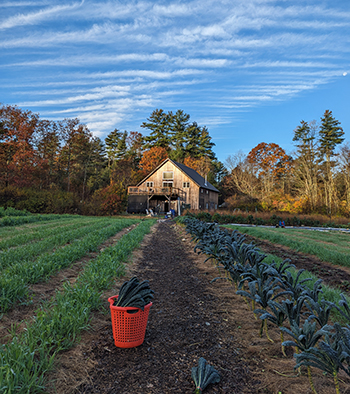
Assawaga Farm in Putnam, Connecticut. All photos courtesy of the author.
I found Yoko and her husband Alex Carpenter’s farm on the opposite side of the state in Putnam, Connecticut. At the time, Assawaga Farm was wrapping up its second season. Yoko generously showed me around and I was impressed with how she and Alex were making their business work on only an acre.
In the intervening years, I’ve found it worthwhile to expand our no-till practices to cover about two-thirds of our production. For our model, which centers around a residential fellowship program of young people rotating through the farm every few months, we can handle the increased hand labor that the shift away from tillage has brought. We have a lot of hands in the field during the season but not a lot of large equipment, acreage, or trained tractor operators (and zero skilled tractor repairers).
Our no-till beds have gorgeous tilth, are more resilient to drought and over-saturation, and can produce a lot of vegetables per square foot. As excited as I’ve been about the results of our no-till practices, it is also clear to me that some of our tarping and labor-intensive bed flipping would be prohibitively challenging in a different context. We find that occasional tillage is a useful fall-back for us in situations when we need to prep beds quickly.
I wondered how no-till was going at Assawaga Farm and how they may have honed their practices after six full production seasons. Yoko and I caught up recently and I was excited to hear that they are still going strong, small and productive. Now they are able to support three seasonal employees.
Staying small
Yoko and Alex rely on a suite of intensive management practices to keep their production acreage low. “People look at our farm and think ‘that’s such a small farm, we want to be able to grow more food than that,’ but we actually grow a TON of stuff,” said Yoko.
They focus a lot of attention on soil health to generate high yields per square foot. Tight planting densities take a lot out of the soil. “We put a lot back into it through cover cropping and homemade compost and compost tea,” Yoko said.
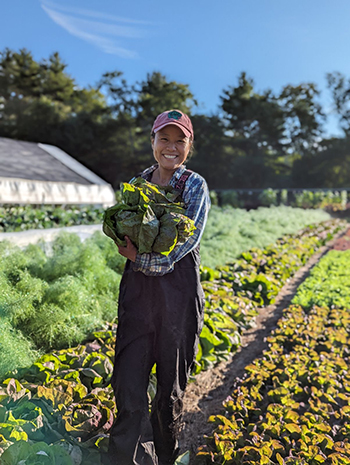
Harvesting at Assawaga Farm in Connecticut.
Another piece of the puzzle is how low they are able to keep their costs and how simple they keep their system by being mostly hand-powered. “There are a lot of efficiencies because of our scale,” says Yoko. “We barely have any machinery so nothing gets broken. We don’t have to wait for anything to get in the field.”
Another attribute is that Assawaga has really simple and effective marketing channels. They attend one weekly, well-trafficked Boston market (a Thursday farmer’s market in Brookline, Massachusetts, near Boston University) where they tend to sell out of almost everything they can fit in their delivery van. They also run a successful onsite market for three hours every Saturday. “Because our marketing is so simple, it allows us to be in the field for longer,” explains Yoko.
Overall, she believes that their focus on efficiency will allow them to continue growing enough vegetables to remain profitable without expanding over the long term.
No-till system
When Yoko and Alex bought their farm in 2016, it had been a hay field for generations. They tarped it for over a year, then plowed it with a rotary plow to loosen the mat of roots. Ever since, they’ve managed over a hundred 100-foot beds without any tillage.
The first few years they used a deep compost mulch system — spreading inches of compost purchased from off-farm. They have since shifted away from so much expensive, purchased, unpredictable compost. Now, they make their own as an inoculant for increasing beneficial microbial populations rather than as a mulch. They rely on cover crops for most of their fertility as well as some bagged fertilizers they bring in for early spring and late fall applications when soil biology is less active.
Their no-till bed-prep tool shed consists of a broadfork, a leaf rake to set aside hay mulch, a metal rake to smooth beds, a Grillo walk-behind tractor with a Berta flail mower attachment for chopping up cover crops, clear greenhouse plastic for solarizing, and black silage tarps for smothering overwintered cover crops. “All beds get mulched with hay unless they are planted very early in the spring, in which case we leave the beds bare to let it heat up under the sun, or if they are being direct-seeded into,” Yoko said. They spread a thick layer of wood chips in all the paths.
One thing might jump out at you looking at photos of Assawaga Farm — very few weeds! Yoko credits the relative weedlessness to their no-till practices, especially the year the land spent under the tarp before they ever started growing.
Compost and compost teas
Yoko and Alex were inspired to make high-biology compost, brew teas, and monitor soil biota with a microscope after taking Elaine Ingham’s Soil Food Web course. Every week of the farming season they mix about 30 to 40 five gallon buckets together at a ratio of 10 percent clean chicken manure (dewormer and antibiotic free) from a friend’s poultry farm or high nitrogen plant matter (such as lawn cuttings), 30 percent veggie scraps from Assawaga, and 60 percent locally sourced new and aged wood chips, leaves, or hay.
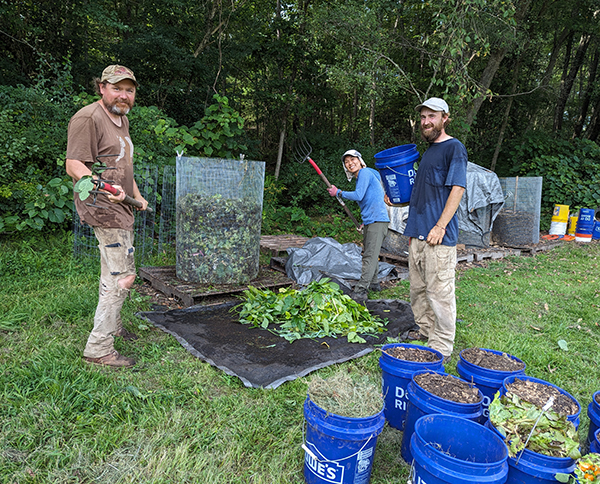
(L to R) Alex, Yoko and an employee making their weekly batch of compost. Every week of the farming season they mix about 30 to 40 five gallon buckets together at a ratio of 10 percent clean chicken manure (dewormer and antibiotic free) from a friend’s poultry farm or high nitrogen plant matter (such as lawn cuttings), 30 percent veggie scraps from Assawaga, and 60 percent locally sourced new and aged wood chips, leaves, or hay.
They mix and soak the materials, pile them into a wire cage on a pallet so the pile is well aerated, and monitor the temperature. When the temperature in the center of the pile reaches 130°F to 150°F they cook it for three days. If it hits 150°F to160°F, they leave it two days, and if it hits 160°F, they leave it for one day. Then, they turn it two times. This process kills pathogens and weed seeds while maintaining healthy biology in the pile. They mix in two 5-gallon buckets of compost per 100-foot bed before planting.
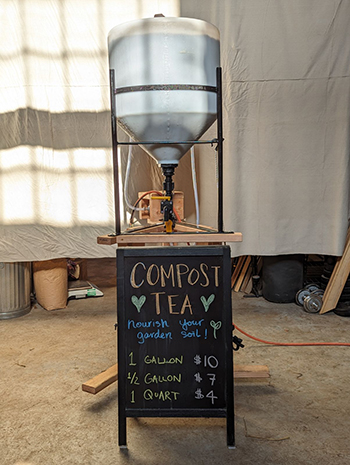
Compost tea for sale to gardeners at Assawaga’s farmstand.
They also use some, along with homemade vermicompost, for brewing teas. They recently purchased a 35-gallon brewer from Wiggle Room to increase the amount of tea they can make at a time over their 5-gallon bucket system with a BubbleSnake compost tea aerator connected to an air pump.
Cover crops
“Sometimes I feel like our employees spend half their time on cover cropping,” Yoko said. Every bed on the farm gets at least one cover crop a season, many have two. Yoko makes her own seed blends with a different mix for spring, quick summer cropping, long summer cropping, fall winter kills, and fall over wintering. Each mix has seven to ten species to stimulate a wide range of microbes in the soil that prefer different plant root exudates.
“It doesn’t matter what it is, as long as the seeds aren’t too expensive we throw it in there.”
Their first step in establishing a cover crop is to rake the hay mulch aside and then to prepare the bed with any necessary fertilizing, composting, and smoothing. Then, they broadcast the cover crop seeds, tamp them down with a bed roller, and place the mulch back on the beds before watering. In early spring they avoid the mulch to allow the soil to warm up, and in late summer they use row cover to protect the seed from birds.
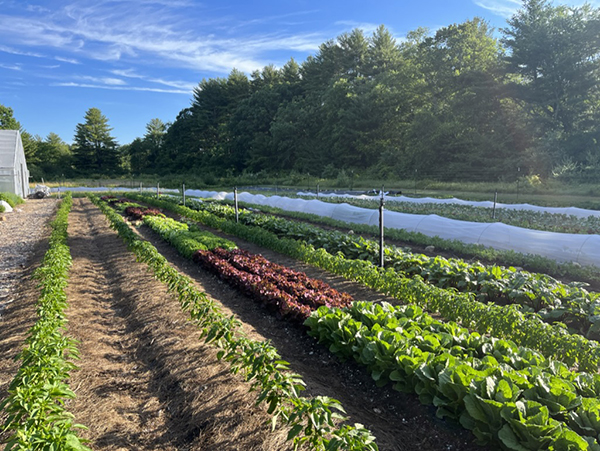
Vegetables on tight spacing with hay mulch at Assawaga Farm.
To terminate overwintered cover crops, they flail mow and then tarp for three to four weeks in early spring. To terminate spring or summer cover crops, they solarize for one sunny, hot day. Winter-killed cover crops can usually be raked aside and planted into, although Yoko and Alex sometimes weed whack them down as close to the soil as possible so that it can be direct-sown with the Jang seeder.
Marketing and sales
“The quality of our vegetables is so high that we’ve built a really strong customer base,” Yoko said. At the height of the season, Assawaga Farm makes about $7,000 per week at the Boston farmers market and $3,000 during the three-hour Saturday farmstand open hours.
Their most profitable crops include herbs, greens, scallions, and cucumbers (in years when they grow well). Yoko’s Japanese heritage has led the farm to specialize in greens like komatsuna, mizuna, and shungiku (chrysanthemum greens) and Japanese varieties of peppers, cucumbers, and eggplant. Some Japanese customers and those with a particular interest in Japanese cuisine seek the farm out, but Yoko estimates that most of their customers don’t fall in those categories. She offers some cooking advice at market, but most people she talks to are simply excited to try something new and tempted by the quality.
Assawaga is right on a busy state road, so simply putting a sign out front and relying on word of mouth has grown the customer base for the Saturday farmstand. Putnam customers differ somewhat in what they are looking for compared to Boston customers, so, it has taken Yoko and Alex some time to figure out how much of which crops to harvest for the farmstand.
“Greens, carrots, and beets are popular onsite,” Yoko said. “There are a lot of gardeners in the area and they are growing a lot of the other crops.”
Yoko and Alex also host a popular plant sale in the spring, and they sell their compost tea throughout the season. They offer cut flower bouquets for product diversity. Yoko hopes to streamline the varieties to make it easier for employees to work with them. Friends from nearby BOTL Farm sell meat and eggs as an independent vendor at the stand.
Next steps
“Having a farmstand on site that is so popular has been just awesome,” Yoko says. “We feel there is unlimited potential with it and no restrictions like how much can the van fit. We plan to sell more variety by putting in fruit trees and seeing what else we can do.”
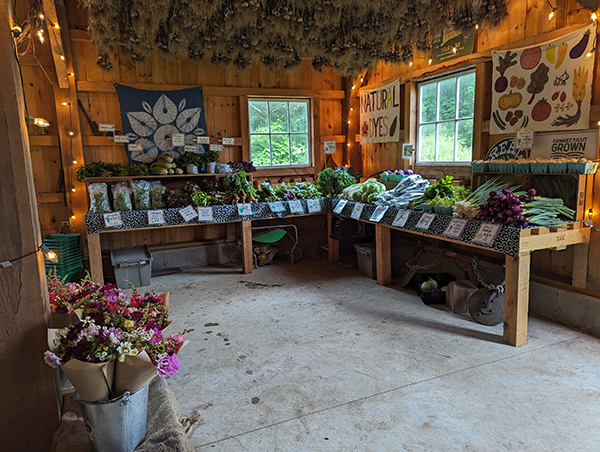
The Assawaga farmstand, which is open for three-hours on Saturdays.
They also are putting up a new unheated high tunnel this spring for growing cucumbers, zucchini, basil, eggplant, and other crops in-ground. It will have seven 50-foot beds and five 25-foot beds as well as a row of potted mint.
“We actually really love growing outside and have resisted indoor growing,” Yoko explained. There has been so much weather fluctuation lately though that we realized we really need some space to ensure early crops.” Half of the similarly sized heated house they currently use is for propagating seedlings and the other half is for growing in-ground. They used SolaWrap on the initial installation of that house.
“We love and hate it,” Yoko said. “It’s very sturdy, you don’t have to inflate it, and you don’t have to worry about it blowing away or puncturing. It will last for decades, but installation was really hard and expensive.”
For their new tunnel, they will use inflated double poly with automated rollup sides and polycarbonate baseboards. They also intend to change the rollup sides on their current house from SolaWrap to poly because the SolaWrap is so thick that it is difficult to roll. They also hope to gradually install the automated components on the current greenhouse.
“The few thousand dollar expense of automation feels worthwhile even though it wasn’t covered by the NRCS high tunnel grant like the rest of the new structure was,” Yoko said. “We got a discount on the Orisha equipment through our membership in the National Young Farmers Coalition and bought everything through friends of ours at Connecticut Greenhouse Company.”
Overall, Yoko is excited about the path Assawaga has taken toward increased on-farm sourcing of fertility and continued commitment to soil health, intensive growing techniques, and high-quality vegetables. Having employees has changed Yoko and Alex’s work-life balance dramatically while requiring a re-developing of some systems so they are easier to explain and delegate.
“It’s possible to make a living off a really small space and I do think that it is a really sustainable way of doing things,” Yoko said. “Our farmers market and farmstand are great, but I don’t think you need those particular sales outlets to be successful. I really believe a lot of markets have potential if you have high-quality produce and that a scale like ours can be successful even with 100 percent wholesale outlets or CSA.”
Janna Siller is the Farm Director at Adamah, an organic production farm and educational program in Falls Village, CT. She also represents the nonprofit organization, Hazon, as a member of the National Sustainable Agriculture Coalition.
Copyright Growing For Market Magazine.
All rights reserved. No portion of this article may be copied
in any manner for use other than by the subscriber without
permission from the publisher.